



BMP-7 Protein, Human (His)
Based on 1 Customer Validation
Bone morphogenetic protein 7 (BMP-7) is a polymorphic ligand protein belonging to the TGF-β family. BMP-7 is involved in regulating the proliferation, invasion and migration of cancer cells and is associated with a variety of human tumors. BMP-7 binds ALK2 or ACVR2A/BMPR2 excitation signal, which is terminated by SMADs regulation. BMP-7 is involved in the BMP-7-SMad1/5/9 signaling pathway, which is associated with the epithelial-mesenchymal transition (EMT) process. BMP-7 also eliminates vascular inflammation, maintains vascular integrity, reduces vascular calcification, and stimulates in situ phosphate ossification deposition.
- Species: Human
- Source: E. coli
-
Storage:Stored at -20°C for 2 years from date of receipt. After reconstitution, it is stable at 4°C for 1 week or -20°C for longer (with carrier protein). It is recommended to freeze aliquots at -20°C or -80°C for extended storage.


To place orders, for customer services and technical support, please contact: MedChemExpress USA
Tel: 609-228-6898 E-mail: [email protected] [email protected]


-
 Biological Activity
-
Technical Parameters
-
Product Properties
- Documentation
- References
- Help & FAQs


-
HY-13027
DAPTγ-secretase Inhibitor -
HY-14648
DexamethasoneGR Agonist -
HY-N0583
HydrocortisoneGlucocorticoid Receptor Agonist -

HY-10071
Y-27632ROCK Inhibitor -

HY-P7109
EGF Protein, Human -
HY-P70583
FGF-19 Protein, Human (His) -
HY-P1097
Gastrin I, humanCCK2 Agonist -
HY-P7014
FGF-4 Protein, Human -
HY-P7004
FGF basic/bFGF Protein, Human (146a.a) -
HY-P7172
FGF-19 Protein, Human -
HY-P7006A
BMP-2 Protein, Human/Mouse/Rat (His) -

HY-K1012
Serum/Protein-Free Cell Freezing Medium


Biological Activity
Description
Bone morphogenetic protein 7 (BMP-7) is a polymorphic ligand protein belonging to the TGF-β family. BMP-7 is involved in regulating the proliferation, invasion and migration of cancer cells and is associated with a variety of human tumors[1]. BMP-7 binds ALK2 or ACVR2A/BMPR2 excitation signal, which is terminated by SMADs regulation[2]. BMP-7 is involved in the BMP-7-SMad1/5/9 signaling pathway, which is associated with the epithelial-mesenchymal transition (EMT) process[1]. BMP-7 also eliminates vascular inflammation, maintains vascular integrity[3], reduces vascular calcification, and stimulates in situ phosphate ossification deposition[4].
Background
Bone Morphogenetic Protein 7 (BMP-7) is a ligand protein with pleiotropic, belongs to TGFβ family. BMP-7 is involved in regulating the proliferation, invasion and migration of cancer cells, associated with a variety of human tumors[1].
BMP-7 also appears to exhibit anti-inflammatory effects on the vasculature, and may function to maintain vascular integrity[3].
BMP-7 attenuates vascular calcification, but also corrects hyperphosphatemia associated with uremia, and stimulates orthotopic skeletal phosphate deposition while simultaneously preventing vascular calcification by direct action on vascular smooth muscle cells[4].
BMP/TGFβ signaling to involve in vascular and valvular homeostasis, which is a critical process of embryonic development[5].
BMP-7 inhibits primary human aortic smooth muscle cells (SMCs) proliferation due to stimulation with serum, platelet-derived growth factor subunit BB (PDGF-BB) or TGFβ1, and maintains the expression of the vascular SMC phenotype[3].
And BMP/TGFβ signaling can be terminated by inhibitory SMADs including SMAD6 and SMAD7, which are activated and induced by BMP signaling and switch off BMP signaling via multiple mechanisms[2].
However, BMP-7 knockdown results the expression of p-Smad1/5/9 significantly decreased, accompanied with BMP-7-Smad1/5/9 signaling pathway inactive and epithelial-mesenchymal transition (EMT) process reverse[1].
In lung cancer, BMP-7 inhibits bone metastasis, and induces apoptosis and cell cycle arrest. In malignant melanoma, BMP-7 can induce mesenchymal-epithelial transformation and inhibit the metastasis of cancer cells. BMP-7 inhibit epithelial-mesenchymal transition (EMT)-related genes and cell invasion, inhibit telomerase, shorten telomeres, and induce the aging and apoptosis of breast cancer cells. BMP-7 has also been found to increase the cell proliferation and migration potential in a model of metastatic breast cancer in the bone and prostate cancer[1].
BMP-7 is widely found in different animals, while the sequence in mouse is highly similar to rat (100.00%), and human (97.67%).
In Vitro
BMP-7 (300 ng/mL) initiates a synchronous wave of differentiation occurred, characterized by flattened, enlarged cells with reduced proliferation[6].
BMP-7 (50 ng/mL; 1, 3, 5, 7, and 17 d) induces SCG neurons dendritic growth[7].
Verified Bioactivity
Recombinant human BMP-7 induces alkaline phosphatase production in the ATDC5 mouse chondrogenic cell line. The ED50 for this effect is <0.5 μg/mL, corresponding to a specific activity is 2×10³ units/mg.
MCE Validation Data
-
Purity - SDS-PAGE
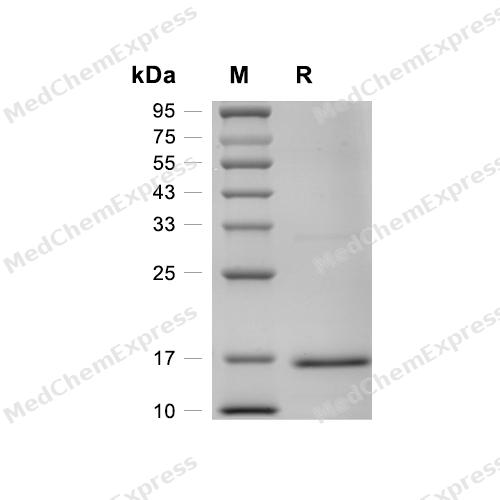
Purity - SDS-PAGE
-
Bioactivity - Cell-Based Assay
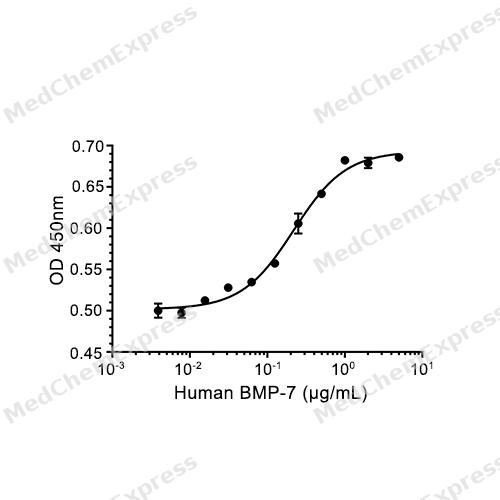
Bioactivity - Cell-Based Assay


Technical Parameters
-
Species Human
-
Source E. coli
-
Tag N-6*His
-
Accession
P18075 (S293-H431)
-
Molecular Construction
-
N-term
-
6*His
-
BMP-7 (S293-H431)
Accession # P18075 -
C-term
-
-
Protein Length
Full Length of Mature Protein
-
Synonyms
BMP7; Eptotermin Alfa; Bone Morphogenetic Protein 7; BMP-7; Osteogenic Protein 1; OP1; OP-1
-
AA Sequence
STGSKQRSQNRSKTPKNQEALRMANVAENSSSDQRQACKKHELYVSFRDLGWQDWIIAPEGYAAYYCEGECAFPLNSYMNATNHAIVQTLVHFINPETVPKPCCAPTQLNAISVLYFDDSSNVILKKYRNMVVRACGCH
-
Predicted Molecular Mass
15.7 kDa
-
Molecular Weight
Approximately 17 kDa, based on SDS-PAGE under reducing conditions.
-
Purity
≥ 95%, as determined by reducing SDS-PAGE.


Product Properties
Lyophilized powder.
Lyophilized from a 0.22 μm filtered solution of 50 mM Tris-HCl, 300 mM NaCl, 500 mM arginine, pH 8.0 or 0.1% TFA, 20% Acetonitrile, pH 2.5.
Note: For SPR assay, please replace the buffer. Primary amine components (e.g., Tris, imidazole) can affect protein-coupled chips.
<1 EU/μg, determined by LAL method.
It is not recommended to reconstitute to a concentration less than 100 μg/mL in ddH2O. For long term storage it is recommended to add a carrier protein (0.1% BSA, 5% HSA, 10% FBS or 5% Trehalose).
Stored at -20°C for 2 years from date of receipt. After reconstitution, it is stable at 4°C for 1 week or -20°C for longer (with carrier protein). It is recommended to freeze aliquots at -20°C or -80°C for extended storage.
Room temperature in continental US; may vary elsewhere.


Documentation
-
Data Sheet (265 KB)
-
SDS (252 KB)
- English - EN (252 KB)
- Français - FR (252 KB)
- Deutsch - DE (252 KB)
- Norwegian - NO (252 KB)
- Español - ES (252 KB)
- Swedish - SV (252 KB)
- Italian - IT (252 KB)
- Korean - KR (252 KB)
- Portuguese - PT (252 KB)
-
Handling Instructions (2659 KB)


References
[1]. Sun R, et al. Expression of BMP-7 in cervical cancer and inhibition of epithelial‑mesenchymal transition by BMP-7 knockdown in HeLa cells. Int J Mol Med. 2020 May;45(5):1417-1424. [Content Brief]
[2]. Miyazawa K, et al. Regulation of TGF-β Family Signaling by Inhibitory Smads. Cold Spring Harb Perspect Biol. 2017 Mar 1;9(3):a022095. [Content Brief]
[3]. Dorai H, et al. Bone morphogenetic protein-7 (osteogenic protein-1) inhibits smooth muscle cell proliferation and stimulates the expression of markers that are characteristic of SMC phenotype in vitro. J Cell Physiol. 2000 Jul;184(1):37-45. [Content Brief]
[4]. Mathew S, et al. Function and effect of bone morphogenetic protein-7 in kidney bone and the bone-vascular links in chronic kidney disease. Eur J Clin Invest. 2006 Aug;36 Suppl 2:43-50. [Content Brief]
[5]. Yang P, et al. The role of bone morphogenetic protein signaling in vascular calcification. Bone. 2020 Dec;141:115542. [Content Brief]
[6]. Xu RH, et al. BMP4 initiates human embryonic stem cell differentiation to trophoblast. Nat Biotechnol. 2002 Dec;20(12):1261-4. [Content Brief]
[7]. Beck HN, et al. Bone morphogenetic protein-5 (BMP-5) promotes dendritic growth in cultured sympathetic neurons. BMC Neurosci. 2001;2:12. [Content Brief]

Calculators
Concentration (start) × Volume (start) = Concentration (final) × Volume (final)


 Powered by Bioz

