



CD14 Protein, Rat (HEK293, His)

Based on 1 Customer Validation
The CD14 protein acts as a coreceptor for bacterial lipopolysaccharide (LPS), forming a complex with LY96 and TLR4. It binds monomeric LPS to LBP, delivers it to the LY96/TLR4 complex and initiates an immune response. CD14 Protein, Rat (HEK293, His) is the recombinant rat-derived CD14 protein, expressed by HEK293 , with C-His labeled tag.
- Species: Rat
- Source: HEK293
-
Storage:Stored at -20°C for 2 years from date of receipt. After reconstitution, it is stable at 4°C for 1 week or -20°C for longer (with carrier protein). It is recommended to freeze aliquots at -20°C or -80°C for extended storage.


To place orders, for customer services and technical support, please contact: MedChemExpress USA
Tel: 609-228-6898 E-mail: [email protected] [email protected]


-
 Biological Activity
-
Technical Parameters
-
Product Properties
- Documentation
- Help & FAQs




Biological Activity
Description
The CD14 protein acts as a coreceptor for bacterial lipopolysaccharide (LPS), forming a complex with LY96 and TLR4. It binds monomeric LPS to LBP, delivers it to the LY96/TLR4 complex and initiates an immune response. CD14 Protein, Rat (HEK293, His) is the recombinant rat-derived CD14 protein, expressed by HEK293 , with C-His labeled tag.
Background
CD14 Protein functions as a coreceptor for bacterial lipopolysaccharide (LPS), forming a multi-protein complex with LY96 and TLR4. Collaborating with LBP, it binds monomeric LPS and delivers it to the LY96/TLR4 complex, initiating the innate immune response. CD14's involvement extends to TLR2:TLR6 and TLR2:TLR1 heterodimers, responding to diacylated and triacylated lipopeptides, respectively. Through interactions with MyD88, TIRAP, and TRAF6, CD14 activates NF-kappa-B, leading to cytokine secretion and inflammation. Additionally, it participates in LDL(-)-induced cytokine release and interacts with LPAR1, MYO18A, and FSTL1, highlighting its diverse roles in immune and signaling pathways.
Verified Bioactivity
Measured by its ability to enhance LPS-induced IL-6 secretion by mouse splenocytes. The ED50 for this effect is 0.488 μg/mL, corresponding to a specific activity is 2049.180 U/mg.
MCE Validation Data
-
Purity - SDS-PAGE
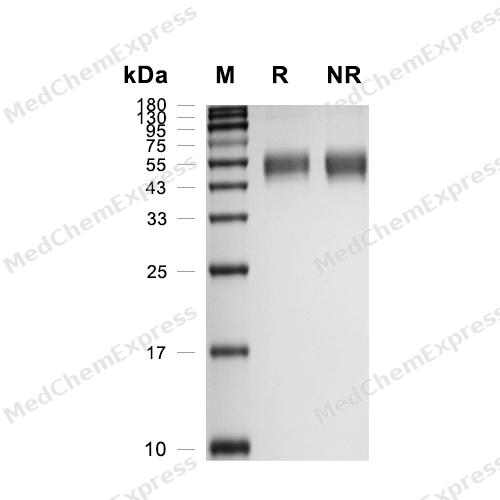
Purity - SDS-PAGE
-
Bioactivity - Cell-Based Assay
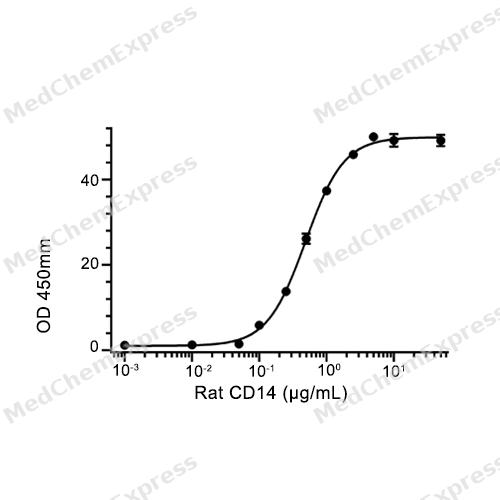
Bioactivity - Cell-Based Assay


Technical Parameters
-
Species Rat
-
Source HEK293
-
Tag C-6*His
-
Accession
Q63691 (S18-Y341)
-
Molecular Construction
-
N-term
-
CD14 (M1-Y341)
Accession # Q63691 -
His
-
C-term
-
-
Protein Length
Full Length of Monocyte differentiation antigen CD14 Chain
-
Synonyms
CD14; Monocyte Differentiation Antigen CD14; CD14 Molecule; CD14 Antigen; Myeloid Cell-Specific Leucine-Rich Glycoprotein; My23 Antigen
-
AA Sequence
SPATPEPCELDQDEESVRCYCNFSDPQPNWSSAFLCAGAEDVEFYGGGRSLEYLLKRVDTEANLGQYTDIIRSLPLKRLTVRSARVPTQILFGTLRVLGYSGLRELTLENLEVTGTALSPLLDATGPDLNTLSLRNVSWATTDTWLAELQQWLKPGLKVLSIAQAHSLNFSCKQVGVFPALATLDLSDNPELGEKGLISALCPHKFPTLQVLALRNAGMETTSGVCSALAAARVPLQALDLSHNSLRDTAGTPSCDWPSQLNSLNLSFTGLEHVPKGLPAKLSVLDLSYNRLDRKPRPEELPEVGSLSLTGNPFLHSESQSEAY
-
Molecular Weight
Approximately 45-57 kDa, based on SDS-PAGE under reducing conditions, due to the glycosylation.
-
Glycosylation
Yes
-
Purity
≥ 95%, as determined by reducing SDS-PAGE.


Product Properties
Lyophilized powder.
Lyophilized from a 0.22 μm filtered solution of PBS, pH 7.4.
<1 EU/μg, determined by LAL method.
It is not recommended to reconstitute to a concentration less than 100 μg/mL in ddH2O. For long term storage it is recommended to add a carrier protein (0.1% BSA, 5% HSA, 10% FBS or 5% Trehalose).
Stored at -20°C for 2 years from date of receipt. After reconstitution, it is stable at 4°C for 1 week or -20°C for longer (with carrier protein). It is recommended to freeze aliquots at -20°C or -80°C for extended storage.
Room temperature in continental US; may vary elsewhere.


Documentation
-
Data Sheet (237 KB)
-
SDS (252 KB)
- English - EN (252 KB)
- Français - FR (252 KB)
- Deutsch - DE (252 KB)
- Norwegian - NO (252 KB)
- Español - ES (252 KB)
- Swedish - SV (252 KB)
- Italian - IT (252 KB)
- Korean - KR (252 KB)
- Portuguese - PT (252 KB)
-
Handling Instructions (2659 KB)

Calculators
Concentration (start) × Volume (start) = Concentration (final) × Volume (final)


 Powered by Bioz

