



Fc epsilon RIA/FCER1A Protein, Human (His-SUMO)

Based on 1 Customer Validation
The Fc epsilon RIA/FCER1A protein is a high-affinity receptor for IgE and critically mediates IgE effector function in myeloid cells. After binding to IgE and cross-linking with antigen, it activates signaling pathways that induce myeloid cell activation and differentiation. Fc epsilon RIA/FCER1A Protein, Human (His-SUMO) is the recombinant human-derived Fc epsilon RIA/FCER1A protein, expressed by E. coli , with N-6*His, N-SUMO labeled tag.
- Species: Human
- Source: E. coli
-
Storage:Stored at -20°C for 2 years from date of receipt. After reconstitution, it is stable at 4°C for 1 week or -20°C for longer (with carrier protein). It is recommended to freeze aliquots at -20°C or -80°C for extended storage.


To place orders, for customer services and technical support, please contact: MedChemExpress USA
Tel: 609-228-6898 E-mail: [email protected] [email protected]


-
 Biological Activity
-
Technical Parameters
-
Product Properties
- Documentation
- Help & FAQs




Biological Activity
Description
The Fc epsilon RIA/FCER1A protein is a high-affinity receptor for IgE and critically mediates IgE effector function in myeloid cells. After binding to IgE and cross-linking with antigen, it activates signaling pathways that induce myeloid cell activation and differentiation. Fc epsilon RIA/FCER1A Protein, Human (His-SUMO) is the recombinant human-derived Fc epsilon RIA/FCER1A protein, expressed by E. coli , with N-6*His, N-SUMO labeled tag.
Background
Fc epsilon RIA/FCER1A Protein takes center stage as a high-affinity receptor designed for immunoglobulin epsilon/IgE, serving as a crucial mediator of IgE effector functions in myeloid cells. Upon binding to IgE and subsequent cross-linking with antigens/allergens, it activates signaling pathways that induce myeloid cell activation and differentiation. Particularly on mast cells, basophils, and eosinophils, Fc epsilon RIA triggers the secretion of vasoactive amines, lipid mediators, and cytokines, contributing to inflammatory responses, tissue remodeling, and cytotoxicity against microbes. This orchestrated response forms a part of the immediate hypersensitivity reaction to allergens, acting as a host defense mechanism against helminth parasites, pathogenic bacteria, and venom toxicity. However, when dysregulated, this receptor can lead to harmful and life-threatening allergic and anaphylactic reactions. Structurally, it exists as a tetramer comprising an alpha chain, a beta chain, and two disulfide-linked gamma chains, and it interacts with IGHE via the CH3 region.
Verified Bioactivity
Measured by its binding ability in a functional ELISA.When Recombinant Human Fc epsilon RIA/FCER1A is immobilized at 0.1 μg/mL can bind Biotinylated Human IgE. The ED50 for this effect is 5.864 μg/mL.
MCE Validation Data
-
Bioactivity - ELISA
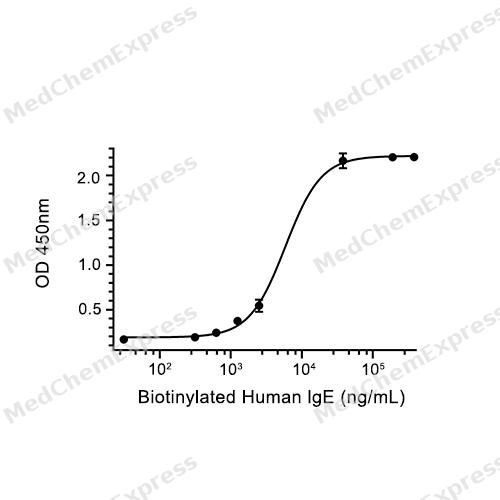
Bioactivity - ELISA


Technical Parameters
-
Species Human
-
Source E. coli
-
Tag N-6*His;N-SUMO
-
Accession
P12319 (V26-Q205)
-
Molecular Construction
-
N-term
-
6*His-SUMO
-
FCER1A (V26-Q205)
Accession # P12319 -
C-term
-
-
Protein Length
Extracellular Domain
-
Synonyms
FCER1A; FcepsilonRI Alpha Chain; Prev. FCE1A; FcERI; FcepsilonRIalpha; Immunoglobulin E Receptor, High-Affinity, Of Mast Cells, Alpha Polypeptide; FCERIA; High Affinity Immunoglobulin Epsilon Receptor Alpha-Subunit; Fc Fragment Of IgE, High Affinity I, Re
-
AA Sequence
VPQKPKVSLNPPWNRIFKGENVTLTCNGNNFFEVSSTKWFHNGSLSEETNSSLNIVNAKFEDSGEYKCQHQQVNESEPVYLEVFSDWLLLQASAEVVMEGQPLFLRCHGWRNWDVYKVIYYKDGEALKYWYENHNISITNATVEDSGTYYCTGKVWQLDYESEPLNITVIKAPREKYWLQ
-
Predicted Molecular Mass
37 kDa
-
Molecular Weight
Approximately 37 kDa, based on SDS-PAGE under reducing conditions.
-
Purity
≥ 95%, as determined by reducing SDS-PAGE.


Product Properties
Lyophilized powder.
Lyophilized from a 0.22 μm filtered solution of 10 mM Tris-HCl, 1 mM EDTA, 6% trehalose, pH 8.0.
Note: For SPR assay, please replace the buffer. Primary amine components (e.g., Tris, imidazole) can affect protein-coupled chips.
<1 EU/μg, determined by LAL method.
It is not recommended to reconstitute to a concentration less than 100 μg/mL in ddH2O.
Stored at -20°C for 2 years from date of receipt. After reconstitution, it is stable at 4°C for 1 week or -20°C for longer (with carrier protein). It is recommended to freeze aliquots at -20°C or -80°C for extended storage.
Room temperature in continental US; may vary elsewhere.


Documentation
-
Data Sheet (237 KB)
-
SDS (252 KB)
- English - EN (252 KB)
- Français - FR (252 KB)
- Deutsch - DE (252 KB)
- Norwegian - NO (252 KB)
- Español - ES (252 KB)
- Swedish - SV (252 KB)
- Italian - IT (252 KB)
- Korean - KR (252 KB)
- Portuguese - PT (252 KB)
-
Handling Instructions (2659 KB)

Calculators
Concentration (start) × Volume (start) = Concentration (final) × Volume (final)


 Powered by Bioz

