



HLA-A Protein, Human (His)

Based on 1 Customer Validation
HLA-A protein is an antigen-presenting MHCI molecule that is critical for mediating reproductive and antiviral immunity. It partners with B2M to provide self- and viral peptides as ligands that inhibit and activate KIR on NK cells. HLA-A Protein, Human (His) is the recombinant human-derived HLA-A protein, expressed by E. coli , with N-6*His labeled tag.
- Species: Human
- Source: E. coli
-
Storage:Stored at -20°C for 2 years from date of receipt. After reconstitution, it is stable at 4°C for 1 week or -20°C for longer (with carrier protein). It is recommended to freeze aliquots at -20°C or -80°C for extended storage.


To place orders, for customer services and technical support, please contact: MedChemExpress USA
Tel: 609-228-6898 E-mail: [email protected] [email protected]


-
 Biological Activity
-
Technical Parameters
-
Product Properties
- Documentation
- Help & FAQs




Biological Activity
Description
HLA-A protein is an antigen-presenting MHCI molecule that is critical for mediating reproductive and antiviral immunity. It partners with B2M to provide self- and viral peptides as ligands that inhibit and activate KIR on NK cells. HLA-A Protein, Human (His) is the recombinant human-derived HLA-A protein, expressed by E. coli , with N-6*His labeled tag.
Background
HLA-C*0304, an antigen-presenting major histocompatibility complex class I (MHCI) molecule, plays a crucial role in both reproduction and antiviral immunity. In collaboration with B2M/beta 2 microglobulin, it exhibits a limited repertoire of self and viral peptides, serving as a prominent ligand for both inhibitory and activating killer immunoglobulin receptors (KIRs) expressed on natural killer (NK) cells. Particularly in the context of pregnancy, HLA-C*0304 mediates the interaction between extravillous trophoblasts and uterine NK cells through KIR, thereby regulating trophoblast invasion essential for placentation and overall fetal growth. During viral infections, it presents viral peptides with low affinity for KIRs, preventing KIR-mediated inhibition and promoting the lysis of infected cells. Furthermore, HLA-C*0304 displays a restricted repertoire of viral peptides on antigen-presenting cells, facilitating recognition by alpha-beta T cell receptors on CD8-positive T cells, thereby guiding antigen-specific T cell immune responses to eliminate infected cells, especially in chronic viral infection scenarios such as HIV-1 or CMV infection. The peptide and the MHC molecule jointly contribute to antigen recognition, with the peptide determining fine specificity, and MHC residues dictating T cell receptor restriction. Typically presenting intracellular peptide antigens of 9 amino acids originating from cytosolic proteolysis via the proteasome, HLA-C*0304 exhibits binding preferences for peptides with specific anchor residues at positions 2 and 9, mainly comprising hydrophobic or aromatic amino acids (Phe, Ile, Leu, Met, Val, and Tyr).
MCE Validation Data
-
Purity - SDS-PAGE
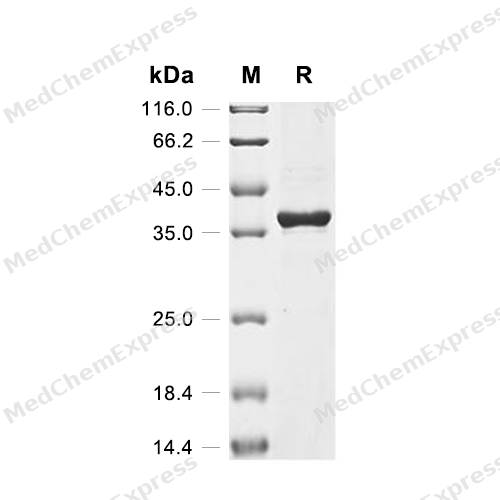
Purity - SDS-PAGE


Technical Parameters
-
Species Human
-
Source E. coli
-
Tag N-6*His
-
Accession
Q5SUL5 (G25-I308)
-
Molecular Construction
-
N-term
-
6*His
-
HLA-A (G25-I308)
Accession # Q5SUL5 -
C-term
-
-
Protein Length
Extracellular Domain
-
Synonyms
HLA-A; MHC class I antigen; HLA class I histocompatibility antigen A alpha chain
-
AA Sequence
GSHSMRYFFTSVSRPGRGEPRFIAVGYVDDTQFVRFDSDAASQKMEPRAPWIEQEGPEYWDQETRNMKAHSQTDRANLGTLRGYYNQSEDGSHTIQIMYGCDVGPDGRFLRGYRQDAYDGKDYIALNEDLRSWTAADMAAQITKRKWEAVHAAEQRRVYLEGRCVDGLRRYLENGKETLQRTDPPKTHMTHHPISDHEATLRCWALGFYPAEITLTWQRDGEDQTQDTELVETRPAGDGTFQKWAAVVVPSGEEQRYTCHVQHEGLPKPLTLRWELSSQPTIPI
-
Predicted Molecular Mass
36.7 kDa
-
Purity
≥ 90%, as determined by reducing SDS-PAGE.


Product Properties
Lyophilized powder.
Lyophilized from a 0.22 μm filtered solution of 10 mM Tris-HCl, 1 mM EDTA, 6% trehalose, pH 8.0.
Note: For SPR assay, please replace the buffer. Primary amine components (e.g., Tris, imidazole) can affect protein-coupled chips.
<1 EU/μg, determined by LAL method.
It is not recommended to reconstitute to a concentration less than 100 μg/mL in ddH2O.
Stored at -20°C for 2 years from date of receipt. After reconstitution, it is stable at 4°C for 1 week or -20°C for longer (with carrier protein). It is recommended to freeze aliquots at -20°C or -80°C for extended storage.
Room temperature in continental US; may vary elsewhere.


Documentation
-
Data Sheet (237 KB)
-
SDS (251 KB)
- English - EN (251 KB)
- Français - FR (251 KB)
- Deutsch - DE (251 KB)
- Norwegian - NO (251 KB)
- Español - ES (251 KB)
- Swedish - SV (251 KB)
- Italian - IT (251 KB)
- Korean - KR (251 KB)
- Portuguese - PT (251 KB)
-
Handling Instructions (2659 KB)

Calculators
Concentration (start) × Volume (start) = Concentration (final) × Volume (final)


 Powered by Bioz

