



I-TAC/CXCL11 Protein, Human (HEK293)
Based on 1 publication(s) in Google Scholar
CXCL11, also known as IFN-inducible T-cell α-chemoattractant (I-TAC), belongs to the ELR-negative CXC chemokine family. CXCL11 is produced by a variety of cells including leukocytes, fibroblasts, and endothelial cells upon stimulation with interferons (IFNs). CXCL11 signals through CXCR3. CXCL11 is associated with pleiotropic functions including chemotactic migration, regulation of cell proliferation and self-renewal, increasing cell adhesion, and modulation of angiostatic effects. I-TAC/CXCL11 Protein, Human (HEK293) consists of 73 amino acids (F22-F94) and is expressed in HEK293 cells.
- Species: Human
- Source: HEK293
-
Storage:Stored at -20°C for 2 years from date of receipt. After reconstitution, it is stable at 4°C for 1 week or -20°C for longer (with carrier protein). It is recommended to freeze aliquots at -20°C or -80°C for extended storage.


To place orders, for customer services and technical support, please contact: MedChemExpress USA
Tel: 609-228-6898 E-mail: [email protected] [email protected]


-
 Biological Activity
-
Technical Parameters
-
Product Properties
- Documentation
- References
- Help & FAQs




Biological Activity
Description
CXCL11, also known as IFN-inducible T-cell α-chemoattractant (I-TAC), belongs to the ELR-negative CXC chemokine family. CXCL11 is produced by a variety of cells including leukocytes, fibroblasts, and endothelial cells upon stimulation with interferons (IFNs). CXCL11 signals through CXCR3. CXCL11 is associated with pleiotropic functions including chemotactic migration, regulation of cell proliferation and self-renewal, increasing cell adhesion, and modulation of angiostatic effects[1][2]. I-TAC/CXCL11 Protein, Human (HEK293) consists of 73 amino acids (F22-F94) and is expressed in HEK293 cells.
Background
CXCL11 is mainly expressed in the lung, pancreas, thymus, peripheral blood leukocytes, spleen, and liver and is expressed at lesser levels in the intestine, placenta, and prostate. CXCL11 is located on human chromosome 4 and is mainly secreted by cancer cells, leukocytes, monocytes, dendritic cells, endothelial cells, and fibroblasts. CXCL11 attracts activated lymphocytes and NK cells to inflamed tissue and to tumors and inhibits the generation of novel blood vessels essential for tumor growth and tissue repair[1][2].
CXCL11 which can bind to two different chemokine receptors, CXCR3 and CXCR7. CXCL11 is characterized by the presence of 1 amino acid in between the 2 NH2-terminal cysteines. CXCL11 is usually expressed at low levels in homeostatic conditions, but is upregulated during cancer or infectious disease processes. CXCL11 is mainly induced by IFN-γ and IFN-β and is weakly induced by IFN-α. CXCL11 has potent chemoattractant activity for IL-2 activated T cells and transfected cell lines expressing CXCR3, but not freshly isolated T cells, neutrophils or monocytes. Simultaneous stimulation of fibroblasts or endothelial cells with IFN-γ and interleukin-1β or the TLR3 ligand double-stranded RNA resulted in a synergistic increase of CXCL11 production. In leukocytes, bacterial LPS and PGN even inhibited interferon-induced CXCL11 production. CXCL11 attracts activated T-helper 1 (Th1) lymphocytes and natural killer (NK) cells. Furthermore, CXCL11 can bind to CXCR7, which is associated with invasiveness and reduces apoptosis of tumor cells[1][2].
The diverse functions of CXCL11 include inhibiting angiogenesis, affecting the proliferation of different cell types, playing a role in fibroblast directed carcinoma invasion, increasing adhesion properties, suppressing M2 macrophage polarization, and facilitating the migration of certain immune cells[1][2].
In Vitro
Recombinant human CXCL11 (100 ng/mL) promotes proliferation and migration of IGROV-1 cells via CXCR3. Recombinant human CXCL11 (100 ng/mL; 5-60 min) increases the phosphorylated p44/42 and phosphorylated Akt in ovarian cancer cells[3].
Verified Bioactivity
1.The ED50 is <0.5 μg/mL as measured by CHO-K1/Gα15/hCXCR3 cells (human Gα15 and human CXCR3 stably expressed in CHO-K1 cells).
2.The biological activity determined by a chemotaxis bioassay using activated human T-lymphocytes. The ED50 for this effect is <2.5 ng/mL in the presence of 1 ng/mL human IL-2.
3. Measured by its ability to chemoattract BaF3 mouse pro‑B cells transfected with human CXCR3. The ED50 for this effect is ≤3.091 ng/mL, corresponding to a specific activity is ≥3.24×10⁵ U/mg.
MCE Validation Data
-
Purity - SDS-PAGE
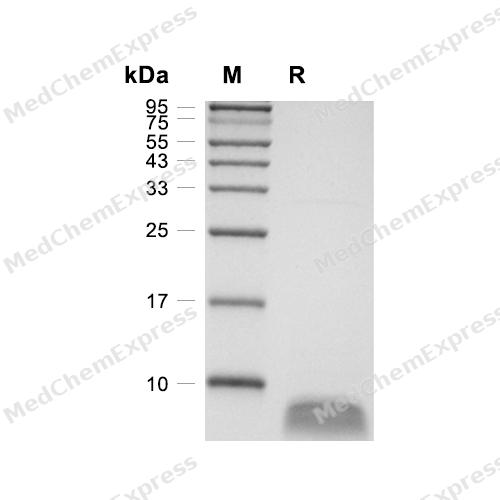
Purity - SDS-PAGE
-
Bioactivity - Cell-Based Assay
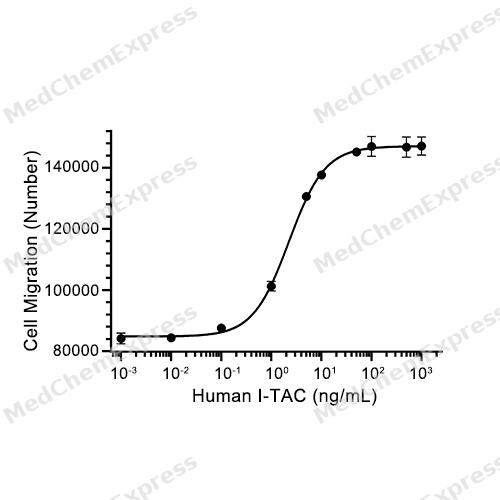
Bioactivity - Cell-Based Assay


Publications (1)
-
Journal Impact Factor
-
Most Recent
-
Immunity
Spatiotemporal dynamics of CXCL10 encode contextual immune information revealed by the genetically encoded fluorescent sensor. [Abstract]2025 Sep 9;58(9):2320-2335.e9. PMID: 40818452


Technical Parameters
-
Species Human
-
Source HEK293
-
Tag Tag Free
-
Accession
O14625 (F22-F94)
-
Molecular Construction
-
N-term
-
CXCL11 (F22-F94)
Accession # O14625 -
C-term
-
-
Protein Length
Full Length of Mature Protein
-
Synonyms
CXCL11; Interferon Gamma-Inducible Protein 9; Prev. SCYB11; C-X-C Motif Chemokine 11; Prev. SCYB9B; Beta-R1; I-TAC; Small Inducible Cytokine Subfamily B (Cys-X-Cys), Member 9B; H174; Small Inducible Cytokine B11; IP-9; Small-Inducible Cytokine B11; B-R1; Alternative Protein CXCL11; Small Inducible Cytokine Subfamily B (Cys-X-Cys), Member 11; ITAC; Interferon-Inducible T-Cell Alpha Chemoattractant; IP9; C-X-C Motif Chemokine Ligand 11; Chemokine (C-X-C Motif) Ligand 11
-
AA Sequence
FPMFKRGRCLCIGPGVKAVKVADIEKASIMYPSNNCDKIEVIITLKENKGQRCLNPKSKQARLIIKKVERKNF
-
Predicted Molecular Mass
8.3 kDa
-
Molecular Weight
Approximately 9-11 kDa, based on SDS-PAGE under reducing conditions.
-
Purity
≥ 95%, as determined by reducing SDS-PAGE.


Product Properties
Lyophilized powder
Lyophilized from a 0.22 μm filtered solution of PBS, pH 7.4.
<0.2 EU/μg, determined by LAL method.
It is not recommended to reconstitute to a concentration less than 100 μg/mL in ddH2O. For long term storage it is recommended to add a carrier protein (0.1% BSA, 5% HSA, 10% FBS or 5% Trehalose).
Stored at -20°C for 2 years from date of receipt. After reconstitution, it is stable at 4°C for 1 week or -20°C for longer (with carrier protein). It is recommended to freeze aliquots at -20°C or -80°C for extended storage.
Room temperature in continental US; may vary elsewhere.


Documentation
-
Data Sheet (264 KB)
-
SDS (252 KB)
- English - EN (252 KB)
- Français - FR (252 KB)
- Deutsch - DE (252 KB)
- Norwegian - NO (252 KB)
- Español - ES (252 KB)
- Swedish - SV (252 KB)
- Italian - IT (252 KB)
- Korean - KR (252 KB)
- Portuguese - PT (252 KB)
-
Handling Instructions (2659 KB)


References
[1]. Proost P, et al. Proteolytic processing of CXCL11 by CD13/aminopeptidase N impairs CXCR3 and CXCR7 binding and signaling and reduces lymphocyte and endothelial cell migration. Blood. 2007 Jul 1;110(1):37-44. [Content Brief]
[2]. Proost P, et al. Proteolytic processing of CXCL11 by CD13/aminopeptidase N impairs CXCR3 and CXCR7 binding and signaling and reduces lymphocyte and endothelial cell migration. Blood. 2007 Jul 1;110(1):37-44. [Content Brief]
[3]. Qun Gao, et al. CXCL11 Signaling in the Tumor Microenvironment. Adv Exp Med Biol. 2021;1302:41-50. [Content Brief]
[4]. Tat-San Lau, et al. Cancer cell-derived lymphotoxin mediates reciprocal tumour-stromal interactions in human ovarian cancer by inducing CXCL11 in fibroblasts. J Pathol. 2014 Jan;232(1):43-56. [Content Brief]

Calculators
Concentration (start) × Volume (start) = Concentration (final) × Volume (final)


 Powered by Bioz

