



IL-10 Protein, Human (HEK293)
Based on 1 publication(s) in Google Scholar
IL-10 protein is a major immunoregulatory cytokine with profound anti-inflammatory functions that limits excessive tissue destruction caused by inflammation. Mechanistically, IL10 binds to its heterotetrameric receptors IL10RA and IL10RB, leading to JAK1- and STAT2-mediated phosphorylation of STAT3, which translocates to the nucleus and drives the expression of anti-inflammatory mediators. IL-10 Protein, Human (HEK293) is the recombinant human-derived IL-10 protein, expressed by HEK293 , with tag free.
- Species: Human
- Source: HEK293
-
Storage:Stored at -20°C for 2 years from date of receipt. After reconstitution, it is stable at 4°C for 1 week or -20°C for longer (with carrier protein). It is recommended to freeze aliquots at -20°C or -80°C for extended storage.


To place orders, for customer services and technical support, please contact: MedChemExpress USA
Tel: 609-228-6898 E-mail: [email protected] [email protected]


-
 Biological Activity
-
Technical Parameters
-
Product Properties
- Documentation
- Help & FAQs


-

HY-P70445
IL-4 Protein, Human -
HY-P7025
IFN-gamma Protein, Human -
HY-P70568
IL-13 Protein, Human (HEK293, His) -
HY-P7044
IL-6 Protein, Human -
HY-P70543
TGF beta 1/TGFB1 Protein, Human (HEK293) -
HY-P70750
IL-4 Protein, Human (HEK293) -
HY-P7058
TNF-alpha/TNFSF2 Protein, Human -
HY-P7028
IL-1 beta Protein, Human -
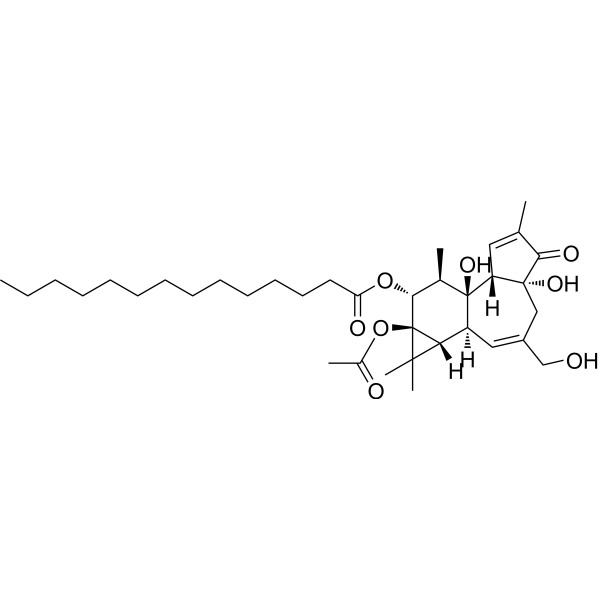
HY-18739
Phorbol 12-myristate 13-acetate -
HY-P70527
IL-17A Protein, Human (HEK293, His) -

HY-D1056
Lipopolysaccharides, from E. coli O55:B5 -
HY-P70499
Osteopontin/OPN Protein, Human (HEK293, His)


Biological Activity
Description
IL-10 protein is a major immunoregulatory cytokine with profound anti-inflammatory functions that limits excessive tissue destruction caused by inflammation. Mechanistically, IL10 binds to its heterotetrameric receptors IL10RA and IL10RB, leading to JAK1- and STAT2-mediated phosphorylation of STAT3, which translocates to the nucleus and drives the expression of anti-inflammatory mediators. IL-10 Protein, Human (HEK293) is the recombinant human-derived IL-10 protein, expressed by HEK293 , with tag free.
Background
IL-10 Protein, a key immune regulatory cytokine, exerts potent anti-inflammatory effects to prevent excessive tissue damage caused by inflammation. It engages its heterotetrameric receptor, composed of IL10RA and IL10RB, triggering JAK1 and STAT2-mediated phosphorylation of STAT3. This leads to STAT3 translocation into the nucleus, driving the expression of anti-inflammatory mediators. IL-10 Protein targets antigen-presenting cells like macrophages and monocytes, inhibiting the release of pro-inflammatory cytokines. It also hinders antigen presentation by reducing MHC-class II and co-stimulatory molecule expression, thereby dampening T cell activation. Additionally, it reprograms metabolic pathways, including mTOR signaling, to control the inflammatory response of macrophages. The protein forms homodimers and interacts with IL10RA and IL10RB.
Verified Bioactivity
Immobilized human IL10 at 10 μg/mL (100 μL/well) can bind Cynomolgus IL10RA-Fc. The EC50 for this effect is 0.3113 μg/mL.
MCE Validation Data
-
Purity - SDS-PAGE
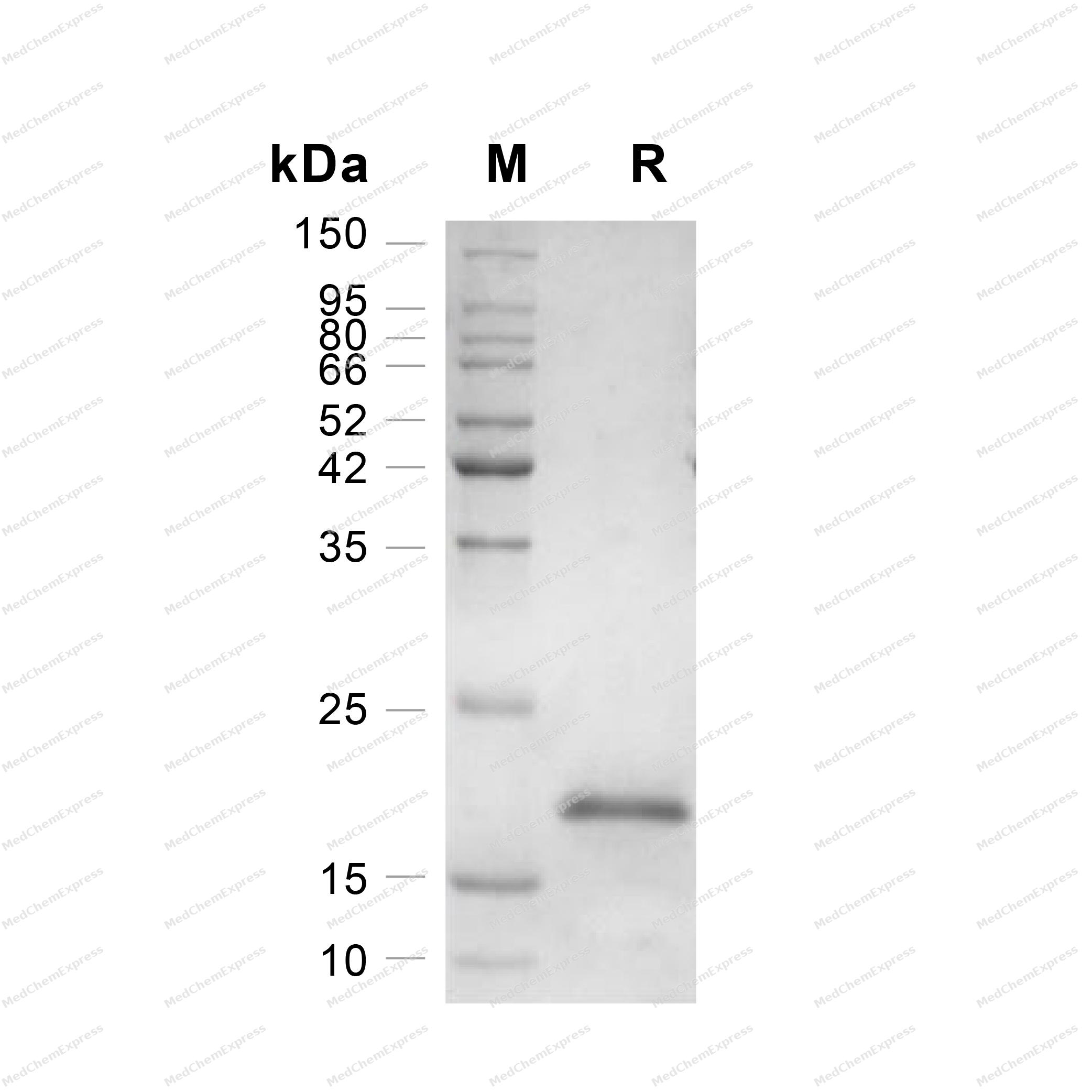
Purity - SDS-PAGE
-
Bioactivity - ELISA
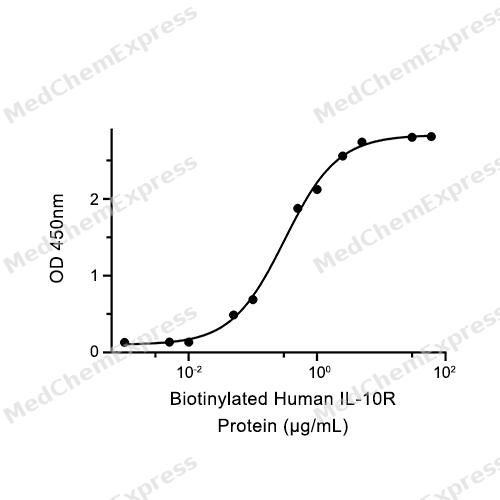
Bioactivity - ELISA


Publications (1)
-
Journal Impact Factor
-
Most Recent
-
Immunity
Spatiotemporal dynamics of CXCL10 encode contextual immune information revealed by the genetically encoded fluorescent sensor. [Abstract]2025 Sep 9;58(9):2320-2335.e9. PMID: 40818452


Technical Parameters
-
Species Human
-
Source HEK293
-
Tag Tag Free
-
Accession
P22301 (S19-N178)
-
Molecular Construction
-
N-term
-
IL-10 (S19-N178)
Accession # P22301 -
C-term
-
-
Protein Length
Full Length of Mature Protein
-
Synonyms
IL10; TGIF; Interleukin 10; T-Cell Growth Inhibitory Factor; IL-10; Interleukin-10; CSIF; Interleukin Family Protein; Cytokine Synthesis Inhibitory Factor; GVHDS; IL10A; IF2A
-
AA Sequence
SPGQGTQSENSCTHFPGNLPNMLRDLRDAFSRVKTFFQMKDQLDNLLLKESLLEDFKGYLGCQALSEMIQFYLEEVMPQAENQDPDIKAHVNSLGENLKTLRLRLRRCHRFLPCENKSKAVEQVKNAFNKLQEKGIYKAMSEFDIFINYIEAYMTMKIRN
-
Predicted Molecular Mass
18.6 kDa
-
Molecular Weight
Approximately 16-20 kDa, based on SDS-PAGE under reducing conditions, due to the glycosylation.
-
Glycosylation
Yes
-
Purity
≥ 95%, as determined by reducing SDS-PAGE.


Product Properties
Lyophilized powder
1.Lyophilized from a 0.22 μm filtered solution of PBS, pH 7.4.
2.Lyophilized from a 0.22 μm filtered solution of 20 mM PB, 150 mM NaCl, pH 7.4.
Please refer to the lot-specific COA for specific buffer information.
<1 EU/μg, determined by LAL method.
It is not recommended to reconstitute to a concentration less than 100 μg/mL in ddH2O. For long term storage it is recommended to add a carrier protein (0.1% BSA, 5% HSA, 10% FBS or 5% Trehalose).
Stored at -20°C for 2 years from date of receipt. After reconstitution, it is stable at 4°C for 1 week or -20°C for longer (with carrier protein). It is recommended to freeze aliquots at -20°C or -80°C for extended storage.
Room temperature in continental US; may vary elsewhere.


Documentation
-
Data Sheet (236 KB)
-
SDS (251 KB)
- English - EN (251 KB)
- Français - FR (251 KB)
- Deutsch - DE (251 KB)
- Norwegian - NO (251 KB)
- Español - ES (251 KB)
- Swedish - SV (251 KB)
- Italian - IT (251 KB)
- Korean - KR (251 KB)
- Portuguese - PT (251 KB)
-
Handling Instructions (2659 KB)

Calculators
Concentration (start) × Volume (start) = Concentration (final) × Volume (final)


 Powered by Bioz

