



IL-33 Protein, Mouse
Based on 14 publication(s) in Google Scholar
IL-33 Protein, Mouse is a tissue-derived nuclear cytokine from the IL-1 family abundantly expressed in endothelial cells, epithelial cells and fibroblast-like cells, both during homeostasis and inflammation.
- Species: Mouse
- Source: E. coli
-
Storage:Stored at -20°C for 2 years from date of receipt. After reconstitution, it is stable at 4°C for 1 week or -20°C for longer (with carrier protein). It is recommended to freeze aliquots at -20°C or -80°C for extended storage.


To place orders, for customer services and technical support, please contact: MedChemExpress USA
Tel: 609-228-6898 E-mail: [email protected] [email protected]


-
 Biological Activity
-
Technical Parameters
-
Product Properties
- Documentation
- References
- Help & FAQs


-

HY-P7077
IL-2 Protein, Mouse -
HY-P7041
IL-33 Protein, Human -
HY-P7073
IL-1 beta Protein, Mouse -
HY-P72459
ST2/IL1RL1 Protein, Mouse (HEK293, His) -
HY-P73226
IL-7 Protein, Mouse -
HY-P7070
IGF-I/IGF-1 Protein, Mouse -
HY-P7071
IFN-gamma Protein, Mouse -
HY-P70626
TSLP Protein, Mouse (HEK293, Fc) -
HY-P7080
IL-4 Protein, Mouse (CHO) -
HY-P70342
MMP-12 Protein, Mouse (HEK293, His) -
HY-P72566
IL-1RA/IL-1RN Protein, Mouse -
HY-P70642
IL-18 Protein, Mouse (His)


Biological Activity
Description
IL-33 Protein, Mouse is a tissue-derived nuclear cytokine from the IL-1 family abundantly expressed in endothelial cells, epithelial cells and fibroblast-like cells, both during homeostasis and inflammation.
Background
Interleukin-33 (IL-33) was originally described as an inducer of type 2 immune responses, activating T helper 2 cells and mast cells. Evidence shows that IL-33 also potently stimulates group 2 innate lymphoid cells, regulatory T cells, TH1 cells, CD8+ T cells and natural killer cells[1]. IL-33 is a crucial immune modulator with pleiotropic activities in type-2, type-1 and regulatory immune responses, and important roles in allergic, fibrotic, infectious, and chronic inflammatory diseases[2].
Verified Bioactivity
1.The ED50 is <0.5 ng/mL as measured by murine D10S cells, corresponding to a specific activity of >2.0 × 10⁶ units/mg.
2.Measured in a cell proliferation assay using CTLL-2 cells. The ED50 for this effect is 0.007306 ng/mL, corresponding to a specific activity is 1.37×10⁸ units/mg.
3.Immobilized Mouse IL-33 at 5 μg/mL (100 μl/well) can bind Mouse ST2-Fc.The ED50 of Mouse ST2-Fc is 0.194 μg/mL.
4.Immobilized Mouse ST2 (V192A, C-Fc) at 5 μg/mL (100 μL/well) can bind Mouse IL-33: Biotinylated by NHS-biotin prior to testing. The EC50 of Mouse IL-33 is 5-13 ng/mL.
5.Measured by its binding ability in a functional ELISA. Immobilized Mouse ST2 at 5 μg/mL (100 μL/well) can bind biotinylated Mouse IL-33, the ED50 for this effect is 18.79 ng/mL.
MCE Validation Data
-
Purity - SDS-PAGE
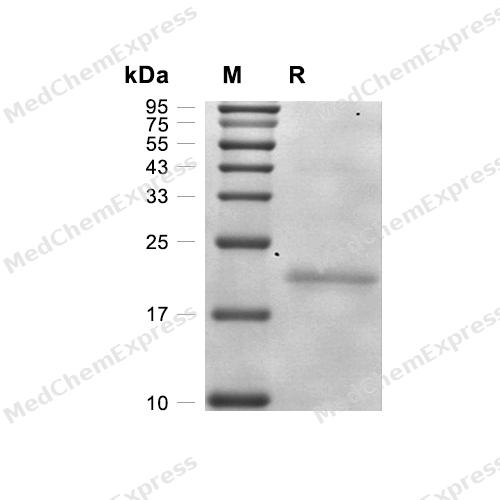
Purity - SDS-PAGE
-
Bioactivity - Cell-Based Assay
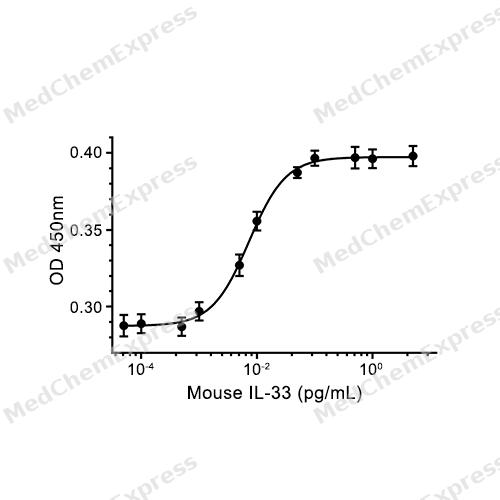
Bioactivity - Cell-Based Assay


Publications (14)
-
Journal Impact Factor
-
Most Recent
-
Mil Med Res
Decreased IL-33 in the brain following repetitive mild traumatic brain injury contributes to cognitive impairment by inhibiting microglial phagocytosis. [Abstract]2025 Aug 5;12(1):46. PMID: 40764944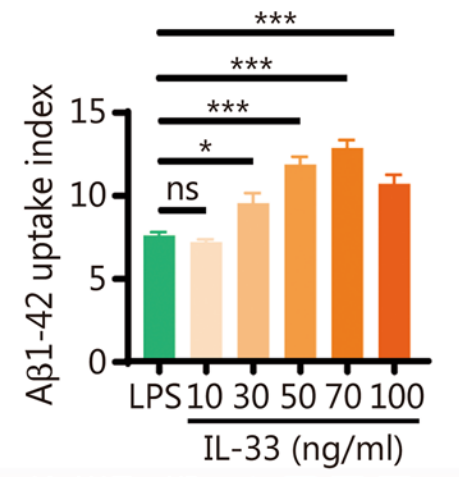
IL-33 Protein, Mouse purchased from MedChemExpress. Usage Cited in: Mil Med Res. 2025 Aug 5;12(1):46. [Abstract]
The uptake of Aβ1-42 by BV2 cells under different concentrations of IL-33 (0-100 ng/mL, 12 h) intervention.
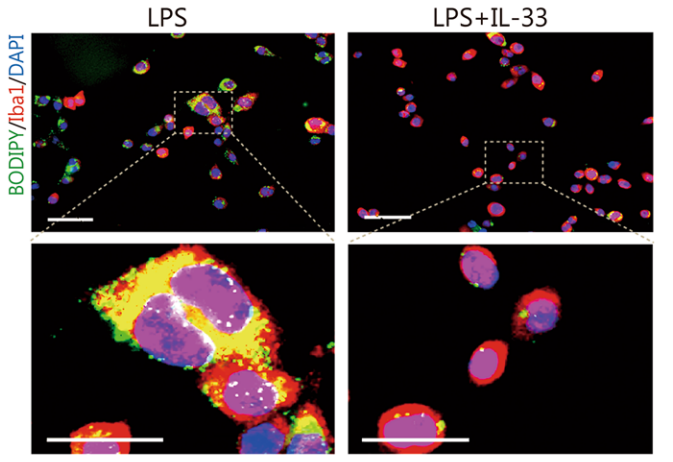
IL-33 Protein, Mouse purchased from MedChemExpress. Usage Cited in: Mil Med Res. 2025 Aug 5;12(1):46. [Abstract]
Representative immunofluorescence staining images of BODIPY+ (green) in BV2 cells after IL-33 (50 ng/mL, 12 h) intervention.
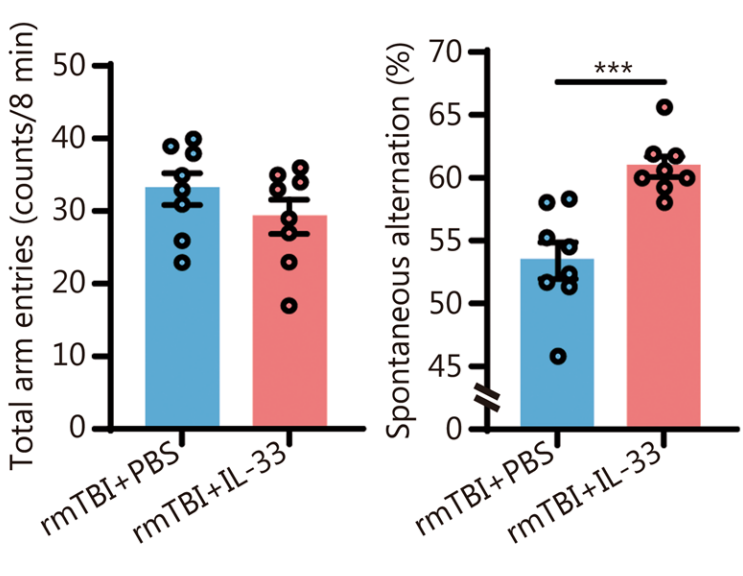
IL-33 Protein, Mouse purchased from MedChemExpress. Usage Cited in: Mil Med Res. 2025 Aug 5;12(1):46. [Abstract]
We administered exogenous recombinant IL-33 protein (2 µg per 30 g of body weight) intranasally to mice on days 0, 7, 14, 21, 28, 35, and 42 following rmTBI. Detect the percentage of total entries and spontaneous alternations in the Y-maze test.
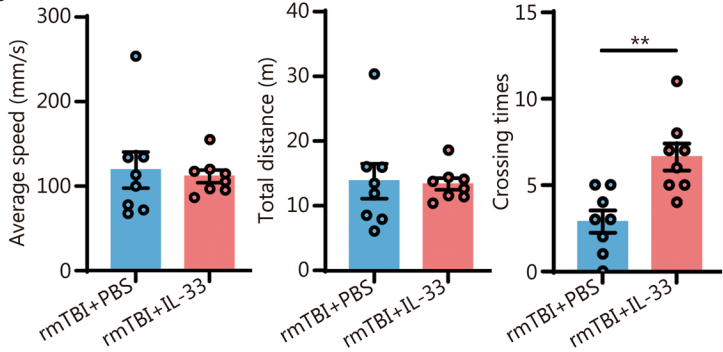
IL-33 Protein, Mouse purchased from MedChemExpress. Usage Cited in: Mil Med Res. 2025 Aug 5;12(1):46. [Abstract]
We administered exogenous recombinant IL-33 protein (2 µg per 30 g of body weight) intranasally to mice on days 0, 7, 14, 21, 28, 35, and 42 following rmTBI. The average speed, total distance, and time taken by mice during the exploration phase of the Barnes maze were measured.
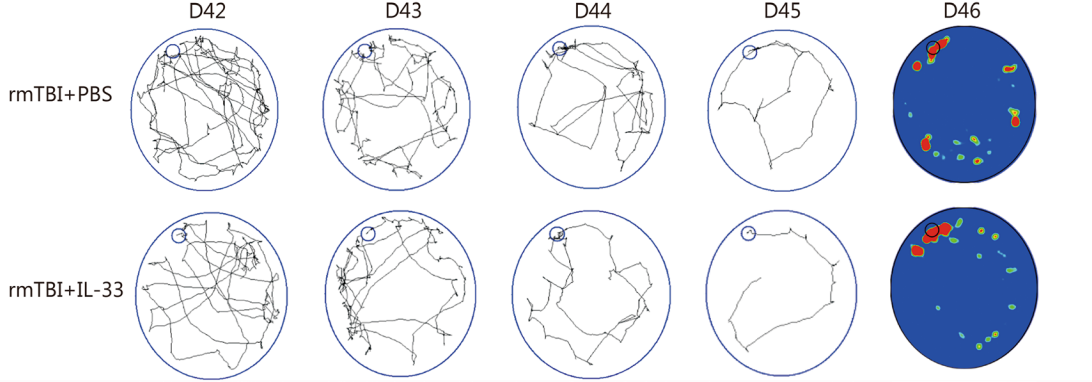
IL-33 Protein, Mouse purchased from MedChemExpress. Usage Cited in: Mil Med Res. 2025 Aug 5;12(1):46. [Abstract]
We administered exogenous recombinant IL-33 protein (2 µg per 30 g of body weight) intranasally to mice on days 0, 7, 14, 21, 28, 35, and 42 following rmTBI. The training and spatial exploration paths of mice in the Barnes maze experiment were examined from day 42 to day 46 after rmTBI.
-
MedComm (2020)
Partial reduction of interleukin-33 signaling improves senescence and renal injury in diabetic nephropathy. [Abstract]2024 Oct 24;5(11):e742. PMID: 39465143 -
-
Neurosci Bull
IL-33 Regulates the Phenotypic Transformation of Reactive Astrocytes via PENK-ERK/MAPK Pathway in Parkinson's Disease. [Abstract]2026 Jan 3. PMID: 41483148 -
Pharmaceuticals (Basel)
IL-33-Driven Macrophage Reprogramming as a Potential Immunometabolic Strategy for Herpes Simplex Keratitis. [Abstract]2026 Feb 8;19(2):285. PMID: 41754825 -
Int Immunopharmacol
The role of the IL-33/ST2/MAPK signalling pathway in macrophage polarisation and endometrial fibrosis. [Abstract]2026 Apr 26:180:116743. PMID: 42044577 -
Int Immunopharmacol
Interleukin-33 induces angiogenesis after myocardial infarction via AKT/eNOS signaling pathway. [Abstract]2024 Oct 31;143(Pt 3):113433. PMID: 39486188 -
Int Immunopharmacol
IL-33/ST2 axis promotes remodeling of the extracellular matrix and drives protective microglial responses in the mouse model of perioperative neurocognitive disorders. [Abstract]2023 Jan:114:109479. PMID: 36446234 -
Int Immunopharmacol
Follistatin-related protein 1 in asthma: miR-200b-3p interactions affect airway remodeling and inflammation phenotype. [Abstract]2022 Aug:109:108793. PMID: 35483234 -
Cell Signal
IL-33/ST2 axis delays disc degeneration through PI3K/AKT-dependent regulation of nucleus pulposus cell proliferation and apoptosis. [Abstract]2026 Aug:144:112548. PMID: 42025895 -
Mol Immunol
Luteolin attenuates type 2 inflammation in asthmatic mice induced by OVA by regulating IL-33/ST2- GSK3β-M2 macrophage polarization. [Abstract]2025 Oct:186:1-12. PMID: 40752323 -
Neuroscience
De novo Lipogenesis in Astrocytes Promotes the Repair of Blood-Brain Barrier after Transient Cerebral Ischemia Through Interleukin-33. [Abstract]2022 Jan 15:481:85-98. PMID: 34822949 -
BMC Cardiovasc Disord
Exosomes activate hippocampal microglia in atrial fibrillation through long-distance heart-brain communication. [Abstract]2024 Nov 9;24(1):627. PMID: 39516720 -
Immunol Invest
Neuroblast Differentiation-Associated Protein Derived Polypeptides: AHNAK(5758-5775) Induces Inflammation by Activating Mast Cells via ST2. [Abstract]2023 Feb;52(2):178-193. PMID: 36511894


Technical Parameters
-
Species Mouse
-
Source E. coli
-
Tag Tag Free
-
Accession
Q8BVZ5 (S109-I266)
-
Molecular Construction
-
N-term
-
IL-33 (S109-I266)
Accession # Q8BVZ5 -
C-term
-
-
Protein Length
Full Length of Interleukin-33(109-266) Chain
-
Synonyms
IL33; DVS27-Related Protein; Prev. C9orf26; Chromosome 9 Open Reading Frame 26 (NF-HEV); NF-HEV; Interleukin-1 Family, Member 11; IL1F11; Alternative Protein IL33; Interleukin-33; IL-1F11; DVS27; NFEHEV; Nuclear Factor From High Endothelial Venules; IL-33
-
AA Sequence
SIQGTSLLTQSPASLSTYNDQSVSFVLENGCYVINVDDSGKDQEQDQVLLRYYESPCPASQSGDGVDGKKLMVNMSPIKDTDIWLHANDKDYSVELQRGDVSPPEQAFFVLHKKSSDFVSFECKNLPGTYIGVKDNQLALVEEKDESCNNIMFKLSKI
-
Predicted Molecular Mass
17.6 kDa
-
Molecular Weight
Approximately 17-22 kDa, based on SDS-PAGE under reducing conditions.
-
Purity
≥ 95%, as determined by reducing SDS-PAGE.


Product Properties
Lyophilized powder
1.Lyophilized from a 0.22 μm filtered solution of PBS, 1 mM EDTA.
2.Lyophilized from a 0.22 μm filtered solution of PBS, pH 7.4.
Please refer to the lot-specific COA for specific buffer information.
<1 EU/μg, determined by LAL method.
It is not recommended to reconstitute to a concentration less than 100 μg/mL in ddH2O. For long term storage it is recommended to add a carrier protein (0.1% BSA, 5% HSA, 10% FBS or 5% Trehalose).
Stored at -20°C for 2 years from date of receipt. After reconstitution, it is stable at 4°C for 1 week or -20°C for longer (with carrier protein). It is recommended to freeze aliquots at -20°C or -80°C for extended storage.
Room temperature in continental US; may vary elsewhere.


Documentation
-
Data Sheet (262 KB)
-
SDS (254 KB)
- English - EN (254 KB)
- Français - FR (254 KB)
- Deutsch - DE (254 KB)
- Norwegian - NO (254 KB)
- Español - ES (254 KB)
- Swedish - SV (254 KB)
- Italian - IT (254 KB)
- Korean - KR (254 KB)
- Portuguese - PT (254 KB)
-
Handling Instructions (2659 KB)


References

Calculators
Concentration (start) × Volume (start) = Concentration (final) × Volume (final)


 Powered by Bioz

