



Livin/BIRC7 Protein, Human (His)

Based on 1 Customer Validation
Livin/BIRC7 is an apoptosis regulator that coordinates pro- and anti-apoptotic activities and is critical for apoptosis, cell proliferation, and cell cycle control. Its anti-apoptotic functions include inhibition of CASP3, CASP7 and CASP9, as well as E3 ubiquitin protein ligase activity. Livin/BIRC7 Protein, Human (His) is the recombinant human-derived Livin/BIRC7 protein, expressed by E. coli , with C-His labeled tag.
- Species: Human
- Source: E. coli
-
Storage:Stored at -80°C for 1 year from date of receipt. It is stable at -20°C for 3 months after opening. It is recommended to freeze aliquots at -80°C for extended storage. Avoid repeated freeze-thaw cycles.


To place orders, for customer services and technical support, please contact: MedChemExpress USA
Tel: 609-228-6898 E-mail: [email protected] [email protected]


-
 Biological Activity
-
Technical Parameters
-
Product Properties
- Documentation
- Help & FAQs




Biological Activity
Description
Livin/BIRC7 is an apoptosis regulator that coordinates pro- and anti-apoptotic activities and is critical for apoptosis, cell proliferation, and cell cycle control. Its anti-apoptotic functions include inhibition of CASP3, CASP7 and CASP9, as well as E3 ubiquitin protein ligase activity. Livin/BIRC7 Protein, Human (His) is the recombinant human-derived Livin/BIRC7 protein, expressed by E. coli , with C-His labeled tag.
Background
Livin/BIRC7, an apoptotic regulator, intricately modulates both proapoptotic and anti-apoptotic activities, holding pivotal roles in apoptosis, cell proliferation, and cell cycle control. Its anti-apoptotic prowess stems from the inhibition of CASP3, CASP7, and CASP9, coupled with its E3 ubiquitin-protein ligase activity. Despite its classification as a weak caspase inhibitor, Livin's anti-apoptotic function is attributed to its capability to ubiquitinate DIABLO/SMAC, directing it for degradation and thereby fostering cell survival. Furthermore, Livin may hinder DIABLO/SMAC from disrupting XIAP/BIRC4-caspase interactions, potentially contributing to caspase inhibition. Notably, Livin safeguards against apoptosis induced by TNF or chemical agents like adriamycin, etoposide, or staurosporine. This protective effect is facilitated through the activation of MAPK8/JNK1 and possibly MAPK9/JNK2, contingent upon TAB1 and MAP3K7/TAK1. Livin's multifaceted functions also extend to inhibiting CASP3 and impeding the proteolytic activation of pro-CASP9 in vitro, as well as blocking staurosporine-induced apoptosis. Moreover, Livin promotes natural killer (NK) cell-mediated killing, underscoring its diverse regulatory roles in cellular processes.
Verified Bioactivity
Measured by its ability to inhibit DEVD-AFC cleavage activity in cell extracts activated by addition of cytochrome c and dATP. The IC50 value is 1.223 nM, as measured under the described conditions.
MCE Validation Data
-
Purity - SDS-PAGE
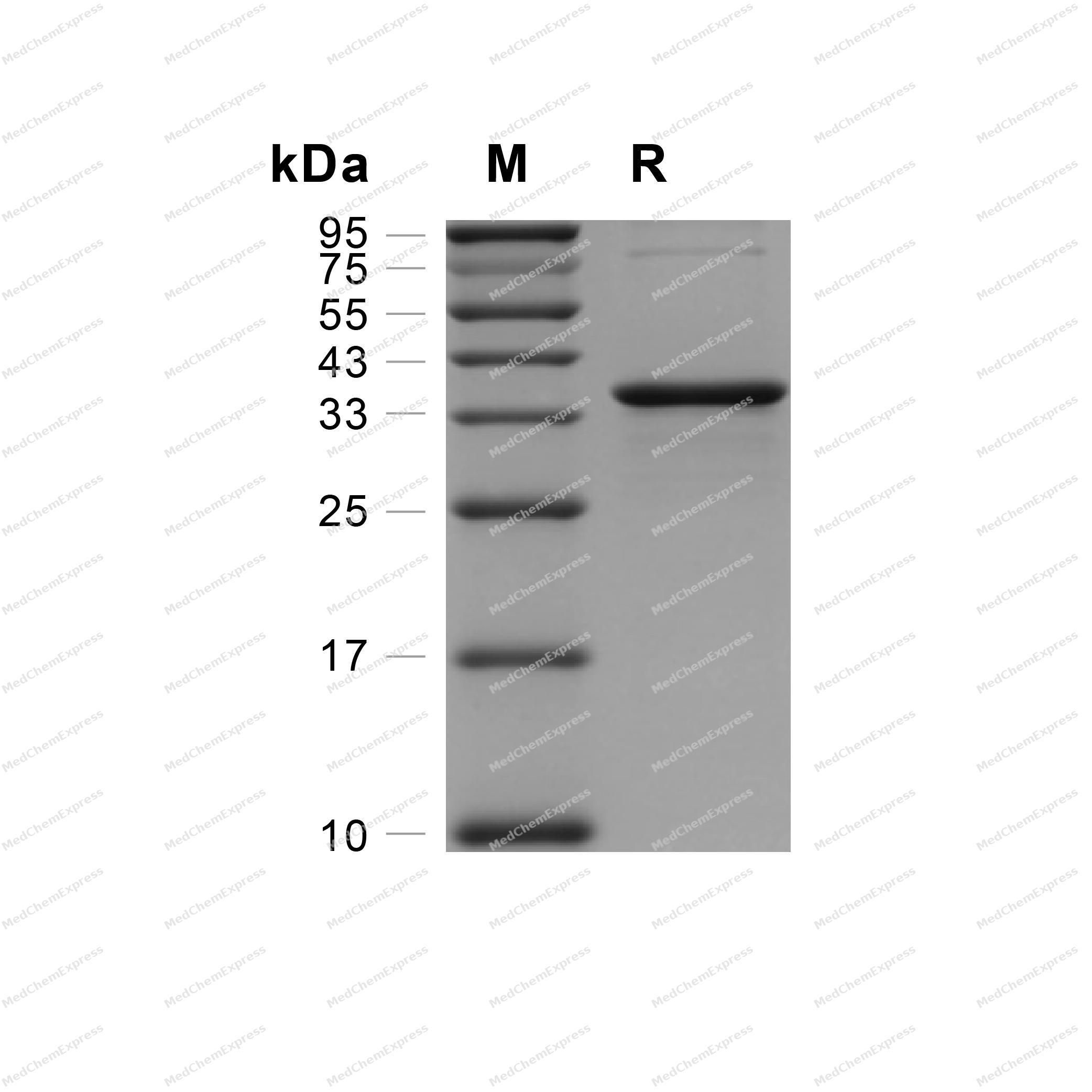
Purity - SDS-PAGE


Technical Parameters
-
Species Human
-
Source E. coli
-
Tag C-His
-
Accession
Q96CA5-1 (M1-S298)
-
Molecular Construction
-
N-term
-
Livin (M1-S298)
Accession # Q96CA5-1 -
His
-
C-term
-
-
Protein Length
Full Length of Isoform-1
-
Synonyms
BIRC7; Baculoviral IAP Repeat-Containing Protein 7; Baculoviral IAP Repeat Containing 7; RING-Type E3 Ubiquitin Transferase BIRC7; ML-IAP; RING Finger Protein 50; RNF50; Baculoviral IAP Repeat-Containing 7; KIAP; RING-Type E3 Ubiquitin Transferase; Melano
-
AA Sequence
MGPKDSAKCLHRGPQPSHWAAGDGPTQERCGPRSLGSPVLGLDTCRAWDHVDGQILGQLRPLTEEEEEEGAGATLSRGPAFPGMGSEELRLASFYDWPLTAEVPPELLAAAGFFHTGHQDKVRCFFCYGGLQSWKRGDDPWTEHAKWFPSCQFLLRSKGRDFVHSVQETHSQLLGSWDPWEEPEDAAPVAPSVPASGYPELPTPRREVQSESAQEPGGVSPAEAQRAWWVLEPPGARDVEAQLRRLQEERTCKVCLDRAVSIVFVPCGHLVCAECAPGLQLCPICRAPVRSRVRTFLS
-
Molecular Weight
Approximately 35 kDa, based on SDS-PAGE under reducing conditions.
-
Purity
≥ 95%, as determined by reducing SDS-PAGE.


Product Properties
Solution
Supplied as a 0.22 μm filtered solution of 50 mM Tris, 200 mM NaCl, pH 8.0.
Note: For SPR assay, please replace the buffer. Primary amine components (e.g., Tris, imidazole) can affect protein-coupled chips.
<1 EU/μg, determined by LAL method.
Stored at -80°C for 1 year from date of receipt. It is stable at -20°C for 3 months after opening. It is recommended to freeze aliquots at -80°C for extended storage. Avoid repeated freeze-thaw cycles.
Shipping with dry ice.


Documentation
-
Data Sheet (237 KB)
-
SDS (251 KB)
- English - EN (251 KB)
- Français - FR (251 KB)
- Deutsch - DE (251 KB)
- Norwegian - NO (251 KB)
- Español - ES (251 KB)
- Swedish - SV (251 KB)
- Italian - IT (251 KB)
- Korean - KR (251 KB)
- Portuguese - PT (251 KB)
-
Handling Instructions (2659 KB)

Calculators
Concentration (start) × Volume (start) = Concentration (final) × Volume (final)


 Powered by Bioz

