



OX40/TNFRSF4 Protein, Human (HEK293, His)
Based on 1 Customer Validation
OX40 (TNFRSF4), is a receptor for OX40 Ligand. OX40 is preferentially expressed by T cells. OX40 can be activated by OX40 Ligand, thereby functioning as a T cell co-stimulatory molecule. The OX40-OX40 Ligand interaction promotes effector T-cell survival and effectively induces memory T-cell generation, as well as enhances the helper function of Tfh for B cells, and also promotes the differentiation and maturation of DCs. OX40/TNFRSF4 Protein, Human (HEK293, His) is a recombinant human OX40 (L29-A216) with C-terminal His tag, which is produced in HEK293.
- Species: Human
- Source: HEK293
-
Storage:Stored at -20°C for 2 years from date of receipt. After reconstitution, it is stable at 4°C for 1 week or -20°C for longer (with carrier protein). It is recommended to freeze aliquots at -20°C or -80°C for extended storage.


To place orders, for customer services and technical support, please contact: MedChemExpress USA
Tel: 609-228-6898 E-mail: [email protected] [email protected]


-
 Biological Activity
-
Technical Parameters
-
Product Properties
- Documentation
- References
- Help & FAQs




Biological Activity
Description
OX40 (TNFRSF4), is a receptor for OX40 Ligand. OX40 is preferentially expressed by T cells. OX40 can be activated by OX40 Ligand, thereby functioning as a T cell co-stimulatory molecule. The OX40-OX40 Ligand interaction promotes effector T-cell survival and effectively induces memory T-cell generation, as well as enhances the helper function of Tfh for B cells, and also promotes the differentiation and maturation of DCs[1][2]. OX40/TNFRSF4 Protein, Human (HEK293, His) is a recombinant human OX40 (L29-A216) with C-terminal His tag, which is produced in HEK293.
Background
OX40 (TNFRSF4), a member of TNFR superfamily, is a receptor for OX40 Ligand. OX40 is preferentially expressed by T cells, but also found in natural killer T cells, natural killer cells, neutrophils, and human airway smooth muscle cells. Human OX40 shares <30% aa sequence identity with mouse and rat. Mouse OX40 shares 90% aa sequence identity with rat[1].
OX40 Ligand can activate OX40 and thereby functioning as a T cell co-stimulatory molecule. The OX40-OX40 Ligand interaction promotes effector T-cell survival and effectively induces memory T-cell generation, as well as enhances the helper function of Tfh for B cells, and also promotes the differentiation and maturation of DCs[1][2].
The interaction between OX40 Ligand with OX40 is essential for the generation of antigen-specific memory T cells, and induces host antitumor immunity[3]. But the over-upregulation of OX40 and OX40L may induce abnormal activation of Tfh cells and excessive production of autoantibodies, which leads to autoimmune disease[1].
In Vitro
OX40 increases expression of RANTES protein in HUVECs[4].
Verified Bioactivity
1.2 µg/mL (100 µL/well) of immoblized recombinant human OX40/TNFRSF4-His can bind human Biotin-OX40L-His with a linear range of 1-20 ng/mL.
2.Immobilized Mouse OX40L-His at 10 μg/mL (100 μL/well) can bind Human OX40-6*His: Biotinylated by NHS-biotin prior to testing The ED50 of Recombinant Human OX40-6His is ≤9 μg/mL.
3.Loaded Telazorlimab (HY-P99570) on AHC2 biosensor, can bind OX40/TNFRSF4 Protein, Human (HEK293, His) with an affinity constant of 2.951E-08 M as determined in BLI assay.
4.Immobilized Recombinant Mouse OX40L-Fc at 5 μg/mL (100 μL/well) can bind Recombinant Human OX40-6His.The ED50 of Recombinant Human OX40-6His is 1.0-10.0 μg/mL.
MCE Validation Data
-
Bioactivity - BLI
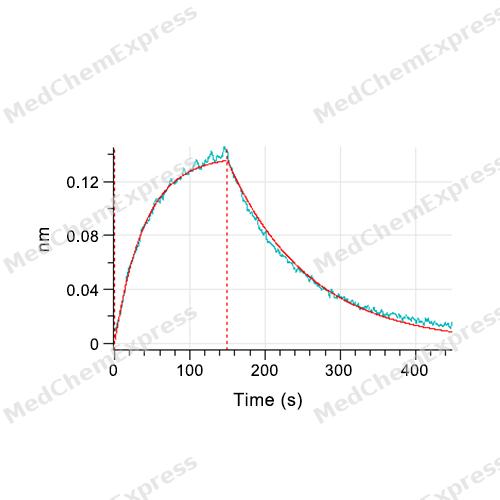
Bioactivity - BLI


Technical Parameters
-
Species Human
-
Source HEK293
-
Tag C-His
-
Accession
P43489 (L29-A216)
-
Molecular Construction
-
N-term
-
OX40 (L29-A216)
Accession # P43489 -
His
-
C-term
-
-
Protein Length
Extracellular Domain
-
Synonyms
TNFRSF4; CD134 Antigen; Prev. TXGP1L; Tumor Necrosis Factor Receptor Superfamily, Member 4; Tumor Necrosis Factor Receptor Superfamily Member 4; Lymphoid Activation Antigene ACT35; OX40L Receptor; OX40 Cell Surface Antigen; ACT35; OX40 Homologue; CD134; A
-
AA Sequence
LHCVGDTYPSNDRCCHECRPGNGMVSRCSRSQNTVCRPCGPGFYNDVVSSKPCKPCTWCNLRSGSERKQLCTATQDTVCRCRAGTQPLDSYKPGVDCAPCPPGHFSPGDNQACKPWTNCTLAGKHTLQPASNSSDAICEDRDPPATQPQETQGPPARPITVQPTEAWPRTSQGPSTRPVEVPGGRAVA
-
Predicted Molecular Mass
21 kDa
-
Molecular Weight
Approximately 35-45 kDa, based on SDS-PAGE under reducing conditions, due to the glycosylation.
-
Glycosylation
Yes
-
Purity
≥ 95%, as determined by reducing SDS-PAGE.


Product Properties
Lyophilized powder.
Lyophilized from a 0.22 μm filtered solution of PBS, pH 7.4.
<1 EU/μg, determined by LAL method.
It is not recommended to reconstitute to a concentration less than 100 μg/mL in ddH2O. For long term storage it is recommended to add a carrier protein (0.1% BSA, 5% HSA, 10% FBS or 5% Trehalose).
Stored at -20°C for 2 years from date of receipt. After reconstitution, it is stable at 4°C for 1 week or -20°C for longer (with carrier protein). It is recommended to freeze aliquots at -20°C or -80°C for extended storage.
Room temperature in continental US; may vary elsewhere.


Documentation
-
Data Sheet (264 KB)
-
SDS (252 KB)
- English - EN (252 KB)
- Français - FR (252 KB)
- Deutsch - DE (252 KB)
- Norwegian - NO (252 KB)
- Español - ES (252 KB)
- Swedish - SV (252 KB)
- Italian - IT (252 KB)
- Korean - KR (252 KB)
- Portuguese - PT (252 KB)
-
Handling Instructions (2659 KB)


References
[1]. Kaur D, et al. OX40/OX40 ligand interactions in T-cell regulation and asthma. Chest. 2012 Feb;141(2):494-499. [Content Brief]
[2]. TNFRSF4 TNF receptor superfamily member 4 [ Homo sapiens (human) ]
[3]. Fu N, et al. The OX40/OX40L Axis Regulates T Follicular Helper Cell Differentiation: Implications for Autoimmune Diseases. Front Immunol. 2021 Jun 21;12:670637. [Content Brief]
[4]. Buglio D, et al. HDAC11 plays an essential role in regulating OX40 ligand expression in Hodgkin lymphoma. Blood. 2011 Mar 10;117(10):2910-7. [Content Brief]
[5]. Kotani A, et al. Signaling of gp34 (OX40 ligand) induces vascular endothelial cells to produce a CC chemokine RANTES/CCL5. Immunol Lett. 2002 Oct 21;84(1):1-7. [Content Brief]

Calculators
Concentration (start) × Volume (start) = Concentration (final) × Volume (final)


 Powered by Bioz

