



PD-1 Protein, Human (HEK293, His)
Based on 2 publication(s) in Google Scholar
PD-1 Protein, Human (HEK293, His) suppress activating signals from the T cell receptor when bound by either of its ligands, programmed death-ligand 1 (PD-L1) or PD-L2.
- Species: Human
- Source: HEK293
-
Storage:Stored at -20°C for 2 years from date of receipt. After reconstitution, it is stable at 4°C for 1 week or -20°C for longer (with carrier protein). It is recommended to freeze aliquots at -20°C or -80°C for extended storage.


To place orders, for customer services and technical support, please contact: MedChemExpress USA
Tel: 609-228-6898 E-mail: [email protected] [email protected]


-
 Biological Activity
-
Technical Parameters
-
Product Properties
- Documentation
- References
- Help & FAQs


-

HY-P73361
PD-L1 Protein, Human (HEK293) -
HY-P7110A
VEGF165 Protein, Human (HEK293) -
HY-W090090
BODIPY 493/503 -

HY-P9904
Atezolizumab -
HY-P7398
PD-L1 Protein, Human (HEK293, His) -
HY-P70640
PD-1 Protein, Mouse (HEK293, His) -
HY-P70631
IL-2R beta/CD122 Protein, Human (HEK293, His) -
HY-P70632
PD-L1 Protein, Mouse (HEK293, His) -
HY-P74522
TGFBR1/ALK-5 Protein, Human (Active, sf9, His-GST) -
HY-P75424
CD28 Protein, Human/Cynomolgus/Rhesus Macaque (HEK293, C-His) -
HY-P70684
CTLA-4 Protein, Human (HEK293, His) -
HY-P7397
PD-L1 Protein, Human (CHO, Fc)


Biological Activity
Description
PD-1 Protein, Human (HEK293, His) suppress activating signals from the T cell receptor when bound by either of its ligands, programmed death-ligand 1 (PD-L1) or PD-L2.
Background
Programmed death-1 (PD-1) is a receptor on T cells that has been shown to suppress activating signals from the T cell receptor when bound by either of its ligands, programmed death-ligand 1 (PD-L1) or PD-L2. When PD-1 expressing T cells contact cells expressing its ligands, functional activities in response to antigenic stimuli, including proliferation, cytokine secretion, and cytotoxicity are reduced[1].
Verified Bioactivity
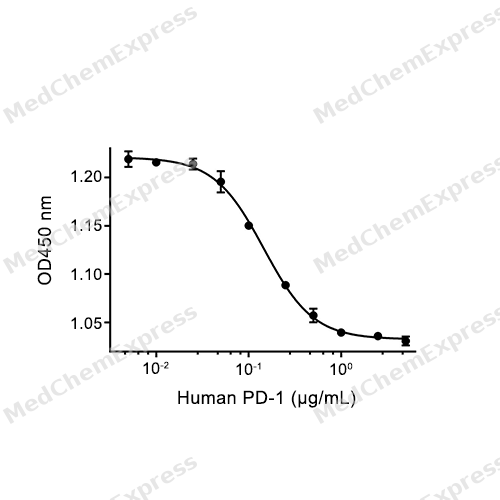
1. Measured by its ability to inhibit proliferation of HT-29 cells. The ED50 this effect is 0.1452 μg/mL, corresponding to a specific activity is 6.89×10³ units/mg.
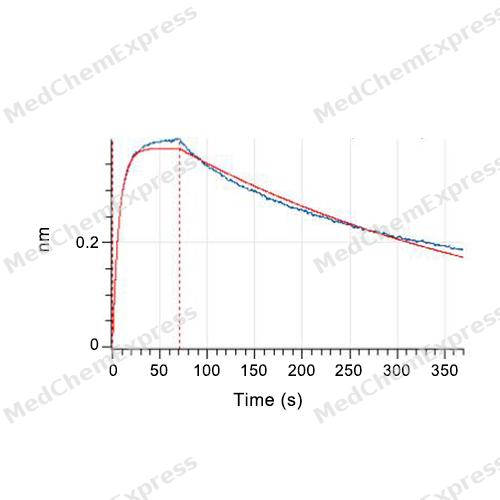
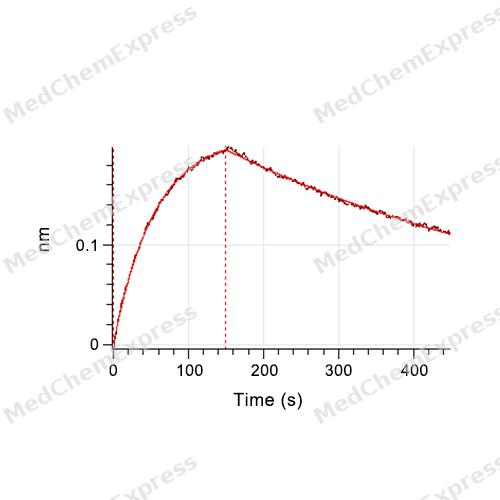
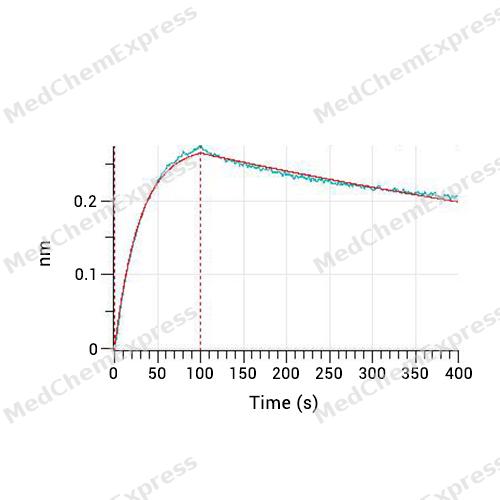
2. Loaded Pembrolizumab (HY-P9902) on AHC2 biosensor, can bind PD-1 Protein, Human (143a.a, HEK293, His) with an affinity constant of 1.898E-09 M as determined in BLI assay.
3. Loaded Ivonescimab (HY-P99675) on AHC2 biosensor, can bind PD-1 Protein, Human (143a.a, HEK293, His) with an affinity constant of 5.804E-08 M as determined in BLI assay.
4. Loaded Rosnilimab (HY-P9997) on AHC2 biosensor, can bind PD-1 Protein, Human (143a.a, HEK293, His) with an affinity constant of 2.896E-09 M as determined in BLI assay.
5. Measured by its binding ability in a functional ELISA. Immobilized Human PD-1 Protein at 2 µg/mL (100µL/well) can bind Biotinylated Human PD-L1 Protein. The ED50 for this effect is 100-500 ng/mL.
6. Immobilized PD-1 Protein, Human can bind IBI-363 (HY-P991740). The ED50 for this effect is 4.714 ng/mL.
7. Human PD-L1 Protein (HY-P73361)immobilized on CM5 Sensor Chip can Human PD-1 Protein with an affinity constant of 1.0-5.0 μM as determined in a SPR assay.
MCE Validation Data
-
Purity - SDS-PAGE
Purity - SDS-PAGE
-
Bioactivity - Cell-Based Assay
Bioactivity - Cell-Based Assay
-
Bioactivity - ELISA

Bioactivity - ELISA
-
Bioactivity - BLI
Bioactivity - BLI
-
Bioactivity - BLI
Bioactivity - BLI
-
Bioactivity - BLI
Bioactivity - BLI


Publications (2)
-
Journal Impact Factor
-
Most Recent
-
Cell Rep Med
Glycoengineering-based anti-PD-1-iRGD peptide conjugate boosts antitumor efficacy through T cell engagement. [Abstract]2024 Jun 18;5(6):101590. PMID: 38843844 -
J Nutr Biochem
Docosahexaenoic acid reverses PD-L1-mediated immune suppression by accelerating its ubiquitin-proteasome degradation. [Abstract]2023 Feb:112:109186. PMID: 36309154


Technical Parameters
-
Species Human
-
Source HEK293
-
Tag C-His
-
Accession
Q15116 (L25-Q167)
-
Molecular Construction
-
N-term
-
PD-1 (L25-Q167)
Accession # Q15116 -
His
-
C-term
-
-
Protein Length
Extracellular Domain
-
Synonyms
PDCD1; Systemic Lupus Erythematosus Susceptibility 2; Prev. SLEB2; HPD-1; PD1; Programmed Cell Death 1 Protein; Programmed Cell Death Protein 1; CD279 Antigen; CD279; ADMIO4; HSLE1; AIMTBS; PD-1; HPD-L; Programmed Cell Death 1; Protein PD-1
-
AA Sequence
LDSPDRPWNPPTFSPALLVVTEGDNATFTCSFSNTSESFVLNWYRMSPSNQTDKLAAFPEDRSQPGQDCRFRVTQLPNGRDFHMSVVRARRNDSGTYLCGAISLAPKAQIKESLRAELRVTERRAEVPTAHPSPSPRPAGQFQ
-
Molecular Weight
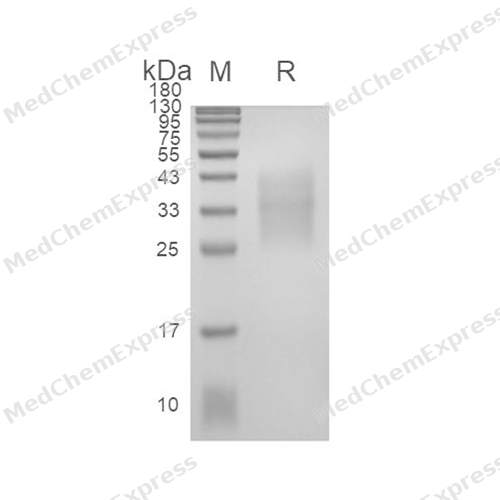
Approximately 25-41 kDa, based on SDS-PAGE under reducing conditions, due to the glycosylation.
-
Glycosylation
Yes
-
Purity
≥ 95%, as determined by reducing SDS-PAGE.


Product Properties
Lyophilized powder
1.Lyophilized from a 0.22 μm filtered solution of PBS, 5% trehalose, mannitol.
2.Lyophilized from a 0.22 μm filtered solution of 20 mM PB, 150 mM NaCl, pH 7.4.
Please refer to the lot-specific COA for specific buffer information.
<1 EU/μg, determined by LAL method.
It is not recommended to reconstitute to a concentration less than 100 μg/mL in ddH2O. For long term storage it is recommended to add a carrier protein (0.1% BSA, 5% HSA, 10% FBS or 5% Trehalose).
Stored at -20°C for 2 years from date of receipt. After reconstitution, it is stable at 4°C for 1 week or -20°C for longer (with carrier protein). It is recommended to freeze aliquots at -20°C or -80°C for extended storage.
Room temperature in continental US; may vary elsewhere.


Documentation
-
Data Sheet (262 KB)
-
SDS (251 KB)
- English - EN (251 KB)
- Français - FR (251 KB)
- Deutsch - DE (251 KB)
- Norwegian - NO (251 KB)
- Español - ES (251 KB)
- Swedish - SV (251 KB)
- Italian - IT (251 KB)
- Korean - KR (251 KB)
- Portuguese - PT (251 KB)
-
Handling Instructions (2659 KB)


References

Calculators
Concentration (start) × Volume (start) = Concentration (final) × Volume (final)


 Powered by Bioz

