



PLA2G1B Protein, Mouse (HEK293, His)

Based on 1 Customer Validation
The PLA2G1B protein is a secreted calcium-dependent phospholipase A2 that targets dietary phospholipids in the intestine.Phosphatidylethanolamine and phosphatidylglycerol are preferred, which hydrolyze the ester bond of the fatty acyl group at the sn-2 position.PLA2G1B Protein, Mouse (HEK293, His) is the recombinant mouse-derived PLA2G1B protein, expressed by HEK293 , with C-6*His labeled tag.
- Species: Mouse
- Source: HEK293
-
Storage:Stored at -80°C for 1 year from date of receipt. It is stable at -20°C for 3 months after opening. It is recommended to freeze aliquots at -80°C for extended storage. Avoid repeated freeze-thaw cycles.


To place orders, for customer services and technical support, please contact: MedChemExpress USA
Tel: 609-228-6898 E-mail: [email protected] [email protected]


-
 Biological Activity
-
Technical Parameters
-
Product Properties
- Documentation
- Help & FAQs




Biological Activity
Description
The PLA2G1B protein is a secreted calcium-dependent phospholipase A2 that targets dietary phospholipids in the intestine.Phosphatidylethanolamine and phosphatidylglycerol are preferred, which hydrolyze the ester bond of the fatty acyl group at the sn-2 position.PLA2G1B Protein, Mouse (HEK293, His) is the recombinant mouse-derived PLA2G1B protein, expressed by HEK293 , with C-6*His labeled tag.
Background
PLA2G1B is a secretory calcium-dependent phospholipase A2 that predominantly targets dietary phospholipids in the intestinal tract. Exhibiting phospholipase A2 activity, it hydrolyzes the ester bond of the fatty acyl group at the sn-2 position of phospholipids, with a preference for phosphatidylethanolamines and phosphatidylglycerols over phosphatidylcholines. PLA2G1B may play a crucial role in the biosynthesis of N-acyl ethanolamines, regulating energy metabolism and inflammation in the intestinal tract. It acts in an autocrine and paracrine manner and, upon binding to the PLA2R1 receptor, can regulate podocyte survival and glomerular homeostasis. Additionally, PLA2G1B exhibits anti-helminth activity, impacting the integrity and infectivity of helminth larvae by directly affecting phosphatidylethanolamine contents in their membranes during intestinal epithelia infection, a process regulated by gut microbiota.
Verified Bioactivity
The enzyme activity of this recombinant protein is testing in progress, we cannot offer a guarantee yet.
MCE Validation Data
-
Purity - SDS-PAGE
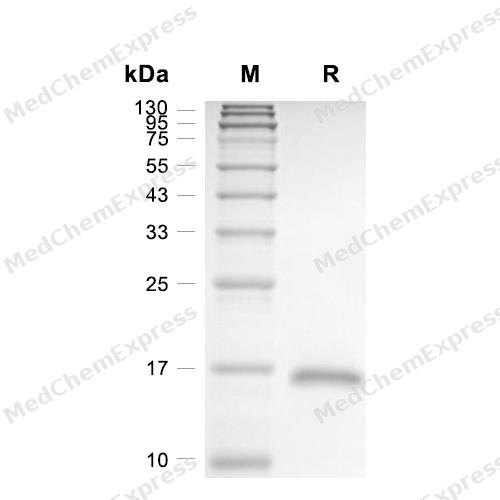
Purity - SDS-PAGE

Assay Procedure
Materials
Assay buffer: 50 mM HEPES, 1 mg/mL BSA, pH 7.0
Substrate buffer: 50 mM HEPES, 20 mM CaCl?, 1 mg/mL BSA, pH 7.0
PLA2G1B Protein, Mouse (HEK293, His) (HY-P71212)
Trypsin
Substrate: 1-hexadecanoyl-2-(1-pyrenedecanoyl)-sn-glycero-3-phosphocholine (16:0-Pyr PC). Dilute to 2 mM in DMSO first, then dilute to a final stock concentration of 400 μM in ethanol
Standard: 1-Pyrenedecanoic Acid
Procedure
1. Preparation of standard curve: Dilute the standard with assay buffer to concentrations of 0, 0.1, 1, 2.5, 5, 10, 25, 50, and 100 μM. Add 100 μL of each dilution to a 96-well black microplate, and read the fluorescence intensity in endpoint mode with excitation and emission wavelengths of 345 nm and 395 nm (top read).
2. Thaw the frozen substrate at 37°C for 5 minutes and mix well.
3. Dilute Mouse PLA2G1B protein to 100 μg/mL in assay buffer.
4. Dilute trypsin to 0.5 μg/mL in assay buffer.
5. Mixture preparation: Mix equal volumes of diluted trypsin and Mouse PLA2G1B protein, and incubate at room temperature for 30 minutes.
6. Dilute the substrate to 100 μM in substrate buffer.
Experimental group: 50 μL mixture + 50 μL substrate.
Blank group: 50 μL assay buffer + 50 μL substrate.
7. Read in kinetic mode for 5 minutes with excitation and emission wavelengths of 345 nm and 395 nm (top read) respectively.
8. Calculate the specific activity:
Specific Activity (pmol/min/μg) = | Adjusted Vmax* (RFU/min) x Conversion Factor ** (pmol/RFU) |
| amount of enzyme (μg) |
*Adjusted for Substrate Blank
**Derived using calibration standard
Per Well:
Mouse PLA2G1B: 5 μg
Substrate: 50 μM


Technical Parameters
-
Species Mouse
-
Source HEK293
-
Tag C-6*His
-
Accession
Q9Z0Y2 (A16-C146)
-
Molecular Construction
-
N-term
-
PLA2G1B (A16-C146)
Accession # Q9Z0Y2 -
6*His
-
C-term
-
-
Protein Length
Full Length of Mature Protein
-
Synonyms
PLA2G1B; Phospholipase A2; Prev. PLA2A; Phospholipase A2, Group IB (Pancreas); Prev. PPLA2; Group IB Phospholipase A2; Prev. PLA2; Phospholipase A2 Group IB; Phosphatidylcholine 2-Acylhydrolase 1B
-
AA Sequence
AHSISPRAVWQFRNMIKCTIPGSDPLKDYNNYGCYCGLGGWGTPVDDLDRCCQTHDHCYSQAKKLESCKFLIDNPYTNTYSYSCSGSEITCSAKNNKCEDFICNCDREAAICFSKVPYNKEYKNLDTGKFC
-
Predicted Molecular Mass
15.6 kDa
-
Molecular Weight
Approximately 15-18 kDa, based on SDS-PAGE under reducing conditions, due to the glycosylation.
-
Purity
≥ 95%, as determined by reducing SDS-PAGE.


Product Properties
Solution
Supplied as a 0.22 μm filtered solution of 20 mM HEPES, 150 mM NaCl, pH 7.0.
<1 EU/μg, determined by LAL method.
Stored at -80°C for 1 year from date of receipt. It is stable at -20°C for 3 months after opening. It is recommended to freeze aliquots at -80°C for extended storage. Avoid repeated freeze-thaw cycles.
Shipping with dry ice.


Documentation
-
Data Sheet (236 KB)
-
SDS (252 KB)
- English - EN (252 KB)
- Français - FR (252 KB)
- Deutsch - DE (252 KB)
- Norwegian - NO (252 KB)
- Español - ES (252 KB)
- Swedish - SV (252 KB)
- Italian - IT (252 KB)
- Korean - KR (252 KB)
- Portuguese - PT (252 KB)
-
Handling Instructions (2659 KB)

Calculators
Concentration (start) × Volume (start) = Concentration (final) × Volume (final)


 Powered by Bioz

