



Podoplanin Protein, Rat (HEK293, hFc)
Based on 1 Customer Validation
The Podoplanin protein coordinates migration and adhesion by interacting with partners such as CLEC1B and CD9. It aids in blood vessel separation, platelet activation and platelet aggregation. Podoplanin Protein, Rat (HEK293, hFc) is the recombinant rat-derived Podoplanin protein, expressed by HEK293 , with C-hFc labeled tag.
- Species: Rat
- Source: HEK293
-
Storage:Stored at -20°C for 2 years from date of receipt. After reconstitution, it is stable at 4°C for 1 week or -20°C for longer (with carrier protein). It is recommended to freeze aliquots at -20°C or -80°C for extended storage.


To place orders, for customer services and technical support, please contact: MedChemExpress USA
Tel: 609-228-6898 E-mail: [email protected] [email protected]


-
 Biological Activity
-
Technical Parameters
-
Product Properties
- Documentation
- Help & FAQs




Biological Activity
Description
The Podoplanin protein coordinates migration and adhesion by interacting with partners such as CLEC1B and CD9. It aids in blood vessel separation, platelet activation and platelet aggregation. Podoplanin Protein, Rat (HEK293, hFc) is the recombinant rat-derived Podoplanin protein, expressed by HEK293 , with C-hFc labeled tag.
Background
Podoplanin, a multifaceted protein, orchestrates diverse cellular functions related to migration and adhesion through its interactions with various partners. In developmental processes, it contributes to the separation of blood and lymphatic vessels by binding CLEC1B, activating platelets, and inducing platelet activation or aggregation. Conversely, its interaction with CD9 attenuates platelet aggregation and pulmonary metastasis induced by Podoplanin. Furthermore, Podoplanin plays a crucial role in epithelial-mesenchymal transition (EMT) by promoting ERZ phosphorylation and triggering RHOA activation through interactions with MSN or EZR, leading to increased cell migration and invasiveness. Its binding with CD44 facilitates directional cell migration in epithelial and tumor cells. Within lymph nodes, Podoplanin controls fibroblastic reticular cells (FRCs) adhesion to the extracellular matrix (ECM) and actomyosin contraction by maintaining ERM proteins (EZR, MSN, and RDX) and MYL9 activation. Engagement with CLEC1B promotes FRC relaxation by blocking lateral membrane interactions. Additionally, Podoplanin participates in connecting lymphatic endothelium to the ECM through binding with LGALS8. In keratinocytes, it induces morphological changes, including an elongated shape and increased motility. Podoplanin also regulates invadopodia stability and maturation in tumor cells, influencing extracellular matrix degradation. Moreover, it is essential for normal lung cell proliferation and alveolus formation at birth. Podoplanin exhibits homodimeric structure and interacts with various proteins, including CLEC1B, CD9, LGALS8, HSPA9, CD44, MSN, EZR, and CCL21, playing a critical role in mediating diverse cellular functions.
Verified Bioactivity
Measured by its binding ability in a functional ELISA. Immobilized Rat Podoplanin at 10 μg/mL (100 μL/well) can bind biotinylated Human CLEC2B. The ED50 for this effect is 0.4651 μg/mL.
MCE Validation Data
-
Purity - SDS-PAGE
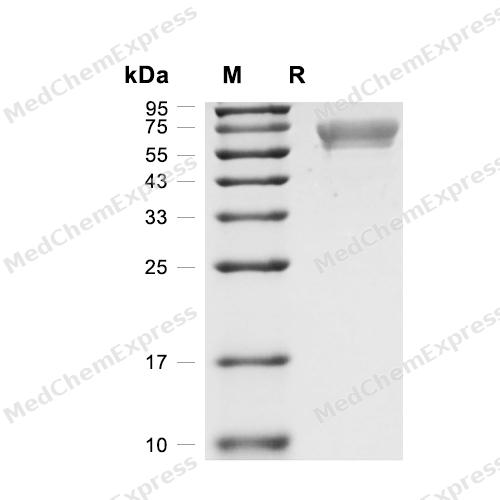
Purity - SDS-PAGE
-
Bioactivity - ELISA
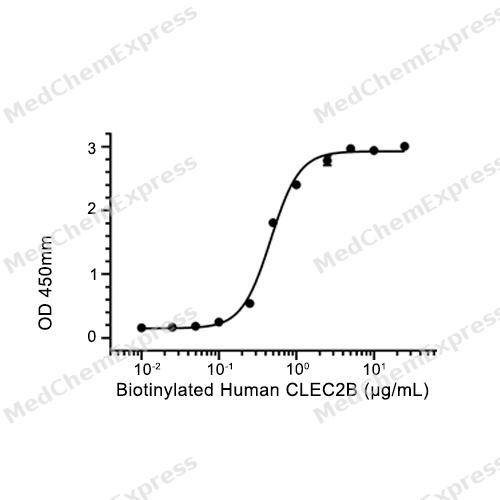
Bioactivity - ELISA


Technical Parameters
-
Species Rat
-
Source HEK293
-
Tag C-hFc
-
Accession
Q64294 (G23-L135)
-
Molecular Construction
-
N-term
-
Podoplanin (G23-L135)
Accession # Q64294 -
hFc
-
C-term
-
-
Protein Length
Extracellular Domain
-
Synonyms
PDPN; GP36; Podoplanin; T1A; Aggrus; Lung Type-I Cell Membrane-Associated Glycoprotein (T1A-2); PA2.26; Glycoprotein, 36-KD; T1A-2; HT1alpha-1; D2-40; HT1alpha-2; Gp38; HT1A-1; GP40; OTS8; Lung Type I Cell Membrane Associated Glycoprotein; T1A2; Glycoprot
-
AA Sequence
GAIGALEDDLVTPGPGDDMVNPGLEDRIETTDTTGELDKSTAKAPLVPTQPPIEELPTSGTSDHDHKEHESTTTVKAVTSHSTDKKTTHPNRDNAGGETQTTDKKDGLAVVTL
-
Molecular Weight
Approximately 55-70 kDa
-
Purity
≥ 95%, as determined by reducing SDS-PAGE.


Product Properties
Lyophilized powder.
Lyophilized from a 0.22 μm filtered solution of PBS, pH 7.4.
<1 EU/μg, determined by LAL method.
It is not recommended to reconstitute to a concentration less than 100 μg/mL in ddH2O. For long term storage it is recommended to add a carrier protein (0.1% BSA, 5% HSA, 10% FBS or 5% Trehalose).
Stored at -20°C for 2 years from date of receipt. After reconstitution, it is stable at 4°C for 1 week or -20°C for longer (with carrier protein). It is recommended to freeze aliquots at -20°C or -80°C for extended storage.
Room temperature in continental US; may vary elsewhere.


Documentation
-
Data Sheet (261 KB)
-
SDS (251 KB)
- English - EN (251 KB)
- Français - FR (251 KB)
- Deutsch - DE (251 KB)
- Norwegian - NO (251 KB)
- Español - ES (251 KB)
- Swedish - SV (251 KB)
- Italian - IT (251 KB)
- Korean - KR (251 KB)
- Portuguese - PT (251 KB)
-
Handling Instructions (2659 KB)

Calculators
Concentration (start) × Volume (start) = Concentration (final) × Volume (final)


 Powered by Bioz

