



S100A8 Protein, Rat (His)
Based on 4 publication(s) in Google Scholar
S100A8 protein functions as a danger signal in inflammation, activating innate immune cells by binding to receptors like Toll-like receptor 4 (TLR4) and receptor for advanced glycation endproducts (AGER). This triggers signaling pathways that enhance the pro-inflammatory response. S100A8 Protein, Rat (His) is the recombinant rat-derived S100A8 protein, expressed by E. coli , with C-6*His labeled tag.
- Species: Rat
- Source: E. coli
-
Storage:Stored at -20°C for 2 years from date of receipt. After reconstitution, it is stable at 4°C for 1 week or -20°C for longer (with carrier protein). It is recommended to freeze aliquots at -20°C or -80°C for extended storage.


To place orders, for customer services and technical support, please contact: MedChemExpress USA
Tel: 609-228-6898 E-mail: [email protected] [email protected]


-
 Biological Activity
-
Technical Parameters
-
Product Properties
- Documentation
- Help & FAQs




Biological Activity
Description
S100A8 protein functions as a danger signal in inflammation, activating innate immune cells by binding to receptors like Toll-like receptor 4 (TLR4) and receptor for advanced glycation endproducts (AGER). This triggers signaling pathways that enhance the pro-inflammatory response. S100A8 Protein, Rat (His) is the recombinant rat-derived S100A8 protein, expressed by E. coli , with C-6*His labeled tag.
Background
S100A8 is a molecule that plays a role in inflammation and immune response. It acts as a danger signal and stimulates innate immune cells by binding to receptors such as Toll-like receptor 4 (TLR4) and receptor for advanced glycation endproducts (AGER). This binding activates signaling pathways that amplify the pro-inflammatory response.
MCE Validation Data
-
Purity - SDS-PAGE
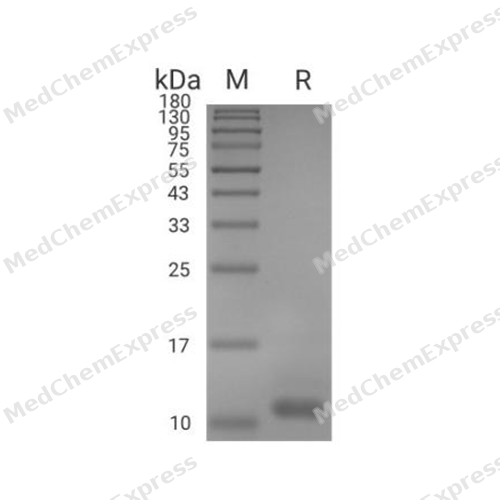
Purity - SDS-PAGE


Publications (4)
-
Journal Impact Factor
-
Most Recent
-
Brain Pathol
Fra-1 induces apoptosis and neuroinflammation by targeting S100A8 to modulate TLR4 pathways in spinal cord ischemia/reperfusion injury. [Abstract]2023 Jan;33(1):e13113. PMID: 36634215 -
Sci Rep
S100A8 regulated by estrogen improves injured endometrial epithelium reconstruction by promoting tight junction formation and stromal cell transformation. [Abstract]2025 Jul 1;15(1):21506. PMID: 40596550 -
J Inflamm Res
Catalpol Alleviates HFpEF via Inhibition of the S100A8-RAGE-NOX4 Inflammatory Axis in Murine Hearts. [Abstract]2025 Dec 8:18:17143-17161. PMID: 41394898 -
FASEB J
TRPA1 deficiency aggravates dilated cardiomyopathy by promoting S100A8 expression to induce M1 macrophage polarization in rats. [Abstract]2023 Jun;37(6):e22982. PMID: 37219522


Technical Parameters
-
Species Rat
-
Source E. coli
-
Tag C-6*His
-
Accession
P50115 (M1-E89)
-
Molecular Construction
-
N-term
-
S100A8 (M1-E89)
Accession # P50115 -
6*His
-
C-term
-
-
Protein Length
Full Length
-
Synonyms
S100A8; MRP-8; Prev. CAGA; Urinary Stone Protein Band A; Prev. CFAG; Protein S100-A8; MRP8; Calgranulin A; P8; S100 Calcium-Binding Protein A8; Migration Inhibitory Factor-Related Protein 8; Calgranulin-A; Leukocyte L1 Complex Light Chain; CP-10; Calprote
-
AA Sequence
MATELEKALSNVIEVYHNYSGIKGNHHALYRDDFRKMVTTECPQFVQNKNTESLFKELDVNSDNAINFEEFLVLVIRVGVAAHKDSHKE
-
Predicted Molecular Mass
11.3 kDa
-
Molecular Weight
Approximately 13 kDa, based on SDS-PAGE under reducing conditions.
-
Purity
≥ 95%, as determined by reducing SDS-PAGE.


Product Properties
Lyophilized powder.
Lyophilized from a 0.22 μm filtered solution of 20 mM Tris-HCl, pH 8.0.
Note: For SPR assay, please replace the buffer. Primary amine components (e.g., Tris, imidazole) can affect protein-coupled chips.
<1 EU/μg, determined by LAL method.
It is not recommended to reconstitute to a concentration less than 100 μg/mL in ddH2O. For long term storage it is recommended to add a carrier protein (0.1% BSA, 5% HSA, 10% FBS or 5% Trehalose).
Stored at -20°C for 2 years from date of receipt. After reconstitution, it is stable at 4°C for 1 week or -20°C for longer (with carrier protein). It is recommended to freeze aliquots at -20°C or -80°C for extended storage.
Room temperature in continental US;may vary elsewhere.


Documentation
-
Data Sheet (235 KB)
-
SDS (251 KB)
- English - EN (251 KB)
- Français - FR (251 KB)
- Deutsch - DE (251 KB)
- Norwegian - NO (251 KB)
- Español - ES (251 KB)
- Swedish - SV (251 KB)
- Italian - IT (251 KB)
- Korean - KR (251 KB)
- Portuguese - PT (251 KB)
-
Handling Instructions (2659 KB)

Calculators
Concentration (start) × Volume (start) = Concentration (final) × Volume (final)


 Powered by Bioz

