



S100A9 Protein, Human (His)

Based on 1 Customer Validation
The S100A9 protein is a calcium and zinc binder that plays a critical regulatory role in inflammation and immune responses. Its diverse functions include induction of neutrophil chemotaxis, adhesion, enhanced bactericidal activity through SYK, PI3K/AKT and ERK1/2 activation, and promotion of phagocytosis. S100A9 Protein, Human (His) is the recombinant human-derived S100A9 protein, expressed by E. coli , with N-6*His labeled tag.
- Species: Human
- Source: E. coli
-
Storage:Stored at -20°C for 2 years from date of receipt. After reconstitution, it is stable at 4°C for 1 week or -20°C for longer (with carrier protein). It is recommended to freeze aliquots at -20°C or -80°C for extended storage.


To place orders, for customer services and technical support, please contact: MedChemExpress USA
Tel: 609-228-6898 E-mail: [email protected] [email protected]


-
 Biological Activity
-
Technical Parameters
-
Product Properties
- Documentation
- Help & FAQs




Biological Activity
Description
The S100A9 protein is a calcium and zinc binder that plays a critical regulatory role in inflammation and immune responses. Its diverse functions include induction of neutrophil chemotaxis, adhesion, enhanced bactericidal activity through SYK, PI3K/AKT and ERK1/2 activation, and promotion of phagocytosis. S100A9 Protein, Human (His) is the recombinant human-derived S100A9 protein, expressed by E. coli , with N-6*His labeled tag.
Background
S100A9, a calcium- and zinc-binding protein, plays a pivotal role in regulating inflammatory processes and immune responses. Its diverse functions include inducing neutrophil chemotaxis, adhesion, and enhancing the bactericidal activity of neutrophils through SYK, PI3K/AKT, and ERK1/2 activation, as well as promoting phagocytosis. Often found in the form of calprotectin (S100A8/A9), it serves intra- and extracellular roles, including facilitating leukocyte arachidonic acid trafficking and NADPH-oxidase activation intracellularly. Extracellularly, it exhibits pro-inflammatory, antimicrobial, oxidant-scavenging, and apoptosis-inducing activities, recruiting leukocytes, promoting cytokine and chemokine production, and regulating leukocyte adhesion and migration. Functioning as an alarmin or DAMP molecule, S100A9 stimulates innate immune cells via Toll-like receptor 4 (TLR4) and receptor for advanced glycation endproducts (AGER), activating MAP-kinase and NF-kappa-B signaling pathways. With antimicrobial activity against bacteria and fungi, it likely acts by chelating Zn(2+), essential for microbial growth. S100A9 can induce cell death through autophagy and apoptosis via mitochondrial-lysosomal cross-talk involving BNIP3 and regulates neutrophil number and apoptosis, acting as an anti-apoptotic factor. Its role as an oxidant scavenger protects against tissue damage by scavenging oxidants. Notably, S100A9 can act as a potent amplifier of inflammation in autoimmunity, cancer development, and tumor spread. It also exhibits transnitrosylase activity, contributing to S-nitrosylation of various targets, and forms complexes with other proteins, such as the iNOS-S100A8/A9 transnitrosylase complex, indicating its multifaceted involvement in immune regulation and inflammatory responses.
Verified Bioactivity
Measured by its ability to induce CXCL1/KC secretion by C3H/10T1/2 mouse embryonic fibroblast cells.The ED50 for this effect is ≤4.506 μg/mL, corresponding to a specific activity is ≥221.93 units/mg.
MCE Validation Data
-
Bioactivity - Cell-Based Assay
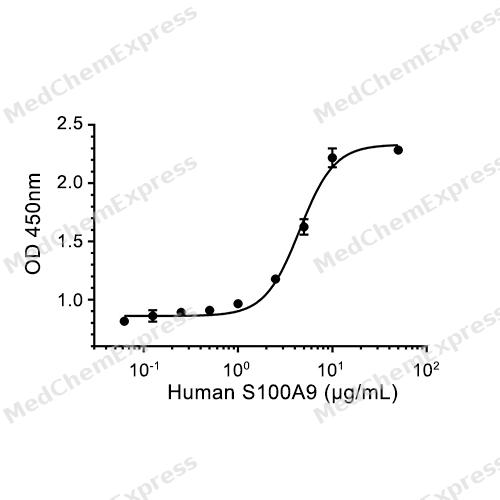
Bioactivity - Cell-Based Assay
-
Purity - SDS-PAGE
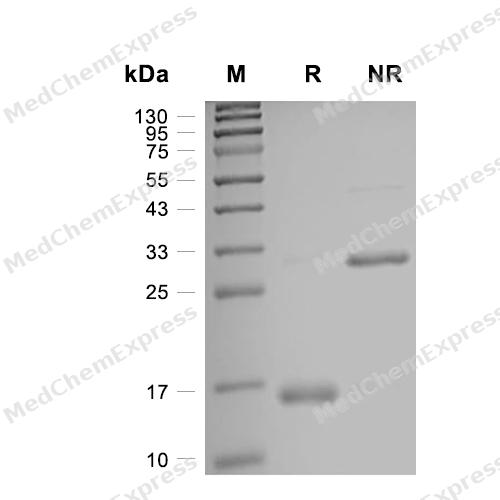
Purity - SDS-PAGE


Technical Parameters
-
Species Human
-
Source E. coli
-
Tag N-6*His
-
Accession
P06702 (T2-P114)
-
Molecular Construction
-
N-term
-
6*His
-
S100A9 (T2-P114)
Accession # P06702 -
C-term
-
-
Protein Length
Full Length
-
Synonyms
S100A9; 60B8AG; Prev. CAGB; CGLB; Prev. CFAG; MIF; MRP-14; NIF; MRP14; Protein S100-A9; P14; Calgranulin B; Migration Inhibitory Factor-Related Protein 14; S100 Calcium-Binding Protein A9 (Calgranulin B); Leukocyte L1 Complex Heavy Chain; S100 Calcium-Bin
-
AA Sequence
TCKMSQLERNIETIINTFHQYSVKLGHPDTLNQGEFKELVRKDLQNFLKKENKNEKVIEHIMEDLDTNADKQLSFEEFIMLMARLTWASHEKMHEGDEGPGHHHKPGLGEGTP
-
Predicted Molecular Mass
13.1 kDa
-
Molecular Weight
Approximately 15 kDa, based on SDS-PAGE under reducing conditions.
-
Purity
≥ 95%, as determined by reducing SDS-PAGE.


Product Properties
Lyophilized powder.
Lyophilized from a 0.22 μm filtered solution of 50 mM Tris-HCl, 300 mM NaCl, pH 7.4, 5% trehalose, 5% mannitol and 0.01% Tween 80 or 50 mM Tris-HCl, 300 mM NaCl, pH 7.4, 8% trehalose, 8% mannitol and 0.02% Tween80 or PBS, pH 7.4, 8% trehalose.
Note: For SPR assay, please replace the buffer. Primary amine components (e.g., Tris, imidazole) can affect protein-coupled chips.
<1 EU/μg, determined by LAL method.
It is not recommended to reconstitute to a concentration less than 100 μg/mL in ddH2O.
Stored at -20°C for 2 years from date of receipt. After reconstitution, it is stable at 4°C for 1 week or -20°C for longer (with carrier protein). It is recommended to freeze aliquots at -20°C or -80°C for extended storage.
Room temperature in continental US; may vary elsewhere.


Documentation
-
Data Sheet (261 KB)
-
SDS (252 KB)
- English - EN (252 KB)
- Français - FR (252 KB)
- Deutsch - DE (252 KB)
- Norwegian - NO (252 KB)
- Español - ES (252 KB)
- Swedish - SV (252 KB)
- Italian - IT (252 KB)
- Korean - KR (252 KB)
- Portuguese - PT (252 KB)
-
Handling Instructions (2659 KB)

Calculators
Concentration (start) × Volume (start) = Concentration (final) × Volume (final)


 Powered by Bioz

