



Serglycin/SRGN Protein, Human (HEK293, His-Myc)
Based on 1 publication(s) in Google Scholar
Serine (SRGN) is essential for the formation of mast cell secretory granules and the storage of various compounds. It plays a crucial role in the storage of proteases in mast cells, including granzyme B in T lymphocytes, and contributes to the localization of neutrophil elastase. Serglycin/SRGN Protein, Human (HEK293, His-Myc) is the recombinant human-derived Serglycin/SRGN protein, expressed by HEK293 , with C-His, C-Myc labeled tag.
- Species: Human
- Source: HEK293
-
Storage:Stored at -80°C for 1 year from date of receipt. It is stable at -20°C for 3 months after opening. It is recommended to freeze aliquots at -80°C for extended storage. Avoid repeated freeze-thaw cycles.


To place orders, for customer services and technical support, please contact: MedChemExpress USA
Tel: 609-228-6898 E-mail: [email protected] [email protected]


-
 Biological Activity
-
Technical Parameters
-
Product Properties
- Documentation
- Help & FAQs




Biological Activity
Description
Serine (SRGN) is essential for the formation of mast cell secretory granules and the storage of various compounds. It plays a crucial role in the storage of proteases in mast cells, including granzyme B in T lymphocytes, and contributes to the localization of neutrophil elastase. Serglycin/SRGN Protein, Human (HEK293, His-Myc) is the recombinant human-derived Serglycin/SRGN protein, expressed by HEK293 , with C-His, C-Myc labeled tag.
Background
Serglycin (SRGN) serves as a crucial player in the formation of mast cell secretory granules, facilitating the storage of various compounds within secretory vesicles. Its indispensability is underscored by its role in storing proteases in connective tissue and mucosal mast cells, including the storage of granzyme B in T-lymphocytes. SRGN also contributes to the localization of neutrophil elastase in azurophil granules of neutrophils. Furthermore, it participates in the processing of MMP2 and, notably, plays a key role in granule-mediated apoptosis by forming a complex with granzyme B. This complex is delivered to cells by perforin, inducing apoptosis. Beyond its involvement in cytotoxic cell granule-mediated processes, SRGN regulates the secretion of TNF-alpha and potentially influences protease secretion. Intriguingly, SRGN exhibits inhibitory effects on bone mineralization and engages in binding interactions with activated CD44 and granzyme B (GZMB), highlighting its multifaceted roles in cellular processes and immune regulation.
MCE Validation Data
-
Purity - SDS-PAGE
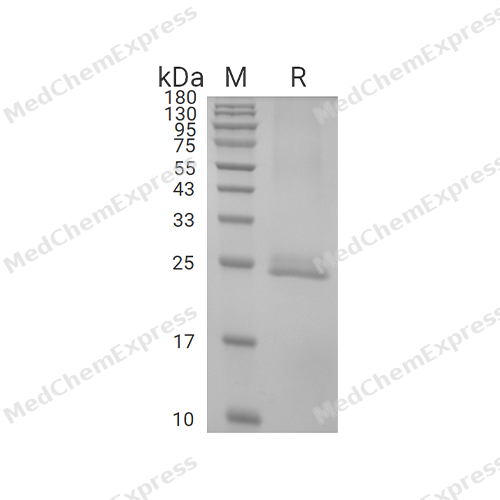
Purity - SDS-PAGE


Publications (1)
-
Journal Impact Factor
-
Most Recent
-
Cancer Res
2026 Feb 24. PMID: 41734377


Technical Parameters
-
Species Human
-
Source HEK293
-
Tag C-His;C-Myc
-
Accession
AAA60179.1 (Y28-L158)
-
Molecular Construction
-
N-term
-
SRGN (Y28-L158)
Accession # AAA60179.1 -
Myc-His
-
C-term
-
-
Protein Length
Full Length of Mature Protein
-
Synonyms
SRGN; Proteoglycan 1, Secretory Granule; Prev. PRG1; P.PG; Prev. PRG; Proteoglycan Protein Core For Mast Cell Secretory Granule; PPG; Secretory Granule Proteoglycan Core Peptide; Secretory Granule Proteoglycan Core Protein; Hematopoetic Proteoglycan Core
-
AA Sequence
YPTQRARYQWVRCNPDSNSANCLEEKGPMFELLPGESNKIPRLRTDLFPKTRIQDLNRIFPLSEDYSGSGFGSGSGSGSGSGSGFLTEMEQDYQLVDESDAFHDNLRSLDRNLPSDSQDLGQHGLEEDFML
-
Predicted Molecular Mass
17.3 kDa
-
Molecular Weight
Approximately 27 kDa, based on SDS-PAGE under reducing conditions.
-
Glycosylation
Yes
-
Purity
≥ 90%, as determined by reducing SDS-PAGE.


Product Properties
Solution
Supplied as a 0.22 μm filtered solution of PBS, pH 7.4.
<1 EU/μg, determined by LAL method.
Stored at -80°C for 1 year from date of receipt. It is stable at -20°C for 3 months after opening. It is recommended to freeze aliquots at -80°C for extended storage. Avoid repeated freeze-thaw cycles.
Shipping with dry ice.


Documentation
-
Data Sheet (235 KB)
-
SDS (254 KB)
- English - EN (254 KB)
- Français - FR (254 KB)
- Deutsch - DE (254 KB)
- Norwegian - NO (254 KB)
- Español - ES (254 KB)
- Swedish - SV (254 KB)
- Italian - IT (254 KB)
- Korean - KR (254 KB)
- Portuguese - PT (254 KB)
-
Handling Instructions (2659 KB)

Calculators
Concentration (start) × Volume (start) = Concentration (final) × Volume (final)


 Powered by Bioz

