



Siglec-2/CD22 Protein, Human (HEK293, His)
Based on 1 Customer Validation
The Siglec-2/CD22 protein mediates B cell interactions and may direct B cell localization within lymphoid tissues. It recognizes sialylated glycoproteins, especially α-2,6-linked sialic acid, and participates in cis-interactions at the cell surface. Siglec-2/CD22 Protein, Human (HEK293, His) is the recombinant human-derived Siglec-2/CD22 protein, expressed by HEK293 , with C-6*His labeled tag.
- Species: Human
- Source: HEK293
-
Storage:Stored at -20°C for 2 years from date of receipt. After reconstitution, it is stable at 4°C for 1 week or -20°C for longer (with carrier protein). It is recommended to freeze aliquots at -20°C or -80°C for extended storage.


To place orders, for customer services and technical support, please contact: MedChemExpress USA
Tel: 609-228-6898 E-mail: [email protected] [email protected]


-
 Biological Activity
-
Technical Parameters
-
Product Properties
- Documentation
- Help & FAQs




Biological Activity
Description
The Siglec-2/CD22 protein mediates B cell interactions and may direct B cell localization within lymphoid tissues. It recognizes sialylated glycoproteins, especially α-2,6-linked sialic acid, and participates in cis-interactions at the cell surface. Siglec-2/CD22 Protein, Human (HEK293, His) is the recombinant human-derived Siglec-2/CD22 protein, expressed by HEK293 , with C-6*His labeled tag.
Background
Siglec-2/CD22 Protein serves as a crucial mediator in B-cell interactions, potentially playing a role in the localization of B-cells within lymphoid tissues. Known for its ability to bind sialylated glycoproteins, including CD45, it exhibits a preference for alpha-2,6-linked sialic acid. The sialic acid recognition site may be masked by cis interactions with sialic acids on the same cell surface. During the immune response, ligand-induced tyrosine phosphorylation suggests its involvement in the regulation of B-cell antigen receptor signaling. The protein's multifaceted role encompasses positive regulation through interaction with Src family tyrosine kinases, while concurrently acting as an inhibitory receptor by recruiting cytoplasmic phosphatases via their SH2 domains to block signal transduction through dephosphorylation of signaling molecules. Siglec-2/CD22 predominately exists as a monomer of isoform CD22-beta and can also form a heterodimer with a shorter isoform. Its intricate interactions with key molecules such as PTPN6/SHP-1, LYN, SYK, PIK3R1/PIK3R2, PLCG1, GRB2, INPP5D, and SHC1, especially upon phosphorylation, highlight its pivotal role in orchestrating complex signaling networks within B-cells. Further research is essential to unravel the precise molecular pathways and functional consequences of Siglec-2/CD22 in B-cell regulation and immune responses.
Verified Bioactivity
1. Measured by its binding ability in a functional ELISA. Immobilized CD22 at 2 μg/mL can bind Anti-CD22 rabbit monoclonal antibody and the EC50 is <1.661 ng/mL.
2. Measured by the ability of the immobilized protein to support the adhesion of Jurkat human T-lymphocyte leukemia cells. The ED50 this effect is 0.8919 μg/mL, corresponding to a specific activity is 1.121×10³ units/mg.
MCE Validation Data
-
Purity - SDS-PAGE
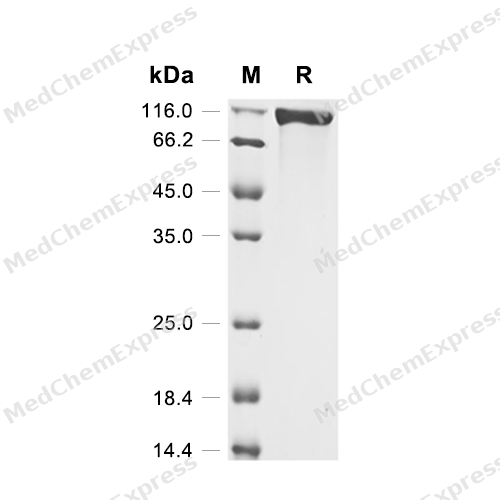
Purity - SDS-PAGE


Technical Parameters
-
Species Human
-
Source HEK293
-
Tag C-6*His
-
Accession
P20273 (D20-R687)
-
Molecular Construction
-
N-term
-
CD22 (D20-R687)
Accession # P20273 -
6*His
-
C-term
-
-
Protein Length
Extracellular Domain
-
Synonyms
CD22; B-Lymphocyte Cell Adhesion Molecule; CD22 Molecule; T-Cell Surface Antigen Leu-14; SIGLEC2; BL-CAM; Sialic Acid-Binding Ig-Like Lectin 2; Sialic Acid Binding Ig-Like Lectin 2; B-Cell Receptor CD22; CD22 Protein; CD22 Antigen; Siglec-2; SIGLEC-2
-
AA Sequence
DSSKWVFEHPETLYAWEGACVWIPCTYRALDGDLESFILFHNPEYNKNTSKFDGTRLYESTKDGKVPSEQKRVQFLGDKNKNCTLSIHPVHLNDSGQLGLRMESKTEKWMERIHLNVSERPFPPHIQLPPEIQESQEVTLTCLLNFSCYGYPIQLQWLLEGVPMRQAAVTSTSLTIKSVFTRSELKFSPQWSHHGKIVTCQLQDADGKFLSNDTVQLNVKHTPKLEIKVTPSDAIVREGDSVTMTCEVSSSNPEYTTVSWLKDGTSLKKQNTFTLNLREVTKDQSGKYCCQVSNDVGPGRSEEVFLQVQYAPEPSTVQILHSPAVEGSQVEFLCMSLANPLPTNYTWYHNGKEMQGRTEEKVHIPKILPWHAGTYSCVAENILGTGQRGPGAELDVQYPPKKVTTVIQNPMPIREGDTVTLSCNYNSSNPSVTRYEWKPHGAWEEPSLGVLKIQNVGWDNTTIACAACNSWCSWASPVALNVQYAPRDVRVRKIKPLSEIHSGNSVSLQCDFSSSHPKEVQFFWEKNGRLLGKESQLNFDSISPEDAGSYSCWVNNSIGQTASKAWTLEVLYAPRRLRVSMSPGDQVMEGKSATLTCESDANPPVSHYTWFDWNNQSLPYHSQKLRLEPVKVQHSGAYWCQGTNSVGKGRSPLSTLTVYYSPETIGRR
-
Predicted Molecular Mass
76.2 kDa
-
Molecular Weight
Approximately 90-140 kDa, based on SDS-PAGE under reducing conditions, due to the glycosylation.
-
Glycosylation
Yes
-
Purity
≥ 90%, as determined by reducing SDS-PAGE.


Product Properties
Lyophilized powder
1.Lyophilized from a 0.22 μm filtered solution of 20 mM Tris-HCl, 0.5 M NaCl, 6% trehalose, pH 8.0.
Note: For SPR assay, please replace the buffer. Primary amine components (e.g., Tris, imidazole) can affect protein-coupled chips.
<1 EU/μg, determined by LAL method.
It is not recommended to reconstitute to a concentration less than 100 μg/mL in ddH2O.
Stored at -20°C for 2 years from date of receipt. After reconstitution, it is stable at 4°C for 1 week or -20°C for longer (with carrier protein). It is recommended to freeze aliquots at -20°C or -80°C for extended storage.
Room temperature in continental US; may vary elsewhere.


Documentation
-
Data Sheet (240 KB)
-
SDS (252 KB)
- English - EN (252 KB)
- Français - FR (252 KB)
- Deutsch - DE (252 KB)
- Norwegian - NO (252 KB)
- Español - ES (252 KB)
- Swedish - SV (252 KB)
- Italian - IT (252 KB)
- Korean - KR (252 KB)
- Portuguese - PT (252 KB)
-
Handling Instructions (2659 KB)

Calculators
Concentration (start) × Volume (start) = Concentration (final) × Volume (final)


 Powered by Bioz

