



SPARC Protein, Rat (HEK293, His)
Based on 1 Customer Validation
SPARC protein is involved in the regulation of cell growth and may play a regulatory role by affecting the interaction of extracellular matrix and cytokines. SPRC protein can bind calcium and copper, several types of collagen, albumin, thrombospondin, PDGF and cell membranes. It has two calcium binding sites: one is an acidic domain that can bind 5-8 Ca2+ with low affinity, and the other is an EF-hand loop that can bind Ca2+ ions with high affinity. SPARC Protein, Rat (HEK293, His) is the recombinant rat-derived SPARC protein, expressed by HEK293 , with C-His labeled tag.
- Species: Rat
- Source: HEK293
-
Storage:Stored at -20°C for 2 years from date of receipt. After reconstitution, it is stable at 4°C for 1 week or -20°C for longer (with carrier protein). It is recommended to freeze aliquots at -20°C or -80°C for extended storage.


To place orders, for customer services and technical support, please contact: MedChemExpress USA
Tel: 609-228-6898 E-mail: [email protected] [email protected]


-
 Biological Activity
-
Technical Parameters
-
Product Properties
- Documentation
- Help & FAQs




Biological Activity
Description
SPARC protein is involved in the regulation of cell growth and may play a regulatory role by affecting the interaction of extracellular matrix and cytokines. SPRC protein can bind calcium and copper, several types of collagen, albumin, thrombospondin, PDGF and cell membranes. It has two calcium binding sites: one is an acidic domain that can bind 5-8 Ca2+ with low affinity, and the other is an EF-hand loop that can bind Ca2+ ions with high affinity. SPARC Protein, Rat (HEK293, His) is the recombinant rat-derived SPARC protein, expressed by HEK293 , with C-His labeled tag.
Background
SPARC protein is a cysteine-rich acidic secreted protein, also known as osteonectin or BM-40, and is a matricellular protein that regulates cell adhesion, extracellular matrix production, growth factor activity, and cell cycle. SPARC protein does not play a structural function, but has anti-proliferative and anti-adhesive properties that can regulate the interaction between cells and the surrounding extracellular matrix. SPRC protein is able to bind to Ca and Cu, several types of collagen, albumin, thrombospondin, PDGF, and cell membranes. It has two calcium binding sites: one is an acidic domain that can bind 5-8 Ca2+ with low affinity, and the other is an EF-hand ring that can bind Ca2+ ions with high affinity. SPARC is overexpressed in sites of injury, regeneration, obesity, cancer, and inflammation, and is a potential target and therapeutic indicator for disease treatment and evaluation.
Verified Bioactivity
Measured by its ability to inhibit the cell growth of Mv-1-Lu mink lung epithelial cells. The ED50 for this effect is typically 3.581μg/mL, corresponding to a specific activity is 2.793×10² U/mg.
MCE Validation Data
-
Purity - SDS-PAGE
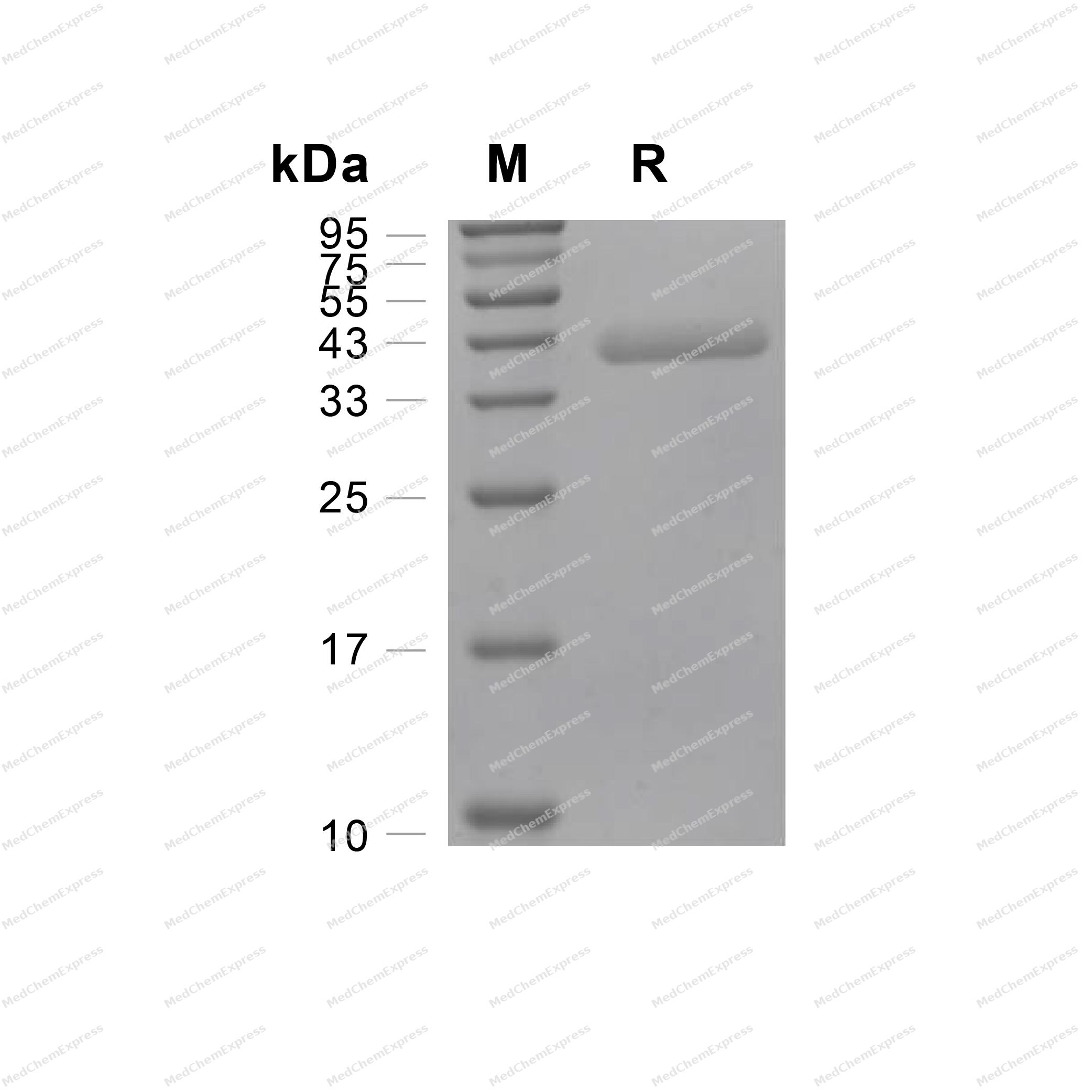
Purity - SDS-PAGE
-
Bioactivity - Cell-Based Assay
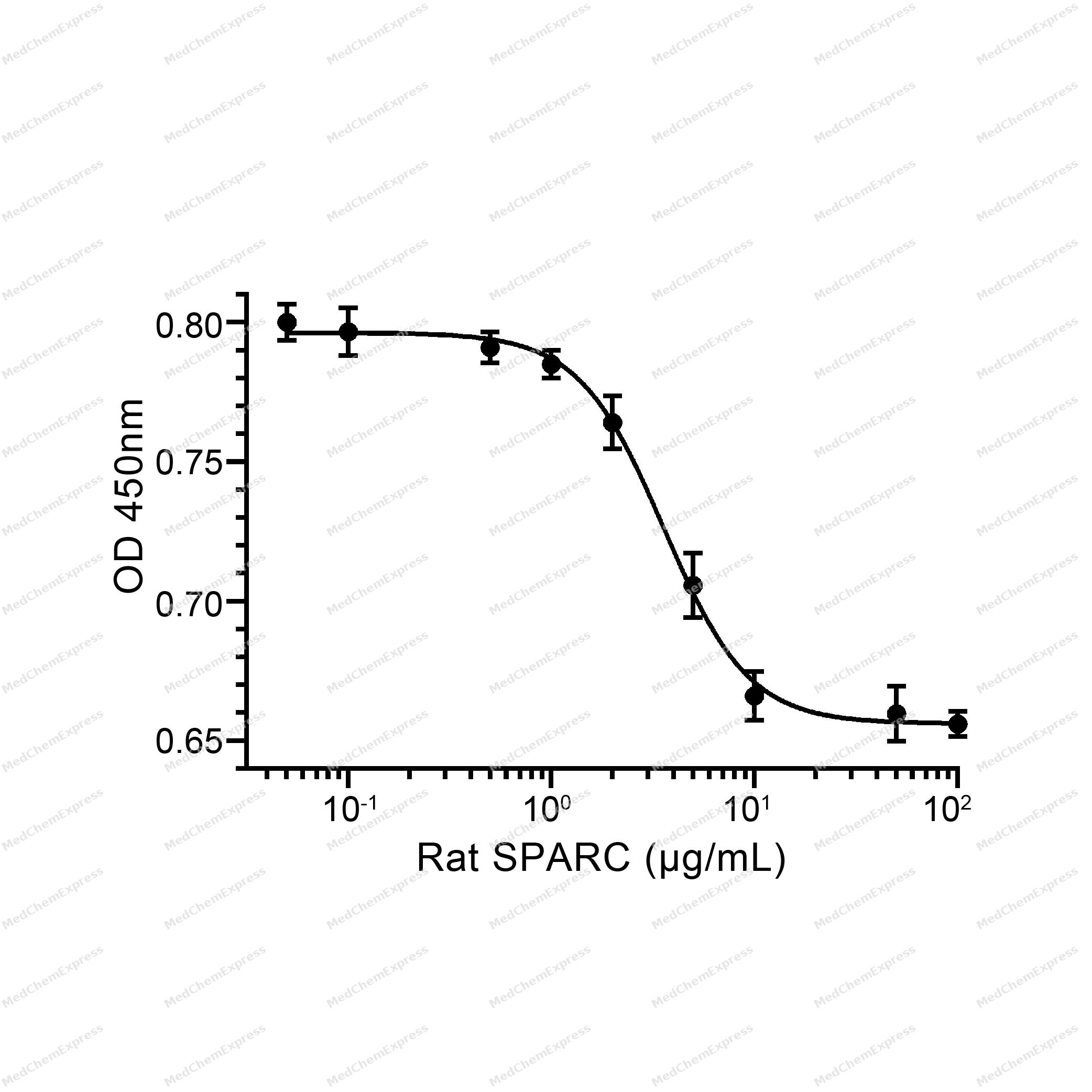
Bioactivity - Cell-Based Assay


Technical Parameters
-
Species Rat
-
Source HEK293
-
Tag C-His
-
Accession
P16975 (A18-I301)
-
Molecular Construction
-
N-term
-
SPARC (A18-I301)
Accession # P16975 -
His
-
C-term
-
-
Protein Length
Full Length of Mature Protein
-
Synonyms
SPARC; Basement-Membrane Protein 40; Prev. ON; Osteonectin; BM-40; Secreted Protein, Acidic, Cysteine-Rich (Osteonectin); ONT; OI17; Secreted Protein Acidic And Rich In Cysteine; Secreted Protein Acidic And Cysteine Rich; Cysteine-Rich Protein
-
AA Sequence
APQTEAAEEMVAEETVVEETGLPVGANPVQVEMGEFEEGAEETVEEVVAENPCQNHHCKHGKVCELDESNTPMCVCQDPTSCPAPIGEFEKVCSNDNKTFDSSCHFFATKCTLEGTKKGHKLHLDYIGPCKYIAPCLDSELTEFPLRMRDWLKNVLVTLYERDEGNNLLTEKQKLRVKKIHENEKRLEAGDHPVELLARDFEKNYNMYIFPVHWQFGQLDQHPIDGYLSHTELAPLRAPLIPMEHCTTRFFETCDLDNDKYIALEEWAGCFGIKEQDINKDLVI
-
Predicted Molecular Mass
32.4 kDa
-
Molecular Weight
Approximately 40 kDa, based on SDS-PAGE under reducing conditions.
-
Purity
≥ 90%, as determined by reducing SDS-PAGE.


Product Properties
Lyophilized powder.
Lyophilized from a 0.22 μm filtered solution of PBS, pH 7.4.
<1 EU/μg, determined by LAL method.
It is not recommended to reconstitute to a concentration less than 100 μg/mL in ddH2O. For long term storage it is recommended to add a carrier protein (0.1% BSA, 5% HSA, 10% FBS or 5% Trehalose).
Stored at -20°C for 2 years from date of receipt. After reconstitution, it is stable at 4°C for 1 week or -20°C for longer (with carrier protein). It is recommended to freeze aliquots at -20°C or -80°C for extended storage.
Room temperature in continental US; may vary elsewhere.


Documentation
-
Data Sheet (237 KB)
-
SDS (251 KB)
- English - EN (251 KB)
- Français - FR (251 KB)
- Deutsch - DE (251 KB)
- Norwegian - NO (251 KB)
- Español - ES (251 KB)
- Swedish - SV (251 KB)
- Italian - IT (251 KB)
- Korean - KR (251 KB)
- Portuguese - PT (251 KB)
-
Handling Instructions (2659 KB)

Calculators
Concentration (start) × Volume (start) = Concentration (final) × Volume (final)


 Powered by Bioz

