



STK11 Protein, Human (His-SUMO)

Based on 1 Customer Validation
The STK11 protein is a tumor suppressor kinase that complexly regulates members of the AMP-activated protein kinase (AMPK) family, affecting cellular processes such as metabolism, apoptosis, and DNA damage responses. It phosphorylates the T-loop of AMPK family proteins and activates PRKAA1, PRKAA2 and other proteins (except MELK). STK11 Protein, Human (His-SUMO) is the recombinant human-derived STK11 protein, expressed by E. coli , with N-SUMO, N-6*His labeled tag.
- Species: Human
- Source: E. coli
-
Storage:Stored at -20°C for 2 years from date of receipt. After reconstitution, it is stable at 4°C for 1 week or -20°C for longer (with carrier protein). It is recommended to freeze aliquots at -20°C or -80°C for extended storage.


To place orders, for customer services and technical support, please contact: MedChemExpress USA
Tel: 609-228-6898 E-mail: [email protected] [email protected]


-
 Biological Activity
-
Technical Parameters
-
Product Properties
- Documentation
- Help & FAQs




Biological Activity
Description
The STK11 protein is a tumor suppressor kinase that complexly regulates members of the AMP-activated protein kinase (AMPK) family, affecting cellular processes such as metabolism, apoptosis, and DNA damage responses. It phosphorylates the T-loop of AMPK family proteins and activates PRKAA1, PRKAA2 and other proteins (except MELK). STK11 Protein, Human (His-SUMO) is the recombinant human-derived STK11 protein, expressed by E. coli , with N-SUMO, N-6*His labeled tag.
Background
STK11 Protein, a tumor suppressor serine/threonine-protein kinase, intricately regulates the activity of AMP-activated protein kinase (AMPK) family members, exerting influence over diverse cellular processes including metabolism, cell polarity, apoptosis, and the DNA damage response. Operating through the phosphorylation of the T-loop of AMPK family proteins, such as PRKAA1, PRKAA2, BRSK1, BRSK2, MARK1, MARK2, MARK3, MARK4, NUAK1, NUAK2, SIK1, SIK2, SIK3, and SNRK, STK11 facilitates their activation while excluding MELK. Beyond the AMPK family, STK11 extends its regulatory reach to non-AMPK proteins like STRADA, PTEN, and possibly p53/TP53. Functioning as a pivotal upstream regulator of AMPK, STK11 orchestrates cellular responses including the inhibition of growth-promoting signaling pathways during low energy conditions, maintenance of glucose homeostasis in the liver, initiation of autophagy in nutrient-deprived cells, and facilitation of B-cell differentiation in the germinal center in response to DNA damage. Additionally, STK11 plays a crucial role in cellular polarity by remodeling the actin cytoskeleton and is essential for cortical neuron polarization through the phosphorylation and activation of BRSK1 and BRSK2. In the realm of DNA damage response, STK11 interacts with p53/TP53, participating in transcription activation on the CDKN1A/WAF1 promoter, and acts as a mediator of p53/TP53-dependent apoptosis. Furthermore, STK11 is implicated in UV radiation-induced DNA damage response by phosphorylating CDKN1A in collaboration with NUAK1, contributing to its degradation for optimal DNA repair, and it also plays a role in spermiogenesis.
Verified Bioactivity
1.The kinase activity of this recombinant protein is testing in progress, we cannot offer a guarantee yet.
2.Immobilized Human STK11 at 2 μg/mL (100 μL/well) can bind STK11 antibody, The ED50 for this effect is 8.246 ng/mL.
MCE Validation Data
-
Purity - SDS-PAGE
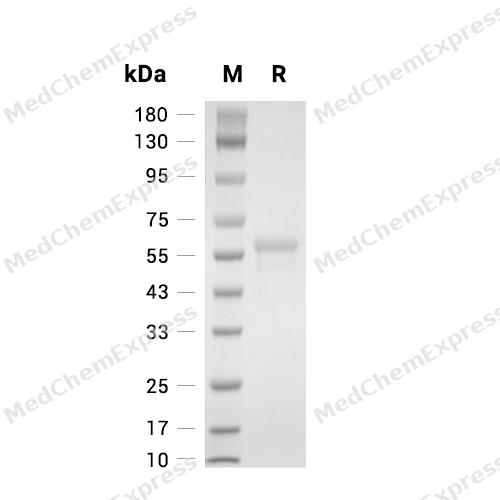
Purity - SDS-PAGE
-
Bioactivity - ELISA
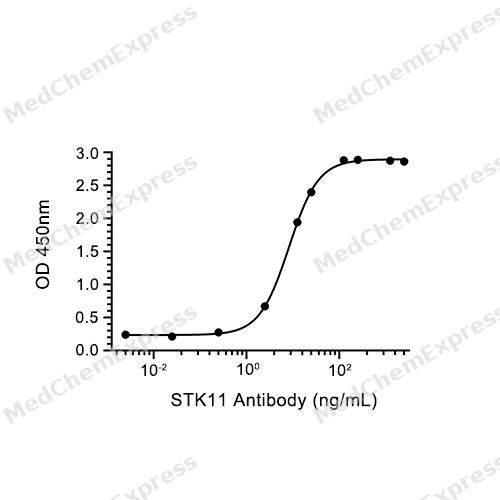
Bioactivity - ELISA


Technical Parameters
-
Species Human
-
Source E. coli
-
Tag N-SUMO;N-6*His
-
Accession
Q15831 (M1-C430)
-
Molecular Construction
-
N-term
-
6*His-SUMO
-
STK11 (M1-C430)
Accession # Q15831 -
C-term
-
-
Protein Length
Full Length of Serine/threonine-protein kinase STK11 Chain
-
Synonyms
STK11; Serine/Threonine Kinase 11 (Peutz-Jeghers Syndrome); Serine/Threonine Kinase 11; Non-Specific Serine/Threonine Protein Kinase; LKB1; Serine/Threonine-Protein Kinase LKB1; PJS; Serine/Threonine-Protein Kinase PLK1; Serine/Threonine-Protein Kinase ST
-
AA Sequence
MEVVDPQQLGMFTEGELMSVGMDTFIHRIDSTEVIYQPRRKRAKLIGKYLMGDLLGEGSYGKVKEVLDSETLCRRAVKILKKKKLRRIPNGEANVKKEIQLLRRLRHKNVIQLVDVLYNEEKQKMYMVMEYCVCGMQEMLDSVPEKRFPVCQAHGYFCQLIDGLEYLHSQGIVHKDIKPGNLLLTTGGTLKISDLGVAEALHPFAADDTCRTSQGSPAFQPPEIANGLDTFSGFKVDIWSAGVTLYNITTGLYPFEGDNIYKLFENIGKGSYAIPGDCGPPLSDLLKGMLEYEPAKRFSIRQIRQHSWFRKKHPPAEAPVPIPPSPDTKDRWRSMTVVPYLEDLHGADEDEDLFDIEDDIIYTQDFTVPGQVPEEEASHNGQRRGLPKAVCMNGTEAAQLSTKSRAEGRAPNPARKACSASSKIRRLSAC
-
Predicted Molecular Mass
64.3 kDa
-
Molecular Weight
Approximately 60 kDa, based on SDS-PAGE under reducing conditions.
-
Purity
≥ 90%, as determined by reducing SDS-PAGE.


Product Properties
Lyophilized powder.
1.Lyophilized from a 0.22 μm filtered solution of 10 mM Tris-HCl, 1 mM EDTA, 6% trehalose.
2.Lyophilized from a 0.22 μm filtered solution of PBS, pH 7.4, 8% trehalose.
Please refer to the lot-specific COA for specific buffer information.
Note: For SPR assay, please replace the buffer. Primary amine components (e.g., Tris, imidazole) can affect protein-coupled chips.
<1 EU/μg, determined by LAL method.
It is not recommended to reconstitute to a concentration less than 100 μg/mL in ddH2O.
Stored at -20°C for 2 years from date of receipt. After reconstitution, it is stable at 4°C for 1 week or -20°C for longer (with carrier protein). It is recommended to freeze aliquots at -20°C or -80°C for extended storage.
Room temperature in continental US; may vary elsewhere.


Documentation
-
Data Sheet (239 KB)
-
SDS (254 KB)
- English - EN (254 KB)
- Français - FR (254 KB)
- Deutsch - DE (254 KB)
- Norwegian - NO (254 KB)
- Español - ES (254 KB)
- Swedish - SV (254 KB)
- Italian - IT (254 KB)
- Korean - KR (254 KB)
- Portuguese - PT (254 KB)
-
Handling Instructions (2659 KB)

Calculators
Concentration (start) × Volume (start) = Concentration (final) × Volume (final)


 Powered by Bioz

