



TREM-1 Protein, Human (HEK293, His)
Based on 1 Customer Validation
The TREM-1 protein is a cell surface receptor that critically regulates innate and adaptive immunity by enhancing inflammatory responses. TREM-1 plays a crucial role in acute and chronic inflammatory diseases, acting as a decoy receptor to balance its pro-inflammatory effects. TREM-1 Protein, Human (HEK293, His) is the recombinant human-derived TREM-1 protein, expressed by HEK293 , with C-6*His labeled tag.
- Species: Human
- Source: HEK293
-
Storage:Stored at -20°C for 2 years from date of receipt. After reconstitution, it is stable at 4°C for 1 week or -20°C for longer (with carrier protein). It is recommended to freeze aliquots at -20°C or -80°C for extended storage.


To place orders, for customer services and technical support, please contact: MedChemExpress USA
Tel: 609-228-6898 E-mail: [email protected] [email protected]


-
 Biological Activity
-
Technical Parameters
-
Product Properties
- Documentation
- Help & FAQs




Biological Activity
Description
The TREM-1 protein is a cell surface receptor that critically regulates innate and adaptive immunity by enhancing inflammatory responses. TREM-1 plays a crucial role in acute and chronic inflammatory diseases, acting as a decoy receptor to balance its pro-inflammatory effects. TREM-1 Protein, Human (HEK293, His) is the recombinant human-derived TREM-1 protein, expressed by HEK293 , with C-6*His labeled tag.
Background
TREM-1 protein, as a cell surface receptor, potentially participates in innate and adaptive immune responses. Following phosphorylation, it interacts with PTPN6 and PTPN11, indicating its role in signaling pathways linked to these phosphatases. This interaction highlights the regulatory mechanisms TREM-1 may contribute to in modulating the immune system.
Verified Bioactivity
Measured by its ability to block anti-TREM-1-induced TNF-alpha secretion by human myeloid leukemia mononuclear cells. At 1 µg/mL, Recombinant Human TREM-1 is able to block is 63% of Anti-Human TREM-1 (20 µg/mL, 200 µL/well) induced TNF-alpha released from 1 x 10⁵ cells.
MCE Validation Data
-
Purity - SDS-PAGE
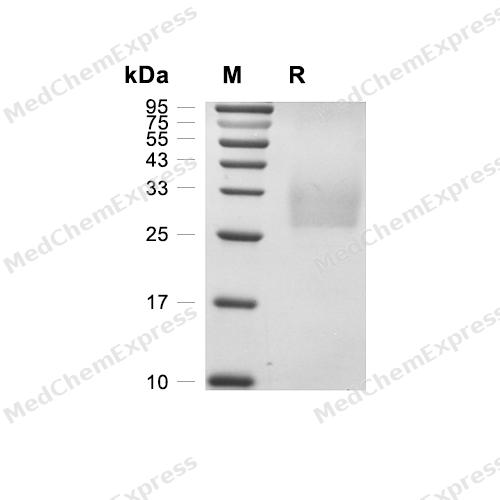
Purity - SDS-PAGE


Technical Parameters
-
Species Human
-
Source HEK293
-
Tag C-6*His
-
Accession
Q9NP99-1 (A21-R200)
-
Molecular Construction
-
N-term
-
TREM-1 (A21-R200)
Accession # Q9NP99-1 -
6*His
-
C-term
-
-
Protein Length
Partial Extracellular Domain
-
Synonyms
TREM1; CD354; Triggering Receptor Expressed On Myeloid Cells 1; Triggering Receptor Expressed On Monocytes 1; TREM-1; CD354 Antigen
-
AA Sequence
ATKLTEEKYELKEGQTLDVKCDYTLEKFASSQKAWQIIRDGEMPKTLACTERPSKNSHPVQVGRIILEDYHDHGLLRVRMVNLQVEDSGLYQCVIYQPPKEPHMLFDRIRLVVTKGFSGTPGSNENSTQNVYKIPPTTTKALCPLYTSPRTVTQAPPKSTADVSTPDSEINLTNVTDIIR
-
Predicted Molecular Mass
21.3 kDa
-
Molecular Weight
Approximately 26-42 kDa, based on SDS-PAGE under reducing conditions, due to the glycosylation.
-
Glycosylation
Yes
-
Purity
≥ 95%, as determined by reducing SDS-PAGE.


Product Properties
Lyophilized powder.
Lyophilized from a 0.22 μm filtered solution of PBS, pH 7.4.
<1 EU/μg, determined by LAL method.
It is not recommended to reconstitute to a concentration less than 100 μg/mL in ddH2O. For long term storage it is recommended to add a carrier protein (0.1% BSA, 5% HSA, 10% FBS or 5% Trehalose).
Stored at -20°C for 2 years from date of receipt. After reconstitution, it is stable at 4°C for 1 week or -20°C for longer (with carrier protein). It is recommended to freeze aliquots at -20°C or -80°C for extended storage.
Room temperature in continental US; may vary elsewhere.


Documentation
-
Data Sheet (236 KB)
-
SDS (252 KB)
- English - EN (252 KB)
- Français - FR (252 KB)
- Deutsch - DE (252 KB)
- Norwegian - NO (252 KB)
- Español - ES (252 KB)
- Swedish - SV (252 KB)
- Italian - IT (252 KB)
- Korean - KR (252 KB)
- Portuguese - PT (252 KB)
-
Handling Instructions (2659 KB)

Calculators
Concentration (start) × Volume (start) = Concentration (final) × Volume (final)


 Powered by Bioz

