



TSPAN8 Protein, Human (HEK293, His)

Based on 1 Customer Validation
TSPAN8 is a cell surface glycoprotein that is complexed with integrins and belongs to the four-span protein family. It has four hydrophobic domains. TSPAN8 mediates extracellular signal transduction processes and regulates cell development, activation, growth, and movement. In addition, TSPAN8 is expressed in different cancers and has potential roles in cancer prognosis and targeted therapy. TSPAN8 Protein, Human (HEK293, His) is the recombinant human-derived TSPAN8 protein, expressed by HEK293 , with N-6*His labeled tag.
- Species: Human
- Source: HEK293
-
Storage:Stored at -20°C for 2 years from date of receipt. After reconstitution, it is stable at 4°C for 1 week or -20°C for longer (with carrier protein). It is recommended to freeze aliquots at -20°C or -80°C for extended storage.


To place orders, for customer services and technical support, please contact: MedChemExpress USA
Tel: 609-228-6898 E-mail: [email protected] [email protected]


-
 Biological Activity
-
Technical Parameters
-
Product Properties
- Documentation
- References
- Help & FAQs




Biological Activity
Description
TSPAN8 is a cell surface glycoprotein that is complexed with integrins and belongs to the four-span protein family. It has four hydrophobic domains. TSPAN8 mediates extracellular signal transduction processes and regulates cell development, activation, growth, and movement. In addition, TSPAN8 is expressed in different cancers and has potential roles in cancer prognosis and targeted therapy. TSPAN8 Protein, Human (HEK293, His) is the recombinant human-derived TSPAN8 protein, expressed by HEK293 , with N-6*His labeled tag.
Background
TSPAN8 plays an important role in promoting tumor metastasis by activating the EGFR/AKT pathway[1].
TSPAN8 alleviates high-glucose-induced autophagy and apoptosis in HK-2 cells by targeting mTORC2[2].
TSPAN8 forms protein complexes mediated by TSPAN8 through interactions with itself and various other cell signaling molecules. These protein complexes help to construct tetraspan-rich microdomains (TEMs), which effectively mediate intracellular signaling transduction. In addition, TSPAN8 plays a crucial role in regulating biological functions such as leukocyte migration, angiogenesis, and wound repair[3].
MCE Validation Data
-
Purity - SDS-PAGE
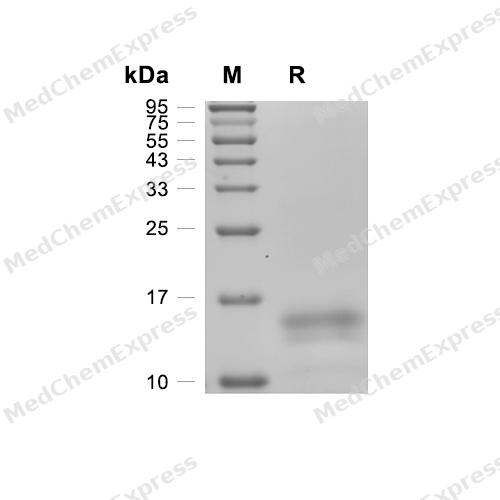
Purity - SDS-PAGE


Technical Parameters
-
Species Human
-
Source HEK293
-
Tag N-6*His
-
Accession
P19075 (K110-N205)
-
Molecular Construction
-
N-term
-
6*His
-
TSPAN8 (K110-N205)
Accession # P19075 -
C-term
-
-
Protein Length
Extracellular Domain
-
Synonyms
Tspan8; Tetraspanin-8; Tspan-8; TM4SF3; TSPAN8; Tumor-associated antigen CO-029; Transmembrane 4 superfamily member 3; CO-029
-
AA Sequence
KSKSDRIVNETLYENTKLLSATGESEKQFQEAIIVFQEEFKCCGLVNGAADWGNNFQHYPELCACLDKQRPCQSYNGKQVYKETCISFIKDFLAKN
-
Predicted Molecular Mass
11 kDa
-
Molecular Weight
Approximately 12-19 kDa, based on SDS-PAGE under reducing conditions, due to the glycosylation.
-
Glycosylation
Yes
-
Purity
≥ 95%, as determined by reducing SDS-PAGE.


Product Properties
Lyophilized powder.
Lyophilized from a 0.22 μm filtered solution of PBS, pH 7.4.
<1 EU/μg, determined by LAL method.
It is not recommended to reconstitute to a concentration less than 100 μg/mL in PBS. For long term storage it is recommended to add a carrier protein (0.1% BSA, 5% HSA, 10% FBS or 5% Trehalose).
Stored at -20°C for 2 years from date of receipt. After reconstitution, it is stable at 4°C for 1 week or -20°C for longer (with carrier protein). It is recommended to freeze aliquots at -20°C or -80°C for extended storage.
Room temperature in continental US; may vary elsewhere.


Documentation
-
Data Sheet (262 KB)
-
SDS (251 KB)
- English - EN (251 KB)
- Français - FR (251 KB)
- Deutsch - DE (251 KB)
- Norwegian - NO (251 KB)
- Español - ES (251 KB)
- Swedish - SV (251 KB)
- Italian - IT (251 KB)
- Korean - KR (251 KB)
- Portuguese - PT (251 KB)
-
Handling Instructions (2659 KB)


References
[1]. Zhang L, et al. TSPAN8 regulates EGFR/AKT pathway to enhance metastasis in gastric cancer. Mol Biol Rep. 2023 Oct;50(10):7955-7965. [Content Brief]
[2]. Zhuang L, et al. TSPAN8 alleviates high glucose-induced apoptosis and autophagy via targeting mTORC2. Cell Biol Int. 2022 Oct;46(10):1693-1703. [Content Brief]
[3]. Heo K, et al. TSPAN8 as a Novel Emerging Therapeutic Target in Cancer for Monoclonal Antibody Therapy. Biomolecules. 2020 Mar 3;10(3):388. [Content Brief]

Calculators
Concentration (start) × Volume (start) = Concentration (final) × Volume (final)


 Powered by Bioz

