



UbcH7/UBE2L3 Protein, Human
Based on 1 publication(s) in Google Scholar
UbcH7/UBE2L3 is a unique ubiquitin-conjugating E2 enzyme that cooperates with HECT-type and RBR family E3 ligases and lacks intrinsic E3-independent reactivity with lysine. It uniquely works with RBR family E3 enzymes such as PRKN, RNF31 and ARIH1, acting like a RING-HECT hybrid. UbcH7/UBE2L3 Protein, Human is the recombinant human-derived UbcH7/UBE2L3 protein, expressed by E. coli , with tag free.
- Species: Human
- Source: E. coli
-
Storage:Stored at -20°C for 2 years from date of receipt. After reconstitution, it is stable at 4°C for 1 week or -20°C for longer (with carrier protein). It is recommended to freeze aliquots at -20°C or -80°C for extended storage.


To place orders, for customer services and technical support, please contact: MedChemExpress USA
Tel: 609-228-6898 E-mail: [email protected] [email protected]


-
 Biological Activity
-
Technical Parameters
-
Product Properties
- Documentation
- Help & FAQs




Biological Activity
Description
UbcH7/UBE2L3 is a unique ubiquitin-conjugating E2 enzyme that cooperates with HECT-type and RBR family E3 ligases and lacks intrinsic E3-independent reactivity with lysine. It uniquely works with RBR family E3 enzymes such as PRKN, RNF31 and ARIH1, acting like a RING-HECT hybrid. UbcH7/UBE2L3 Protein, Human is the recombinant human-derived UbcH7/UBE2L3 protein, expressed by E. coli , with tag free.
Background
UbcH7/UBE2L3, a ubiquitin-conjugating enzyme E2, exhibits specificity in collaboration with HECT-type and RBR family E3 ubiquitin-protein ligases. Notably, its unique characteristic is the absence of intrinsic E3-independent reactivity with lysine, rendering it incompatible with most RING-containing E3 ubiquitin-protein ligases. However, it demonstrates activity with RBR family E3 enzymes such as PRKN, RNF31, and ARIH1, functioning akin to RING-HECT hybrids. Acting downstream of the E1 complex, UbcH7 catalyzes the covalent attachment of ubiquitin to target proteins and, in vitro, facilitates 'Lys-11'-linked polyubiquitination. Its involvement in the selective degradation of short-lived and aberrant proteins highlights its role in cellular quality control. Additionally, down-regulation during the S-phase suggests a contribution to cell cycle progression, while its impact on nuclear hormone receptors' transcriptional activity and potential role in myelopoiesis further underscore its multifaceted functions.
Verified Bioactivity
Recombinant Human UbcH7/UBE2L3 is a member of the Ubiquitin-conjugating (E2) enzyme family that receives Ubiquitin from a Ubiquitin-activating (E1) enzyme and subsequently interacts with a Ubiquitin ligase (E3) to conjugate Ubiquitin to substrate proteins.
MCE Validation Data
-
Purity - SDS-PAGE
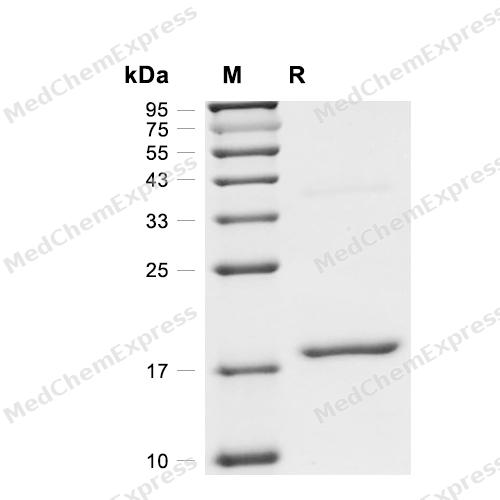
Purity - SDS-PAGE


Publications (1)
-
Journal Impact Factor
-
Most Recent
-
Cell Rep
Glutamine synthetase modulates YAP activation by stabilizing LATS under glutamine homeostasis. [Abstract]2025 Nov 25;44(12):116620. PMID: 41296569


Technical Parameters
-
Species Human
-
Source E. coli
-
Tag Tag Free
-
Accession
P68036-1 (M1-D154)
-
Molecular Construction
-
N-term
-
UbcH7 (M1-D154)
Accession # P68036-1 -
C-term
-
-
Protein Length
Full Length of Isoform-1
-
Synonyms
UBE2L3; Ubiquitin Conjugating Enzyme E2 L3; UBCH7; Ubiquitin-Conjugating Enzyme E2 L3; E2 Ubiquitin-Conjugating Enzyme L3; Ubiquitin-Conjugating Enzyme E2-F1; Ubiquitin Carrier Protein L3; Ubiquitin-Protein Ligase L3; L-UBC; Ubiquitin-Conjugating Enzyme E
-
AA Sequence
MAASRRLMKELEEIRKCGMKNFRNIQVDEANLLTWQGLIVPDNPPYDKGAFRIEINFPAEYPFKPPKITFKTKIYHPNIDEKGQVCLPVISAENWKPATKTDQVIQSLIALVNDPQPEHPLRADLAEEYSKDRKKFCKNAEEFTKKYGEKRPVD
-
Predicted Molecular Mass
17.9 kDa
-
Molecular Weight
Approximately 18 kDa, based on SDS-PAGE under reducing conditions.
-
Purity
≥ 95%, as determined by reducing SDS-PAGE.


Product Properties
Lyophilized powder.
Lyophilized from a 0.22 μm filtered solution of 20 mM Hepes, 50 mM Nacl, pH 7.4.
<1 EU/μg, determined by LAL method.
It is not recommended to reconstitute to a concentration less than 100 μg/mL in ddH2O. For long term storage it is recommended to add a carrier protein (0.1% BSA, 5% HSA, 10% FBS or 5% Trehalose).
Stored at -20°C for 2 years from date of receipt. After reconstitution, it is stable at 4°C for 1 week or -20°C for longer (with carrier protein). It is recommended to freeze aliquots at -20°C or -80°C for extended storage.
Room temperature in continental US; may vary elsewhere.


Documentation
-
Data Sheet (236 KB)
-
SDS (251 KB)
- English - EN (251 KB)
- Français - FR (251 KB)
- Deutsch - DE (251 KB)
- Norwegian - NO (251 KB)
- Español - ES (251 KB)
- Swedish - SV (251 KB)
- Italian - IT (251 KB)
- Korean - KR (251 KB)
- Portuguese - PT (251 KB)
-
Handling Instructions (2659 KB)

Calculators
Concentration (start) × Volume (start) = Concentration (final) × Volume (final)


 Powered by Bioz

