



UBE2D3 Protein, Human
Based on 3 publication(s) in Google Scholar
UBE2D3 is able to accept ubiquitin from specific E2 ubiquitin-conjugating enzymes and transfer it to substrates, often promoting its degradation by the proteasome. UBE2D3 Protein, Human is the recombinant human-derived UBE2D3 protein, expressed by E. coli , with tag free.
- Species: Human
- Source: E. coli
-
Storage:Stored at -80°C for 1 year from date of receipt. It is stable at -20°C for 3 months after opening. It is recommended to freeze aliquots at -80°C for extended storage. Avoid repeated freeze-thaw cycles.


To place orders, for customer services and technical support, please contact: MedChemExpress USA
Tel: 609-228-6898 E-mail: [email protected] [email protected]


-
 Biological Activity
-
Technical Parameters
-
Product Properties
- Documentation
- Help & FAQs




Biological Activity
Description
UBE2D3 is able to accept ubiquitin from specific E2 ubiquitin-conjugating enzymes and transfer it to substrates, often promoting its degradation by the proteasome[1]. UBE2D3 Protein, Human is the recombinant human-derived UBE2D3 protein, expressed by E. coli , with tag free.
Background
Modification of proteins with ubiquitin is an important cellular mechanism that targets abnormal or short-lived proteins for degradation. Ubiquitination involves at least three types of enzymes: ubiquitin-activating enzymes (E1), ubiquitin-conjugating enzymes (E2), and ubiquitin-protein ligases (E3). UBE2D3 encodes a member of the E2 ubiquitin-conjugating enzyme family and inhibits the ubiquitination process of the protein p53 in tumors. UBE2D3 protein is induced by E3 ubiquitin protein ligase and plays an important regulatory role in tumorigenesis. In particular, UBE2D3 is highly expressed in glioma and may be a potential target for glioma treatment. UBE2D3 promotes ubiquitination of SHP-2, thereby activating the STAT3 pathway and promoting glioma proliferation and glycolysis. UBE2D3 can interact with SHP-2 and promote its ubiquitination, thereby increasing the activation of the STAT3 pathway. Inhibition of UBE2D3 inhibits GBM proliferation, glycolysis, and STAT3 phosphorylation in vitro and in vivo[1][2].
Verified Bioactivity
The enzyme activity of this recombinant protein is testing in progress, we cannot offer a guarantee yet.
MCE Validation Data
-
Purity - SDS-PAGE
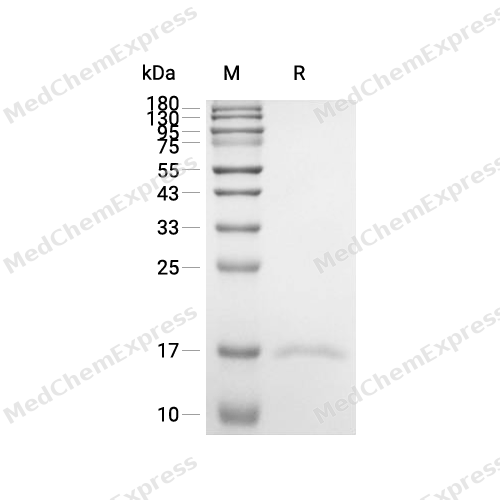
Purity - SDS-PAGE


Publications (3)
-
Journal Impact Factor
-
Most Recent
-
Nat Commun
Proteostasis perturbation of N-Myc leveraging HSP70 mediated protein turnover improves treatment of neuroendocrine prostate cancer. [Abstract]2024 Aug 5;15(1):6626. PMID: 39103353 -
Mol Cell
SMURF2 predisposes cancer cell toward ferroptosis in GPX4-independent manners by promoting GSTP1 degradation. [Abstract]2023 Dec 7;83(23):4352-4369.e8. PMID: 38016474 -
Cell Death Differ
TRIM21-driven K63-linked ubiquitination of RBM38c, as a novel interactor of BECN1, contributes to DNA damage-induced autophagy. [Abstract]2025 Jul;32(7):1317-1335. PMID: 40133668


Technical Parameters
-
Species Human
-
Source E. coli
-
Tag Tag Free
-
Accession
AAH66917 (M1-M147)
-
Molecular Construction
-
N-term
-
UBE2D3 (M1-M147)
Accession # AAH66917 -
C-term
-
-
Protein Length
Full Length
-
Synonyms
UBE2D3; Ubiquitin Conjugating Enzyme E2 D3; UbcH5C; Ubiquitin-Conjugating Enzyme E2D 3 (Homologous To Yeast UBC4/5); Ubiquitin-Conjugating Enzyme E2D 3 (UBC4/5 Homolog,Yeast); (E3-Independent) E2 Ubiquitin-Conjugating Enzyme D3; Ubiquitin-Conjugating Enzy
-
AA Sequence
MALKRINKELSDLARDPPAQCSAGPVGDDMFHWQATIMGPNDSPYQGGVFFLTIHFPTDYPFKPPKVAFTTRIYHPNINSNGSICLDILRSQWSPALTISKVLLSICSLLCDPNPDDPLVPELARIYKTDRDKYNRISREWTQKYAM
-
Predicted Molecular Mass
16.6 kDa
-
Molecular Weight
Approximately 15 kDa, based on SDS-PAGE under reducing conditions.
-
Purity
≥ 95%, as determined by reducing SDS-PAGE.


Product Properties
Solution
1.Supplied as a 0.22 μm filtered solution of 20 mM Tris-HCl, 150 mM NaCl, 50% Glycerol, 8% Sucrose, 0.05% Tween 80, pH 7.1.
2.Supplied as a 0.22 μm filtered solution of 20 mM Tris-HCl, 8% sucrose, 150 mM NaCl, 50% glycerol, 0.05% Tween 80, 1mM TCEP, pH 7.1.
Please refer to the lot-specific COA for specific buffer information.
Note: For SPR assay, please replace the buffer. Primary amine components (e.g., Tris, imidazole) can affect protein-coupled chips.
<1 EU/μg, determined by LAL method.
Stored at -80°C for 1 year from date of receipt. It is stable at -20°C for 3 months after opening. It is recommended to freeze aliquots at -80°C for extended storage. Avoid repeated freeze-thaw cycles.
Shipping with dry ice.


Documentation
-
Data Sheet (236 KB)
-
SDS (252 KB)
- English - EN (252 KB)
- Français - FR (252 KB)
- Deutsch - DE (252 KB)
- Norwegian - NO (252 KB)
- Español - ES (252 KB)
- Swedish - SV (252 KB)
- Italian - IT (252 KB)
- Korean - KR (252 KB)
- Portuguese - PT (252 KB)
-
Handling Instructions (2659 KB)

Calculators
Concentration (start) × Volume (start) = Concentration (final) × Volume (final)


 Powered by Bioz

