



UBE2W Protein, Human (His)

Based on 1 Customer Validation
UBE2W protein is a multifunctional ubiquitin-conjugating enzyme that accepts ubiquitin in the E1 complex and catalyzes its covalent attachment to different substrates. Notably, UBE2W uniquely monoubiquitylates the N-terminus, including ATXN3, MAPT/TAU, POLR2H/RPB8, and STUB1/CHIP, showing specificity for disordered N-termini. UBE2W Protein, Human (His) is the recombinant human-derived UBE2W protein, expressed by E. coli , with N-His labeled tag.
- Species: Human
- Source: E. coli
-
Storage:Stored at -20°C for 2 years from date of receipt. After reconstitution, it is stable at 4°C for 1 week or -20°C for longer (with carrier protein). It is recommended to freeze aliquots at -20°C or -80°C for extended storage.


To place orders, for customer services and technical support, please contact: MedChemExpress USA
Tel: 609-228-6898 E-mail: [email protected] [email protected]


-
 Biological Activity
-
Technical Parameters
-
Product Properties
- Documentation
- Help & FAQs




Biological Activity
Description
UBE2W protein is a multifunctional ubiquitin-conjugating enzyme that accepts ubiquitin in the E1 complex and catalyzes its covalent attachment to different substrates. Notably, UBE2W uniquely monoubiquitylates the N-terminus, including ATXN3, MAPT/TAU, POLR2H/RPB8, and STUB1/CHIP, showing specificity for disordered N-termini. UBE2W Protein, Human (His) is the recombinant human-derived UBE2W protein, expressed by E. coli , with N-His labeled tag.
Background
UBE2W, a versatile ubiquitin-conjugating enzyme, fulfills a crucial role in cellular processes by accepting ubiquitin from the E1 complex and catalyzing its covalent attachment to diverse substrates (PubMed:20061386, PubMed:21229326). Notably, UBE2W exhibits a unique ability to monoubiquitinate the N-terminus of various substrates, including ATXN3, MAPT/TAU, POLR2H/RPB8, and STUB1/CHIP, showcasing its specificity for disordered N-termini (PubMed:23560854, PubMed:23696636, PubMed:25436519). This monoubiquitination process plays a critical role in the degradation of misfolded chaperone substrates, as UBE2W mediates the monoubiquitination of STUB1/CHIP, leading to the recruitment of ATXN3 and restriction of the ubiquitin chain length attached to STUB1/CHIP substrates (PubMed:23696636, PubMed:25436519). Moreover, UBE2W, particularly activated by UV irradiation, acts as a specific E2 ubiquitin-conjugating enzyme for the Fanconi anemia complex, collaborating with E3 ubiquitin-protein ligase FANCL to catalyze monoubiquitination of FANCD2, a crucial step in the DNA damage response pathway (PubMed:19111657, PubMed:21229326). In addition to its versatile monoubiquitination capabilities, UBE2W can catalyze 'Lys-11'-linked polyubiquitination in vitro, demonstrating its flexibility in ubiquitin chain formation (PubMed:25436519).
Verified Bioactivity
Under ATP and E1 conditions, UBE2W binds with ubiquitin molecules to form thioester complexes UBE2W-Ub.
MCE Validation Data
-
Purity - SDS-PAGE
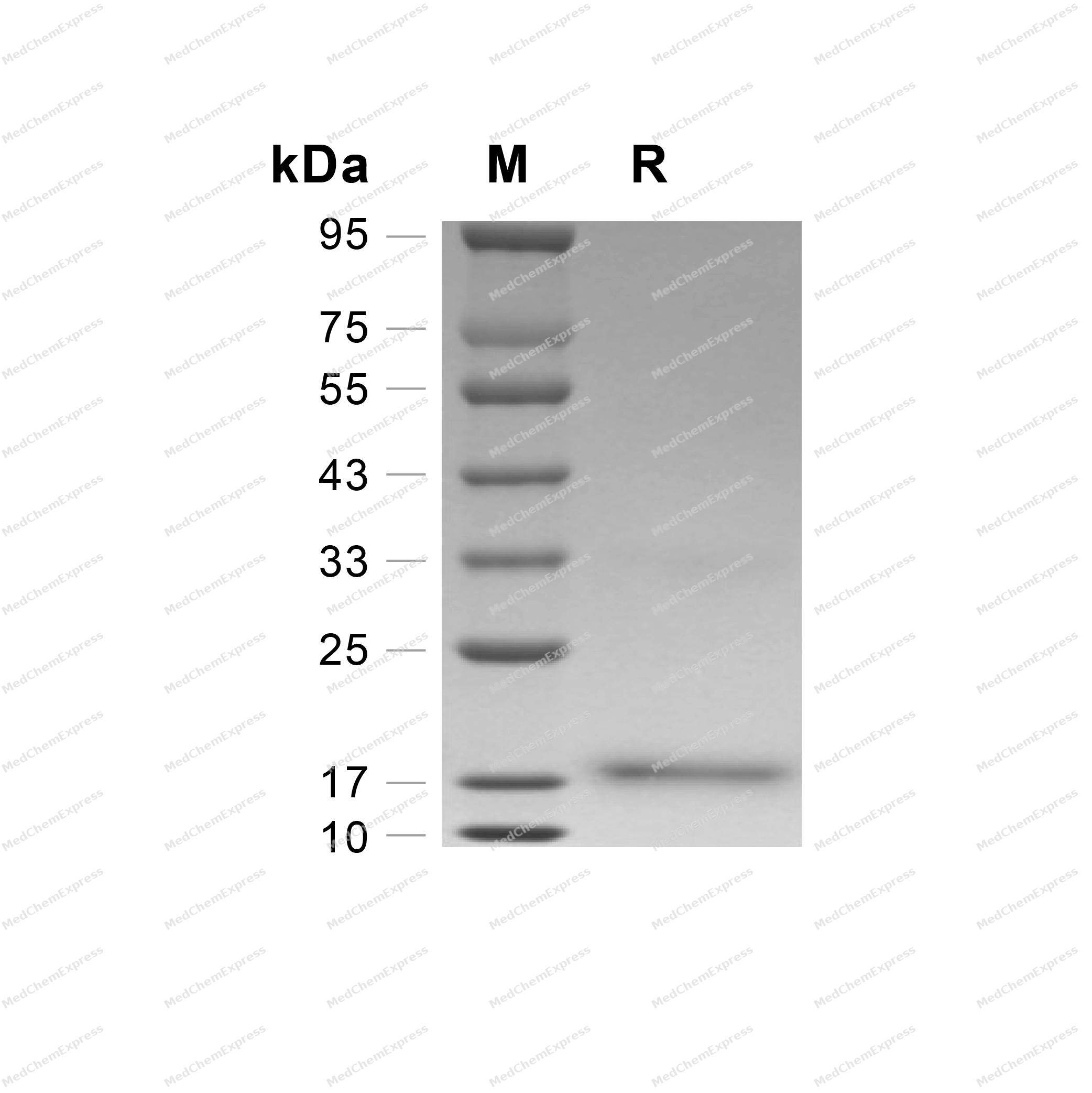
Purity - SDS-PAGE


Technical Parameters
-
Species Human
-
Source E. coli
-
Tag N-His
-
Accession
Q96B02-1 (M1-C151)
-
Molecular Construction
-
N-term
-
His
-
UBE2W (M1-C151)
Accession # Q96B02-1 -
C-term
-
-
Protein Length
Full Length of Isoform-1
-
Synonyms
UBE2W; Ubiquitin Conjugating Enzyme E2 W; N-Terminal E2 Ubiquitin-Conjugating Enzyme; E2 Ubiquitin-Conjugating Enzyme W; Ubiquitin Carrier Protein W; Ubiquitin-Protein Ligase W; N-Terminus-Conjugating E2; UBC-16; Ubiquitin-Conjugating Enzyme E2 W; Ubiquit
-
AA Sequence
MASMQKRLQKELLALQNDPPPGMTLNEKSVQNSITQWIVDMEGAPGTLYEGEKFQLLFKFSSRYPFDSPQVMFTGENIPVHPHVYSNGHICLSILTEDWSPALSVQSVCLSIISMLSSCKEKRRPPDNSFYVRTCNKNPKKTKWWYHDDTC
-
Predicted Molecular Mass
17.3 kDa
-
Molecular Weight
Approximately 18kDa, based on SDS-PAGE under reducing conditions.
-
Purity
≥ 95%, as determined by reducing SDS-PAGE.


Product Properties
Lyophilized powder.
1.Lyophilized from a 0.22 μm filtered solution of 50 mM Tris-HCl, 300 mM NaCl, pH 8.0.
Note: For SPR assay, please replace the buffer. Primary amine components (e.g., Tris, imidazole) can affect protein-coupled chips.
<1 EU/μg, determined by LAL method.
It is not recommended to reconstitute to a concentration less than 100 μg/mL in ddH2O.
Stored at -20°C for 2 years from date of receipt. After reconstitution, it is stable at 4°C for 1 week or -20°C for longer (with carrier protein). It is recommended to freeze aliquots at -20°C or -80°C for extended storage.
Room temperature in continental US; may vary elsewhere.


Documentation
-
Data Sheet (236 KB)
-
SDS (252 KB)
- English - EN (252 KB)
- Français - FR (252 KB)
- Deutsch - DE (252 KB)
- Norwegian - NO (252 KB)
- Español - ES (252 KB)
- Swedish - SV (252 KB)
- Italian - IT (252 KB)
- Korean - KR (252 KB)
- Portuguese - PT (252 KB)
-
Handling Instructions (2659 KB)

Calculators
Concentration (start) × Volume (start) = Concentration (final) × Volume (final)


 Powered by Bioz

