1. Search Result
Search Result
Results for "

hydrogen-bonding network

" in MedChemExpress (MCE) Product Catalog:

7

Inhibitors & Agonists

2

Biochemical Assay Reagents

Cat. No. Product Name Target Research Areas Chemical Structure
  • HY-112624J

    Dextran 4; Dextran D4; Dextran T4(MW 3200-4800)

    Bacterial Others
    Dextran 4,000 is a mucus rheology modifier. The dextran molecules in Dextran 4,000 can reduce the cross-link density of mucus through osmotic effects and hydrogen bond substitution, and reduce viscoelasticity and improve the mucociliary/cough clearance index by destroying the DNA-mucin network structure in mucus. Dextran 4,000 has the ability to improve the rheological properties and clearance ability of cystic fibrosis (CF) sputum, and can be used in the study of inhalation therapy or aerosol delivery of mucostatic respiratory diseases. The Dextran series of compounds are also natural polysaccharide drug carriers that can be connected to drugs through covalent bonding methods such as ester bonds, amide bonds or click chemistry, or self-assembled to form carriers such as nanoparticles and hydrogels. Dextran is biodegradable and biocompatible, and can achieve targeted delivery and controlled release of drugs. Dextran derivatives can prolong the half-life of drugs, increase local concentrations, and reduce the activity of immune clearance .
    Dextran T4 (MW 4,000)
  • HY-W127776

    Ethylenediaminetetraacetic acid zinc disodium tetrahydrate

    Biochemical Assay Reagents Others
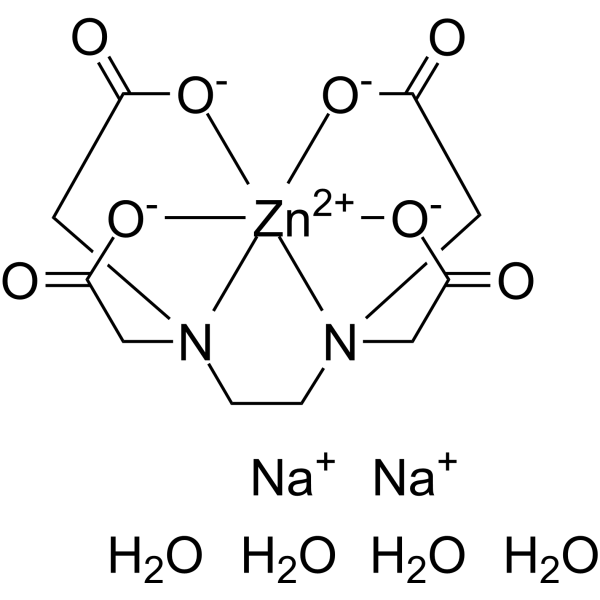
    Zn(II)-EDTA (Ethylenediaminetetraacetic acid zinc) disodium tetrahydrate is a coordinating agent. Zn(II)-EDTA disodium tetrahydrate coordinates with Zn 2+ to modify its solvated structure, provides pre-synthesized EDTA-Zn complexes that release Zn 2+ to repair zinc anode defects under interfacial electric field, adsorbs onto zinc anode surface to block oxygen and water molecules, inhibits corrosion and hydrogen evolution reactions, promotes uniform Zn 2+ deposition, suppresses zinc dendrite formation, and modulates the hydrogen bonding network within the electrolyte. Zn(II)-EDTA disodium tetrahydrate acts as an electrolyte additive to enhance reversibility and stability of zinc anodes in aqueous zinc-ion batteries .
    Zn(Ⅱ)-EDTA disodium tetrahydrate
  • HY-W206987

    Drug Intermediate Others
    2-(Aminomethyl)benzoic acid is an amino acid derivative and also a building block for heterogeneously synthetic folded oligomers with repeating γ/α 2-Amb-Pro motifs. 2-(Aminomethyl)benzoic acid can be used to construct synthetic oligomers .
    2-(Aminomethyl)benzoic acid
  • HY-182346

    FBPase Metabolic Disease
    FBPase-IN-7 is a fructose-1,6-bisphosphatase (FBPase) inhibitor with an IC50 of 0.75 μM. FBPase-IN-7 binds to a cryptic allosteric pocket of FBPase, induces conformational rearrangement of key residues, forms a hydrogen-bond network, and disrupts substrate catalysis. FBPase-IN-7 confirms cellular stabilizes HuFBPase in hepatic cells. FBPase-IN-7 has hypoglycemic activity. FBPase-IN-7 can be used for the research of type 2 diabetes .
    FBPase-IN-7
  • HY-182344

    Ligands for Target Protein for PROTAC Mixed Lineage Kinase Cancer
    MLKL ligand-2 is a mixed lineage kinase domain-like pseudokinase (MLKL) PROTAC ligand with a KD of 9.408 μM. MLKL ligand-2 forms hydrogen bond networks and hydrophobic interactions with specific MLKL residues, and stabilizes MLKL in hepatic cells. MLKL ligand-2 can be used to synthesize PROTAC MLKL Degrader-3 (HY-182343) .
    MLKL ligand-2
  • HY-181888

    HIV HIV Protease Infection
    GRL-142 is a potent HIV-1 protease inhibitor capable of crossing the blood-brain barrier. GRL-142 exhibits extremely high inhibitory activity against both wild-type and multidrug-resistant strains (IC50=0.0094 nM). GRL-142 acts synergistically with the P2/P2' segments via a unique scaffold binding mechanism, utilizes fluorine-mediated stable interactions to maintain its bioactive conformation, adapts to p51 HIV-1 protease mutants, and maintains the flap-closed state by directly acting on the flap tip residues. GRL-142 disrupts the flap-water hydrogen bond network of wild-type protease, thereby effectively blocking viral replication. GRL-142 can be used to study HIV-1 infection and the associated neurocognitive disorder (HAND) .
    GRL-142
  • HY-116053

    HSP Neurological Disease
    PU-11 is a Hsp90α/Hsp90β inhibitor with IC50 values of 18.6 μM and 89.8 μM and Kd values of 2 and 4.2 μM. PU-11 binds to the ATP-binding pocket of Hsp90α and Hsp90β and displays selective binding preference for Hsp90α over Hsp90β, mediated by the nonconserved Hsp90α Ser52 residue. PU-11 can be used for the research of neurodegenerative disorders .
    PU-11

Inquiry Online

Your information is safe with us. * Required Fields.

Salutation


Country or Region *

Applicant Name *


Organization Name *

Department *


Email Address *


Product Name *

Cat. No.


Requested quantity *

Phone Number *


Remarks

Inquiry Online

Inquiry Information

Product Name:
Cat. No.:
Quantity:
MCE Japan Authorized Agent:

