8 Results for "

polar hydrogen bonding

" in MedChemExpress (MCE) Product Catalog:
Products (8)

8 Results for "polar hydrogen bonding" in MCE Product Catalog:

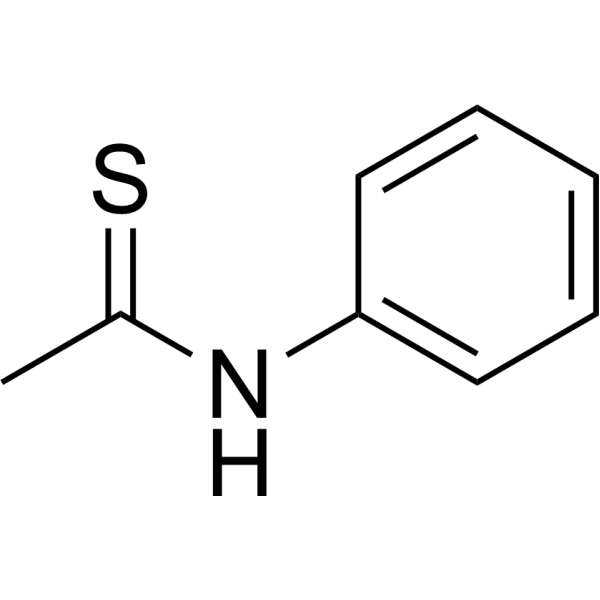
Cat. No.: HY-129756
CAS No.: 637-53-6
Purity:  98.35%
Synonyms: N-Phenylthioacetamide
Research Areas:  

Metabolic Disease

Thioacetanilide (N-Phenylthioacetamide) is a sulfur-containing thioamide derivative of acetanilide. Thioacetanilide displays a solvent‑dependent Z/E isomeric distribution, preferring the E conformation in polar hydrogenbonding solvents and the Z conformation in halogenated solvents. Thioacetanilide serves as a substrate for metabolic desulfurization and aromatic hydroxylation. Thioacetanilide is mainly metabolized via desulfurization and 4‑hydroxylation of the aromatic ring in Rattus norvegicus, and the released sulfur integrates into the total body sulfur pool. Thioacetanilide is well absorbed in rats, and more than 90% of the dose is excreted in urine as conjugated metabolites after oral administration .
loading...
    loading...
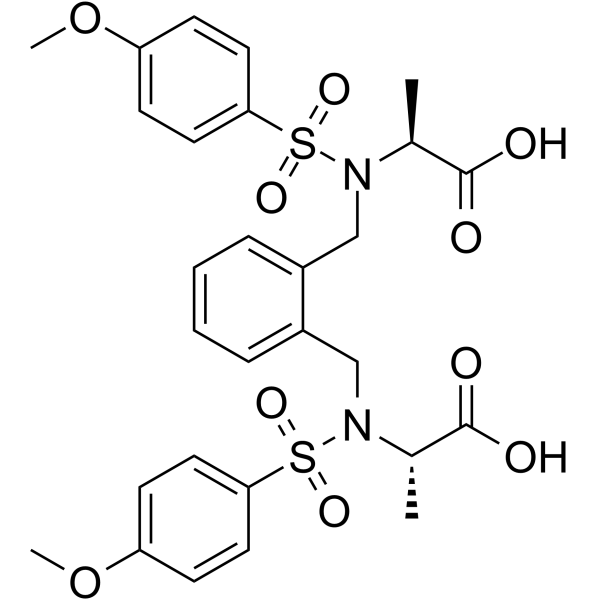
Cat. No.: HY-150579
CAS No.: 2456294-92-9
Purity:  96.77%
Target:  

Keap1-Nrf2

Research Areas:  

Inflammation/Immunology Cancer

Keap1-Nrf2-IN-13 is a Keap1-Nrf2 protein–protein interaction (PPI) inhibitor with an IC50 value of 0.15 μM. Keap1-Nrf2-IN-13 has strong binding affinities to the Keap1 protein by forming hydrogen bond with the key polar residues (Asn414, Arg415, Arg483, Gln530). Keap1-Nrf2-IN-13 can be used in the research of oxidative stress-related and inflammatory diseases, including pulmonary fibrosis, chronic obstructive pulmonary disorder (COPD) and cancers .
loading...
    loading...
Cat. No.: HY-181944
Target:  

RIP kinase Necroptosis

Research Areas:  

Cancer

RIPK1-IN-40 (Compound 51) is a RIPK1 inhibitor and anti-necroptotic agent (with an EC50 of 0.07 μM against necroptosis). RIPK1-IN-40 binds to the kinase domain of RIPK1, forms hydrogen bond interactions with Met95, and establishes additional polar contacts with Asp156 to stabilize binding, thereby inhibiting necroptosis. RIPK1-IN-40 can be used for the research of colorectal cancer .
loading...
    loading...
Cat. No.: HY-187677
CAS No.: 94159-34-9
Target:  

PCSK9 LDLR

Research Areas:  

Metabolic Disease

PCSK9-IN-36 is a PCSK9 inhibitor and a flavonoid glycoside derivative. PCSK9-IN-36 binds stably within the surface groove of PCSK9 through hydrophobic interactions involving its flavonoid scaffold and an electrostatic hydrogen-bonding network formed by its polar glycosidic group, thereby competitively blocking the interaction between PCSK9 and the low-density lipoprotein receptor (LDLR). PCSK9-IN-36 can be used for research on hypercholesterolemia .
loading...
    loading...
Cat. No.: HY-181980
CAS No.: 883054-47-5
Target:  

Glyoxalase (GLO)

Research Areas:  

Cancer

SPB07393SC is a glyoxalase-I (Glo-I) inhibitor with an IC50 of 11.1 μM. SPB07393SC is applicable for cancer research .
loading...
    loading...
Cat. No.: HY-L936V0
11412 compounds

Molecular Glue Virtual Library is constructed using generative AI technology, integrating the structural features, activity data of known molecular glues, and interaction information of ternary complexes (target protein-E3-molecular glue). Endowed with structural novelty, drug-likeness, diversity and synthesizability, it is applicable to molecular glue-based AI drug screening and large-scale virtual screening.

MCE builds this library based on high-quality molecular building blocks by virtue of robust computing power, coupled with rigorous reaction rules and optimized compound generation strategies. To ensure library quality, molecules with high synthetic difficulty, poor drug-likeness, PAINS and other undesirable molecules are excluded first. Subsequently, scaffold-based compound analysis is performed to screen drug-like diverse molecules for synthesizability evaluation; those with excessively high synthetic difficulty are removed, ultimately forming a large-scale molecular glue virtual library with structural diversity, synthesizability and drug-likeness.

Compounds in the library can be synthesized in only 1-2 chemical reaction steps. With MCE’s experienced chemical synthesis team, custom synthesis of different scales from milligram to kilogram can be easily achieved to meet diverse customer needs.

Cat. No.: HY-L912V0
10,000,000 compounds
With MCE's 40,662 BBs, covering around 273 reaction types, more than 40 million molecules were generated. Compounds which comply with Ro5 criteria were selected. Inappropriate chemical structures, such as PAINS motifs and synthetically difficult accessible, were removed. Based on Morgan Fingerprint, molecular clustering analysis was carried out, and molecules close to each clustering center were extracted to form this drug-like and synthesizable diversity library. These selected molecules have 805,822 unique Bemis-Murcko Scaffolds (BMS) with diversified chemical space. This library is highly recommended for AI-based lead discovery, ultra-large virtual screening and novel lead discovery.
Cat. No.: HY-L910V
50,000 compounds
MegaUni 50K Virtual Diversity Library consists of 50,000 novel, synthetically accessible, lead-like compounds. With MCE's 40,662 Building Blocks, covering around 273 reaction types, more than 40 million molecules were generated. Based on Morgan Fingerprint and Tanimoto Coefficient, molecular clustering analysis was carried out, and molecules closest to each clustering center were extracted to form a drug-like and synthesizable diversity library. The selected 50,000 drug-like molecules have 46,744 unique Bemis-Murcko Scaffolds (BMS), each containing only 1-3 compounds. This diverse library is highly recommended for virtual screening and novel lead discovery.

