



Thioacetanilide

Based on 1 Customer Validation
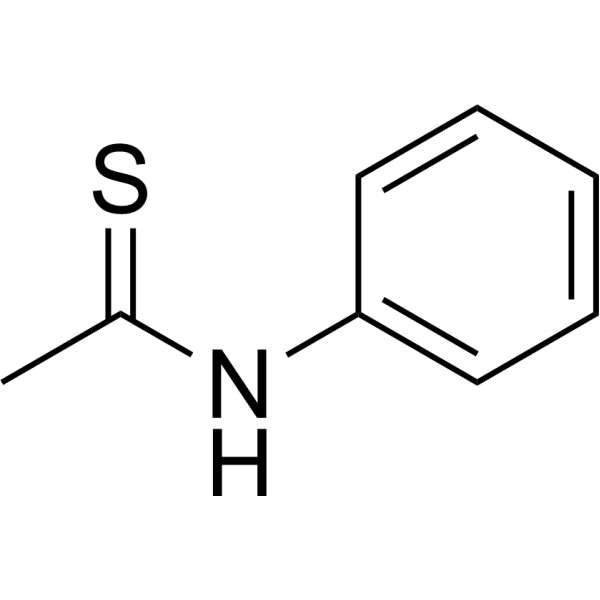
Thioacetanilide (N-Phenylthioacetamide) is a sulfur-containing thioamide derivative of acetanilide. Thioacetanilide displays a solvent‑dependent Z/E isomeric distribution, preferring the E conformation in polar hydrogen‑bonding solvents and the Z conformation in halogenated solvents. Thioacetanilide serves as a substrate for metabolic desulfurization and aromatic hydroxylation. Thioacetanilide is mainly metabolized via desulfurization and 4‑hydroxylation of the aromatic ring in Rattus norvegicus, and the released sulfur integrates into the total body sulfur pool. Thioacetanilide is well absorbed in rats, and more than 90% of the dose is excreted in urine as conjugated metabolites after oral administration.
Nur für Forschungszwecke. Wir verkaufen nicht an Patienten.
- Reinheit : 98.35%
- CAS. Nr.: 637-53-6
- Formel: C8H9NS
- Molecular Weight:151.23
-
Speicherung:Powder -20°C, 3 years , 4°C, 2 years ; In solvent -80°C, 6 months , -20°C, 1 month

To place orders, for customer services and technical support, please contact: MedChemExpress USA
Tel: 609-228-6898 E-mail: [email protected] [email protected]


-
 Biologische Aktivität
-
Chemical Information
-
Lösungsmittel & Löslichkeit
- Protokoll
- Reinheit & Dokumentation
- Verweise
-
 Help & FAQs




Biologische Aktivität
Beschreibung
In Vitro
Thioacetanilide (N-Phenylthioacetamide) shows solvent-dependent Z/E isomer preference, with the E isomer favored in more polar, hydrogen-bond-forming solvents, reaching a 7:93 Z/E ratio in DMSO-d6 at 298 K[1].
MedChemExpress (MCE) has not independently confirmed the accuracy of these methods. They are for reference only.
In Vivo
MedChemExpress (MCE) has not independently confirmed the accuracy of these methods. They are for reference only.
-
Animal Model:Wistar rats (adult male, 250-300 g)[2]
-
Dosage:100 mg/kg; 500 mg/kg; 1000 mg/kg
-
Administration:p.o.; single dose
-
Result:Excreted over 90% of the dose in urine mainly as conjugated metabolites within 96 hours, less than 7% unchanged compound in faeces, and merely 3.4% via bile as N-acetyl-4-aminophenol glucuronide.
Detected major urinary metabolites such as N-acetyl-4-aminophenol sulphate and 4-hydroxythioacetanilide sulphate, along with minor related conjugates and parent substance.
Caused no liver glutathione depletion, with liver biochemical parameters remaining normal at 100 mg/kg.
Displayed no hepatotoxicity at 500 mg/kg, and all hepatic indicators kept consistent with control levels.
Induced mortalities at 1000 mg/kg, and surviving animals had slightly increased ALT levels 24 hours post-administration.


Chemical Information
-
CAS. Nr. 637-53-6
-
Appearance Solid
-
Molecular Weight 151.23
-
Formel C8H9NS
-
Color Off-white to light brown
-
SMILES
CC(NC1=CC=CC=C1)=S
-
Synonyms
N-Phenylthioacetamide
-
Versand
Room temperature in continental US; may vary elsewhere.
-
Speicherung
Powder -20°C 3 years 4°C 2 years In solvent -80°C 6 months -20°C 1 month


Lösungsmittel & Löslichkeit
In Vitro:
DMSO : 200 mg/mL (1322.49 mM; Need ultrasonic; Hygroscopic DMSO has a significant impact on the solubility of product, please use newly opened DMSO)
Please refer to the solubility information to select the appropriate solvent. Once prepared, please aliquot and store the solution to prevent product inactivation from repeated freeze-thaw cycles.
Storage method and period of stock solution: -80°C, 6 months; -20°C, 1 month. When stored at -80°C, please use it within 6 months. When stored at -20°C, please use it within 1 month.
Please refer to the solubility information to select the appropriate solvent. Once prepared, please aliquot and store the solution to prevent product inactivation from repeated freeze-thaw cycles.
Storage method and period of stock solution: -80°C, 6 months; -20°C, 1 month. When stored at -80°C, please use it within 6 months. When stored at -20°C, please use it within 1 month.
Konzentration (Stammlösung) × Volumen (Stammlösung) = Konzentration (Ziellösung) × Volumen (Ziellösung)


Reinheit & Dokumentation
-
Data Sheet (273 KB)
-
SDS (393 KB)
- English - EN (393 KB)
- Français - FR (393 KB)
- Deutsch - DE (393 KB)
- Norwegian - NO (393 KB)
- Español - ES (393 KB)
- Swedish - SV (393 KB)
- Italian - IT (393 KB)
- Korean - KR (393 KB)
- Portuguese - PT (393 KB)
-
Handling Instructions (2659 KB)
Verweise


Complete Stock Solution Preparation Table
Please refer to the solubility information to select the appropriate solvent. Once prepared, please aliquot and store the solution to prevent product inactivation from repeated freeze-thaw cycles.
Storage method and period of stock solution: -80°C, 6 months; -20°C, 1 month. When stored at -80°C, please use it within 6 months. When stored at -20°C, please use it within 1 month.
| Optional Solvent | Concentration Solvent Mass | 1 mg | 5 mg | 10 mg | 25 mg |
|---|---|---|---|---|---|
| DMSO | 1 mM | 6.6124 mL | 33.0622 mL | 66.1244 mL | 165.3111 mL |
| 5 mM | 1.3225 mL | 6.6124 mL | 13.2249 mL | 33.0622 mL | |
| 10 mM | 0.6612 mL | 3.3062 mL | 6.6124 mL | 16.5311 mL | |
| 15 mM | 0.4408 mL | 2.2041 mL | 4.4083 mL | 11.0207 mL | |
| 20 mM | 0.3306 mL | 1.6531 mL | 3.3062 mL | 8.2656 mL | |
| 25 mM | 0.2645 mL | 1.3225 mL | 2.6450 mL | 6.6124 mL | |
| 30 mM | 0.2204 mL | 1.1021 mL | 2.2041 mL | 5.5104 mL | |
| 40 mM | 0.1653 mL | 0.8266 mL | 1.6531 mL | 4.1328 mL | |
| 50 mM | 0.1322 mL | 0.6612 mL | 1.3225 mL | 3.3062 mL | |
| 60 mM | 0.1102 mL | 0.5510 mL | 1.1021 mL | 2.7552 mL | |
| 80 mM | 0.0827 mL | 0.4133 mL | 0.8266 mL | 2.0664 mL | |
| 100 mM | 0.0661 mL | 0.3306 mL | 0.6612 mL | 1.6531 mL |


Thioacetanilide Related Classifications
HY-129756 Related Classifications
 Powered by Bioz