1. Search Result
Search Result
Results for "

reductive amination

" in MedChemExpress (MCE) Product Catalog:

13

Inhibitors & Agonists

1

Fluorescent Dyes

1

Click Chemistry

Cat. No. Product Name Target Research Areas Chemical Structure
  • HY-D1336

    Fluorescent Dye
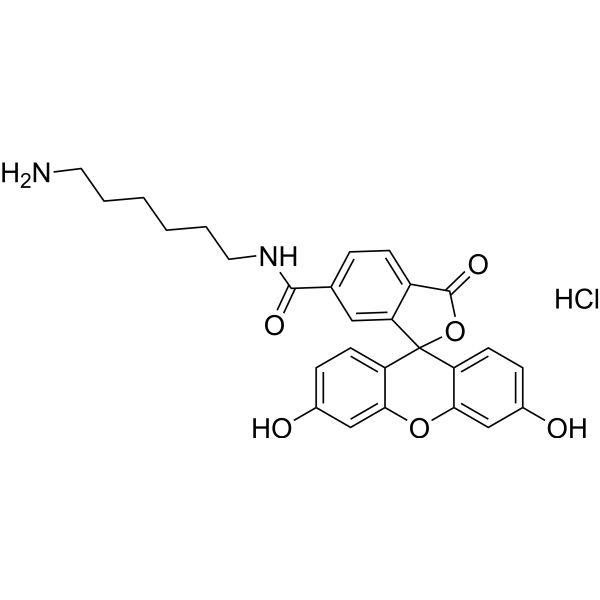
    FAM amine, 6-isomer is a fluorescein derivative with an amine group and contains an isomer of the fluorophore. Can be used to modify biomolecules through enzymatic transamination. Its fatty amine groups can also react with electrophiles such as activated esters. The amine can also be conjugated to carbonyl compounds (aldehydes and ketones) by reductive amination.
    FAM amine, 6-isomer
  • HY-P2768

    LDH, EC 1.4.1.9

    Endogenous Metabolite Metabolic Disease
    Leucine dehydrogenase, Microorganism (EC 1.4.1.9) can be purified from Bacillus spheroides. Leucine dehydrogenase catalyzed the oxidative deamination of L-leucine, L-valine, L-isoleucine, L-norvaline, L-alpha-aminobutyrate, and L-norleucine, and the reductive amination of their keto analogues .
    Leucine dehydrogenase, Microorganism
  • HY-W099634

    Heptadecan-9-one

    Biochemical Assay Reagents Others
    9-Heptadecanone (Heptadecan-9-one) is an aliphatic molecule with a central ketone on a C17 chain. The ketone may react with amines in reductive aminations to link this molecule to larger lipid structures.
    9-Heptadecanone
  • HY-W586329

    Ligands for E3 Ligase Others
    Thalidomide-4-carbaldehyde is a Thalidomide analogue with an aldehyde. Thalidomide recruiits E3 ligase for the ubiquitinylation and subsequent proteolysis of target proteins. The aldehyde is highly reactive towards amine nucleophiles through reductive amination among other reactions.
    Thalidomide-4-carbaldehyde
  • HY-W451211

    Ligands for E3 Ligase Cancer
    Thalidomide-5-carbaldehyde is a Thalidomide analogue with an aldehyde. Thalidomide recruiits E3 ligase for the ubiquitinylation and subsequent proteolysis of target proteins. The aldehyde is highly reactive towards amine nucleophiles through reductive amination among other reactions.
    Thalidomide-5-carbaldehyde
  • HY-W010685

    [Rh(dppb)(COD)]BF4

    Biochemical Assay Reagents Endogenous Metabolite Others
    [1,4-Bis(diphenylphosphino)butane](1,5-cyclooctadiene)rhodium(I) tetrafluoroborate ([Rh(dppb)(COD)]BF4) serves as a rhodium-based catalyst that facilitates regioselective hydrogenation and enantioselective reductive amination reactions.
    [1,4-BIs(diphenylphosphino)butane](1,5-cyclooctadiene)rhodium(I) tetrafluoroborate
  • HY-W800837

    ADC Linker Cancer
    t-Boc-N-amido-PEG4-Val-Cit is a protease-cleavable ADC linker featuring a Boc-protected amine, a hydrophilic PEG spacer, and a Val-Cit dipeptide. The Val-Cit dipeptide is cleavable by cell proteases and features a carboxylic acid which is free for coupling reactions with amines to form amides. The Boc can be removed under acidic conditions to reveal a free primary amine, which may be used in a variety of reactions such as coupling or reductive amination.
    t-Boc-N-amido-PEG4-Val-Cit
  • HY-W800619

    ADC Linker Others
    NH2-PEG4-Val-Cit-PAB-OH is a cleavable ADC linker featuring a primary amine, a hydrophilic PEG spacer, a Val-Cit dipeptide, and a PAB group. The benzylic alcohol on the PAB can be used to attach with reactive groups such as PNP for conjugation with drug payloads. The primary amine is free to perform a wide variety of reactions such as coupling with carboxylic acids, reductive aminations with ketones or aldehydes, or other more specialized uses such as in SNAr reactions or heterocyclic chemistry. The Val-Cit dipeptide is cleaved by cellular proteases within the cell to allow for efficient payload delivery via an elimination mechanism within the PAB structure.
    NH2-PEG4-Val-Cit-PAB-OH
  • HY-W800618

    ADC Linker Others
    NH2-PEG3-Val-Cit-PAB-OH is a cleavable ADC linker featuring a primary amine, a hydrophilic PEG spacer, a Val-Cit dipeptide, and a PAB group. The benzylic alcohol on the PAB can be used to attach with reactive groups such as PNP for conjugation with drug payloads. The primary amine is free to perform a wide variety of reactions such as coupling with carboxylic acids, reductive aminations with ketones or aldehydes, or other more specialized uses such as in SNAr reactions or heterocyclic chemistry. The Val-Cit dipeptide is cleaved by cellular proteases within the cell to allow for efficient payload delivery via an elimination mechanism within the PAB structure.
    NH2-PEG3-Val-Cit-PAB-OH
  • HY-W800617

    ADC Linker Cancer
    NH2-PEG1-Val-Cit-PAB-OH is a cleavable ADC linker intermediate featuring a primary amine, a hydrophilic PEG spacer, a Val-Cit dipeptide, and a PAB group. The benzylic alcohol on the PAB can be used to attach with reactive groups such as PNP for conjugation with drug payloads. The primary amine is free to perform a wide variety of reactions such as coupling with carboxylic acids, reductive aminations with ketones or aldehydes, or other more specialized uses such as in SNAr reactions or heterocyclic chemistry. The Val-Cit dipeptide is cleaved by cellular proteases within the cell to allow for efficient payload delivery via an elimination mechanism within the PAB structure.
    NH2-PEG1-Val-Cit-PAB-OH
  • HY-W800620

    ADC Linker Others
    NH2-PEG6-Val-Cit-PAB-OH is a cleavable ADC linker featuring a primary amine, a hydrophilic PEG spacer, a Val-Cit dipeptide, and a PAB group. The benzylic alcohol on the PAB can be used to attach with reactive groups such as PNP for conjugation with drug payloads. The primary amine is free to perform a wide variety of reactions such as coupling with carboxylic acids, reductive aminations with ketones or aldehydes, or other more specialized uses such as in SNAr reactions or heterocyclic chemistry. The Val-Cit dipeptide is cleaved by cellular proteases within the cell to allow for efficient payload delivery via an elimination mechanism within the PAB structure.
    NH2-PEG6-Val-Cit-PAB-OH
  • HY-W800833

    Biochemical Assay Reagents Others
    Benzyl N-[2-(prop-2-enamido)ethyl]carbamate is a short aliphatic linker featuring a Cbz-protected amine and an acrylamide. Acrylamide is a Michael acceptor which is a good Michael acceptor which can be used in thiol-based bioconjugation or polymerization. Meanwhile, the Cbz protecting group can be removed using Pd-C hydrogenation to reveal a free amine that can participate in a wide variety of reactions such as couplings or reductive amination.
    Benzyl N-[2-(prop-2-enamido)ethyl]carbamate
  • HY-186077

    Drug Intermediate Biochemical Assay Reagents Others
    PEDA is a chemical intermediate. PEDA can participate in the CuAAC reaction to synthesize ethylenediamine analogs including Biot-EDA, Cy3-EDA, EDA-AG and EDA-m 7Gp3G, which are used for RNA modification .
    PEDA

Inquiry Online

Your information is safe with us. * Required Fields.

Salutation


Country or Region *

Applicant Name *


Organization Name *

Department *


Email Address *


Product Name *

Cat. No.


Requested quantity *

Phone Number *


Remarks

Inquiry Online

Inquiry Information

Product Name:
Cat. No.:
Quantity:
MCE Japan Authorized Agent:

