5 Results for "

ubiquitin-proteasomal pathway

" in MedChemExpress (MCE) Product Catalog:
Products (5)

5 Results for "ubiquitin-proteasomal pathway" in MCE Product Catalog:

2
2 Cited Publications
Cat. No.: HY-N10549
CAS No.: 83088-28-2
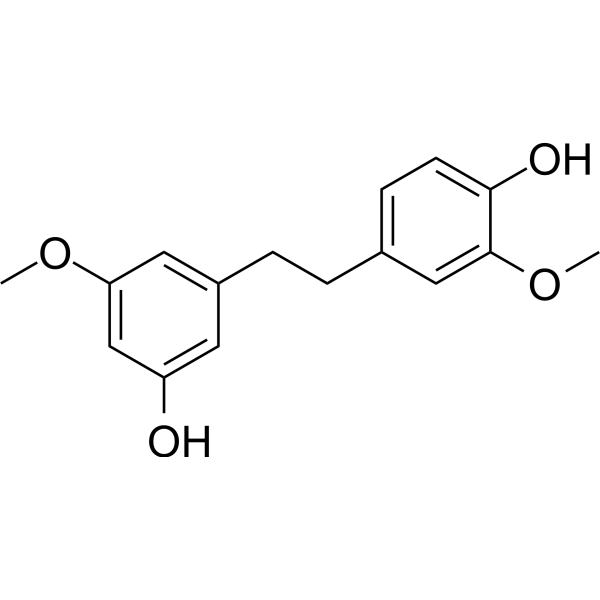
Gigantol is an orally active bibenzyl compound. Gigantol targets MYC to promote its ubiquitin-proteasomal degradation and inhibit the growth of lung cancer cells. Gigantol exerts anti-lung cancer activity by inducing ferroptosis (Ferroptosis) via the SLC7A11-GPX4 axis. Gigantol restores the sensitivity of mcr-harboring multidrug-resistant bacteria to colistin. Gigantol ameliorates carbon tetrachloride-induced liver injury by inhibiting the activation of the JNK/cPLA2/12-LOX inflammatory pathway. Gigantol promotes cholesterol metabolism and progesterone biosynthesis in Leydig cells. Gigantol can be used in studies related to diseases such as lung cancer, multidrug-resistant Gram-negative bacterial infections, and acute liver injury .
loading...
    loading...
Cat. No.: HY-168274
CAS No.: 3100306-42-8
Research Areas:  

Cancer

PROTAC TRIB2 degrader-1 is a selective TRIB2 PROTAC degrader with a DC50 of 16.84 nM in PC3 cells. PROTAC TRIB2 degrader-1 directly interacts with TRIB2 and induces its degradation via the CRBN-dependent ubiquitin-proteasome pathway. PROTAC TRIB2 degrader-1 inhibits cancer cell proliferation and promotes apoptosis by inducing PARP cleavage. PROTAC TRIB2 degrader-1 is applicable to relevant research on prostate cancer .
loading...
    loading...
Cat. No.: HY-179033
Nur77 antagonist 2 (Compound 12b) is an orally active Nur77 antagonist with a KD value of 0.42 μM. Nur77 antagonist 2 exhibits proliferative activity on liver cancer cells. Nur77 antagonist 2 stabilizes Nur77 by inhibiting its ubiquitin-proteasomal degradation, leading to Nur77-dependent apoptosis via the ASK1-JNK/p38 pathway. Nur77 antagonist 2 inhibits tumor growth in the HCCLM3 xenograft model. Nur77 antagonist 2 can be used for the study of hepatocellular carcinoma (HCC) .
loading...
    loading...
Cat. No.: HY-186247
CAS No.: 885986-52-7
Target:  

c-Myc Apoptosis

Research Areas:  

Neurological Disease Cancer

N-Myc-IN-1 is a selective N-Myc inhibitor/degrader with a Kd value of 1.47 μM. N-Myc-IN-1 promotes phosphorylation of N-Myc at threonine-58, triggers N-Myc degradation via the ubiquitin-proteasome pathway, and suppresses the expression of N-Myc target genes. N-Myc-IN-1 reduces the viability of MYCN-dependent tumor cells and induces apoptosis. N-Myc-IN-1 can be used in the research of neuroblastoma .
loading...
    loading...
Cat. No.: HY-184335
CAS No.: 3097564-20-7
Research Areas:  

Cancer

PROTAC BET Degrader-18 is a PROTAC targeting BET, with a DC50 of 0.676 nM in HEK293-BRD4-HiBiT-KI cells. PROTAC BET Degrader-18 mainly targets and degrades BRD4 (EC50 = 59.91 nM), and exhibits weak degradation activity against BRD2. PROTAC BET Degrader-18 inhibits the expression of downstream oncoprotein c-Myc, thereby inducing cell cycle arrest and apoptosis, while suppressing oncoprotein expression. PROTAC BET Degrader-18 shows antiproliferative activity against acute myeloid leukemia cells and triple-negative breast cancer cells. PROTAC BET Degrader-18 demonstrates antitumor efficacy in xenograft mouse models. PROTAC BET Degrader-18 can be used for the research of acute myeloid leukemia and triple-negative breast cancer .
loading...
    loading...

