



3,5,6-Trichloro-2-pyridinol
Based on 1 publication(s) in Google Scholar
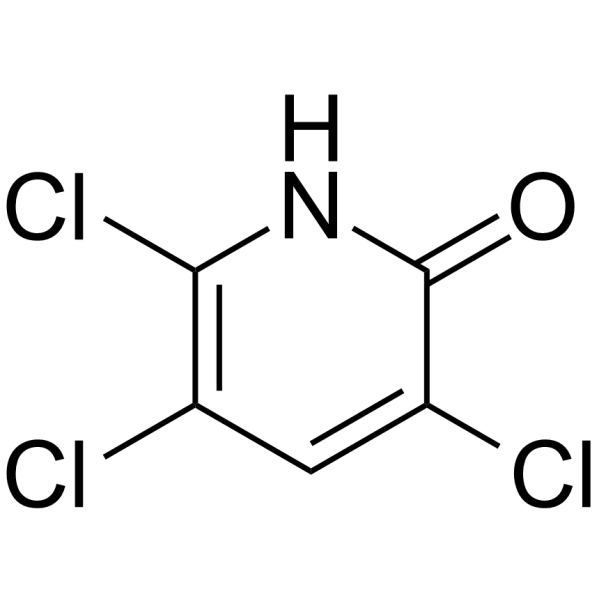
3,5,6-Trichloro-2-pyridinol (TCPy) is a chloride of 2-pyridone with oral activity. 3,5,6-Trichloro-2-pyridinol is the main degradation product of the herbicide Triclopyr and the insecticides Chlorpyrifos and chlorpyrifos-methyl. 3,5,6-Trichloro-2-pyridinol is associated with attention deficit hyperactivity disorder (ADHD) and decreased testosterone levels. 3,5,6-Trichloro-2-pyridinol causes hearing loss, hepatotoxicity and nephrotoxicity in mice .
For research use only. We do not sell to patients.
- Purity : 99.85%
- CAS No.: 6515-38-4
- Formula: C5H2Cl3NO
- Molecular Weight:198.43
-
Storage:Powder -20°C, 3 years , 4°C, 2 years ; In solvent -80°C, 6 months , -20°C, 1 month

To place orders, for customer services and technical support, please contact: MedChemExpress USA
Tel: 609-228-6898 E-mail: [email protected] [email protected]


-
 Biological Activity
-
Chemical Information
-
Solvent & Solubility
- Purity & Documentation
- References
-
 Help & FAQs


Publications Citing Use of MedChemExpress (MCE) 3,5,6-Trichloro-2-pyridinol
More

Biological Activity
Description
In Vivo
3,5,6-Trichloro-2-pyridinol (5-150 mg/kg, daily for 28 days) induces hepatotoxicity and nephrotoxicity, as well as metabolic disturbances[5].
MedChemExpress (MCE) has not independently confirmed the accuracy of these methods. They are for reference only.
-
Animal Model:male mice[5]
-
Dosage:5, 50, 150 mg/kg
-
Administration:Oral gavage (p.o.), daily for 28 days
-
Result:The final body weights of treated groups were significantly lower than control, and the relative organ weights of the liver and kidney were significantly higher than that of control.
A total of 39 serum metabolites were significantly changed in the treated groups, and these metabolites are related to hepatotoxicity and nephrotoxicity.
Metabolic disturbances were also observed.
-
Animal Model:adult male C57BL/6 mice[4]
-
Dosage:50, 150 mg/kg
-
Administration:21 days
-
Result:Showed a dose-dependent elevation of hearing threshold.
Outer hair cells and spiral neuron cells were lost in a dose-dependent manner.
Type I and V of spiral ligament were severely shrunk and stria vascularis were thinned.
ROS levels in the cochlea were significantly increased whereas the activities of anti-oxidation enzymes were decreased.
The expression level of Na+/K+ ATPase was decreased, resulting in cochlear potential disruption.
Levels of inflammatory factors (TNF-α and IL-1β), γ-H2AX, and pro-apoptotic-related factors (Bax and cleaved-Caspase 3) were elevated, respectively.


Chemical Information
-
CAS No. 6515-38-4
-
Appearance Solid
-
Molecular Weight 198.43
-
Formula C5H2Cl3NO
-
Color Off-white to gray
-
SMILES
O=C1C(Cl)=CC(Cl)=C(Cl)N1
-
Synonyms
TCPy
-
Shipping
Room temperature in continental US; may vary elsewhere.
-
Storage
Powder -20°C 3 years 4°C 2 years In solvent -80°C 6 months -20°C 1 month


Publications (1)
-
Journal Impact Factor
-
Most Recent
-
Anal Chem
Exposome-Scale Investigation of Cl-/Br-Containing Chemicals Using High-Resolution Mass Spectrometry, Multistage Machine Learning, and Cloud Computing. [Abstract]2025 Jun 3;97(21):11099-11109. PMID: 40401576


Solvent & Solubility
In Vitro:
DMSO : 32.5 mg/mL (163.79 mM; Need ultrasonic; Hygroscopic DMSO has a significant impact on the solubility of product, please use newly opened DMSO)
Please refer to the solubility information to select the appropriate solvent. Once prepared, please aliquot and store the solution to prevent product inactivation from repeated freeze-thaw cycles.
Storage method and period of stock solution: -80°C, 6 months; -20°C, 1 month. When stored at -80°C, please use it within 6 months. When stored at -20°C, please use it within 1 month.
Please refer to the solubility information to select the appropriate solvent. Once prepared, please aliquot and store the solution to prevent product inactivation from repeated freeze-thaw cycles.
Storage method and period of stock solution: -80°C, 6 months; -20°C, 1 month. When stored at -80°C, please use it within 6 months. When stored at -20°C, please use it within 1 month.
Concentration (start) × Volume (start) = Concentration (final) × Volume (final)
In Vivo:
Select the appropriate dissolution method based on your experimental animal and administration route.
- For the following dissolution methods, please ensure to first prepare a clear stock solution using an In Vitro approach and then sequentially add co-solvents:
- To ensure reliable experimental results, the clarified stock solution can be appropriately stored based on storage conditions. As for the working solution for In Vivo experiments, it is recommended to prepare freshly and use it on the same day.
- The percentages shown for the solvents indicate their volumetric ratio in the final prepared solution. If precipitation or phase separation occurs during preparation, heat and/or sonication can be used to aid dissolution.
Add each solvent one by one: 10% DMSO 40% PEG300 5% Tween-80 45% Saline
Solubility: ≥ 3.25 mg/mL (16.38 mM); Clear solution
This protocol yields a clear solution of ≥ 3.25 mg/mL (saturation unknown).
Taking 1 mL working solution as an example, add 100 μL DMSO stock solution (32.5 mg/mL) to 400 μL PEG300, and mix evenly; then add 50 μL Tween-80 and mix evenly; then add 450 μL Saline to adjust the volume to 1 mL.
Preparation of Saline: Dissolve 0.9 g sodium chloride in ddH₂O and dilute to 100 mL to obtain a clear Saline solution.
In Vivo Dissolution Calculator
Please enter the basic information of animal experiments:
-
-
-
-
Recommended: Prepare an additional quantity of animals to account for potential losses during experiments.
Please enter your animal formula composition:
-
%DMSO +
Recommended: Keep the proportion of DMSO in working solution below 2% if your animal is weak.
-
%+
-
+%Tween-80 + +
-
%Saline +
The co-solvents required include: DMSO, . All of co-solvents are available by MedChemExpress (MCE). , Tween 80. All of co-solvents are available by MedChemExpress (MCE).
Working solution concentration: 0.22 mg/mL
Method for preparing stock solution: mg drug dissolved in μL DMSO. Stock solution concentration: mg/mL.
1. Take μL DMSO stock solution;
2. Add μL .
μL , mix evenly;
3. Then add μL Tween 80, mix evenly;
4. Then add μL
Please ensure that the stock solution in the first step is dissolved to a clear state, and add co-solvents in sequence. You can use ultrasonic heating (ultrasonic cleaner, recommended frequency 20-40 kHz), vortexing, etc. to assist dissolution.


Purity & Documentation
-
Data Sheet (282 KB)
-
SDS (758 KB)
- English - EN (758 KB)
- Français - FR (758 KB)
- Deutsch - DE (758 KB)
- Norwegian - NO (758 KB)
- Español - ES (758 KB)
- Swedish - SV (758 KB)
- Italian - IT (758 KB)
- Korean - KR (758 KB)
- Portuguese - PT (758 KB)
-
Handling Instructions (2659 KB)
References
[1]. Jingquan Li, et al. Novel gene clusters and metabolic pathway involved in 3,5,6-trichloro-2-pyridinol degradation by Ralstonia sp. strain T6. Appl Environ Microbiol. 2013 Dec;79(23):7445-53. [Content Brief]
[2]. Fortenberry GZ, et al. Urinary 3,5,6-trichloro-2-pyridinol (TCPY) in pregnant women from Mexico City: distribution, temporal variability, and relationship with child attention and hyperactivity. Int J Hyg Environ Health. 2014 Mar;217(2-3):405-12. [Content Brief]
[3]. Meeker JD, et al. Exposure to nonpersistent insecticides and male reproductive hormones. Epidemiology. 2006 Jan;17(1):61-8. [Content Brief]
[4]. Huang M, et al. Pesticide metabolite 3, 5, 6-trichloro-2-pyridinol causes massive damage to the cochlea resulting in hearing loss in adult mice. Environ Pollut. 2024 Nov 1;360:124691. [Content Brief]
[5]. Deng Y, et al. Hepatotoxicity and nephrotoxicity induced by the chlorpyrifos and chlorpyrifos-methyl metabolite, 3,5,6-trichloro-2-pyridinol, in orally exposed mice. Sci Total Environ. 2016 Feb 15;544:507-14. [Content Brief]


Complete Stock Solution Preparation Table
Please refer to the solubility information to select the appropriate solvent. Once prepared, please aliquot and store the solution to prevent product inactivation from repeated freeze-thaw cycles.
Storage method and period of stock solution: -80°C, 6 months; -20°C, 1 month. When stored at -80°C, please use it within 6 months. When stored at -20°C, please use it within 1 month.
| Optional Solvent | Concentration Solvent Mass | 1 mg | 5 mg | 10 mg | 25 mg |
|---|---|---|---|---|---|
| DMSO | 1 mM | 5.0396 mL | 25.1978 mL | 50.3956 mL | 125.9890 mL |
| 5 mM | 1.0079 mL | 5.0396 mL | 10.0791 mL | 25.1978 mL | |
| 10 mM | 0.5040 mL | 2.5198 mL | 5.0396 mL | 12.5989 mL | |
| 15 mM | 0.3360 mL | 1.6799 mL | 3.3597 mL | 8.3993 mL | |
| 20 mM | 0.2520 mL | 1.2599 mL | 2.5198 mL | 6.2995 mL | |
| 25 mM | 0.2016 mL | 1.0079 mL | 2.0158 mL | 5.0396 mL | |
| 30 mM | 0.1680 mL | 0.8399 mL | 1.6799 mL | 4.1996 mL | |
| 40 mM | 0.1260 mL | 0.6299 mL | 1.2599 mL | 3.1497 mL | |
| 50 mM | 0.1008 mL | 0.5040 mL | 1.0079 mL | 2.5198 mL | |
| 60 mM | 0.0840 mL | 0.4200 mL | 0.8399 mL | 2.0998 mL | |
| 80 mM | 0.0630 mL | 0.3150 mL | 0.6299 mL | 1.5749 mL | |
| 100 mM | 0.0504 mL | 0.2520 mL | 0.5040 mL | 1.2599 mL |


3,5,6-Trichloro-2-pyridinol Related Classifications
HY-W018171 Related Classifications
 Powered by Bioz