



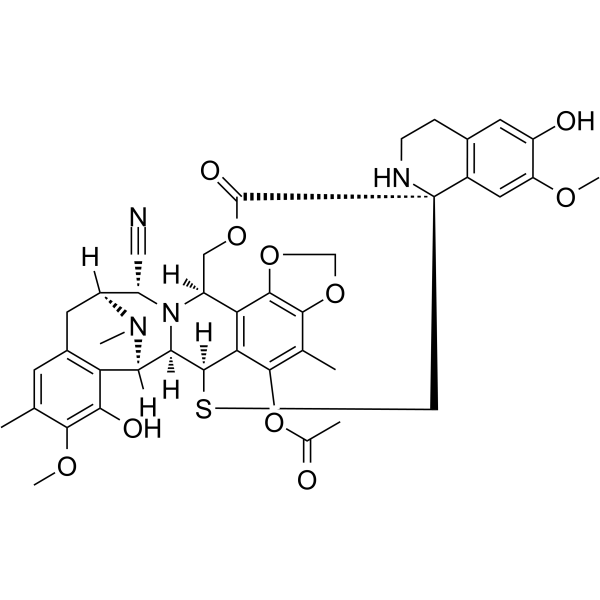
Ecteinascidin 770
Based on 2 publication(s) in Google Scholar
Ecteinascidin 770 (ET-770) is a 1,2,3,4-tetrahydroisoquinoline alkaloid with potent anti-cancer activities; inhibits U373MG cells with an IC50 of 4.83 nM.
For research use only. We do not sell to patients.
- Purity : 99.76%
- CAS No.: 114899-80-8
- Formula: C40H42N4O10S
- Molecular Weight:770.85
-
Storage:
-20°C, protect from light, stored under nitrogen
* In solvent : -80°C, 6 months; -20°C, 1 month (protect from light, stored under nitrogen)

To place orders, for customer services and technical support, please contact: MedChemExpress USA
Tel: 609-228-6898 E-mail: [email protected] [email protected]


-
 Biological Activity
-
Chemical Information
-
Solvent & Solubility
- Protocols
- Purity & Documentation
- References
-
 Help & FAQs


Publications Citing Use of MedChemExpress (MCE) Ecteinascidin 770
More

Biological Activity
Description
IC50 & Target
IC50: 4.83 nM (U373MG cell)[1]; 0.6 nM (HCT116 cell), 2.4 nM (QG56 cell), 0.81 nM (DU145)[2]
Cellular Effect
|
Cell Line

|
Type | Value | Description | References |
|---|---|---|---|---|
| Cancer cell lines | IC50 |
2.5 nM
Compound: 1b
|
Cytotoxicity against breast cancer cells
Cytotoxicity against breast cancer cells
|
[PMID: 12088444] |
| DLD-1 | IC50 |
2.4 nM
Compound: ecteinascidin 770
|
Cytotoxicity against human DLD1 cells after 4 days
Cytotoxicity against human DLD1 cells after 4 days
|
[PMID: 14640515] |
| DU-145 | IC50 |
0.81 nM
Compound: 1b
|
Cytotoxicity against human DU145 cells after 4 days by MTT assay
Cytotoxicity against human DU145 cells after 4 days by MTT assay
|
[PMID: 21752654] |
| HCT-116 | IC50 |
0.6 nM
Compound: 1b
|
Cytotoxicity against human HCT116 cells after 4 days by MTT assay
Cytotoxicity against human HCT116 cells after 4 days by MTT assay
|
[PMID: 21752654] |
| HCT-116 | IC50 |
1.2 nM
Compound: ecteinascidin 770
|
Cytotoxicity against human HCT116 cells after 4 days
Cytotoxicity against human HCT116 cells after 4 days
|
[PMID: 14640515] |
| KB | IC50 |
0.034 nM
Compound: 1b
|
Cytotoxicity against human KB cells
Cytotoxicity against human KB cells
|
[PMID: 12088444] |
| NCI-H460 | IC50 |
0.64 nM
Compound: ecteinascidin 770
|
Cytotoxicity against human NCI-H460 cells after 4 days
Cytotoxicity against human NCI-H460 cells after 4 days
|
[PMID: 14640515] |
| QG-56 | IC50 |
2.4 nM
Compound: 1b
|
Cytotoxicity against human QG56 cells after 4 days by MTT assay
Cytotoxicity against human QG56 cells after 4 days by MTT assay
|
[PMID: 21752654] |
| QG-56 | IC50 |
3.9 nM
Compound: ecteinascidin 770
|
Cytotoxicity against human QG56 cells after 4 days
Cytotoxicity against human QG56 cells after 4 days
|
[PMID: 14640515] |
In Vitro
Ecteinascidin 770 induces apoptosis of U373MG cells. The IC50 concentration of ecteinascidin 770 for killing U373MG glioblastoma cells in culture by using the MTT assay is 4.83 nM by a 72 hour-treatment[1]. The IC50 values against human cell lines HCT116, QG56, and DU145 are 0.6, 2.4, and 0.81 nM, respectively[2]. ET-770 is shown to enhance anoikis response of human lung cancer H23 cells in a dose-dependent manner. Ecteinascidin 770 sensitizes the cells by activating the p53 protein, which in turn down-regulates anti-apoptotic myeloid cell leukemia sequence-1 (MCL1) and up-regulates BCL2-associated X protein (BAX) proteins. However, B-cell lymphoma-2 (BCL2) proteins are not significantly affected by Ecteinascidin 770. The anoikis sensitization of ET-770 is observed in H460 lung cancer cells[3].
MedChemExpress (MCE) has not independently confirmed the accuracy of these methods. They are for reference only. Further protocols information, click here.


Chemical Information
-
CAS No. 114899-80-8
-
Appearance Solid
-
Molecular Weight 770.85
-
Formula C40H42N4O10S
-
Color White to yellow
-
SMILES
N#C[C@@H]([C@@]1([H])N(C)[C@]2([H])C3=C(C=C(C)C(OC)=C3O)C1)N4[C@@]2([H])[C@@](SC[C@@]5(NCC6)C7=C6C=C(O)C(OC)=C7)([H])C8=C(C(OCO9)=C9C(C)=C8OC(C)=O)[C@]4([H])COC5=O
-
Synonyms
Ecteinascidine 770; Et-770
-
Structure Classification
-
Initial Source
Ecteinascidia thurstoni
-
Shipping
Room temperature in continental US; may vary elsewhere.
-
Storage
-20°C, protect from light, stored under nitrogen
* In solvent : -80°C, 6 months; -20°C, 1 month (protect from light, stored under nitrogen)


Publications (2)
-
Journal Impact Factor
-
Most Recent
-
mSphere
2024 Jul 30;9(7):e0027324. PMID: 38940508 -


Solvent & Solubility
In Vitro:
DMSO : 50 mg/mL (64.86 mM; Need ultrasonic; Hygroscopic DMSO has a significant impact on the solubility of product, please use newly opened DMSO)
Please refer to the solubility information to select the appropriate solvent. Once prepared, please aliquot and store the solution to prevent product inactivation from repeated freeze-thaw cycles.
Storage method and period of stock solution: -80°C, 6 months; -20°C, 1 month (protect from light, stored under nitrogen). When stored at -80°C, please use it within 6 months. When stored at -20°C, please use it within 1 month.
Please refer to the solubility information to select the appropriate solvent. Once prepared, please aliquot and store the solution to prevent product inactivation from repeated freeze-thaw cycles.
Storage method and period of stock solution: -80°C, 6 months; -20°C, 1 month (protect from light, stored under nitrogen). When stored at -80°C, please use it within 6 months. When stored at -20°C, please use it within 1 month.
Concentration (start) × Volume (start) = Concentration (final) × Volume (final)
In Vivo:
Select the appropriate dissolution method based on your experimental animal and administration route.
- For the following dissolution methods, please ensure to first prepare a clear stock solution using an In Vitro approach and then sequentially add co-solvents:
- To ensure reliable experimental results, the clarified stock solution can be appropriately stored based on storage conditions. As for the working solution for In Vivo experiments, it is recommended to prepare freshly and use it on the same day.
- The percentages shown for the solvents indicate their volumetric ratio in the final prepared solution. If precipitation or phase separation occurs during preparation, heat and/or sonication can be used to aid dissolution.
Add each solvent one by one: 10% DMSO 40% PEG300 5% Tween-80 45% Saline
Solubility: ≥ 2.5 mg/mL (3.24 mM); Clear solution
This protocol yields a clear solution of ≥ 2.5 mg/mL (saturation unknown).
Taking 1 mL working solution as an example, add 100 μL DMSO stock solution (25.0 mg/mL) to 400 μL PEG300, and mix evenly; then add 50 μL Tween-80 and mix evenly; then add 450 μL Saline to adjust the volume to 1 mL.
Preparation of Saline: Dissolve 0.9 g sodium chloride in ddH₂O and dilute to 100 mL to obtain a clear Saline solution.
In Vivo Dissolution Calculator
Please enter the basic information of animal experiments:
-
-
-
-
Recommended: Prepare an additional quantity of animals to account for potential losses during experiments.
Please enter your animal formula composition:
-
%DMSO +
Recommended: Keep the proportion of DMSO in working solution below 2% if your animal is weak.
-
%+
-
+%Tween-80 + +
-
%Saline +
The co-solvents required include: DMSO, . All of co-solvents are available by MedChemExpress (MCE). , Tween 80. All of co-solvents are available by MedChemExpress (MCE).
Working solution concentration: 0.22 mg/mL
Method for preparing stock solution: mg drug dissolved in μL DMSO. Stock solution concentration: mg/mL. * In solvent : -80°C, 6 months; -20°C, 1 month (protect from light, stored under nitrogen)
1. Take μL DMSO stock solution;
2. Add μL .
μL , mix evenly;
3. Then add μL Tween 80, mix evenly;
4. Then add μL
Please ensure that the stock solution in the first step is dissolved to a clear state, and add co-solvents in sequence. You can use ultrasonic heating (ultrasonic cleaner, recommended frequency 20-40 kHz), vortexing, etc. to assist dissolution.

Protocols
-
Cell Cytotoxicity Assay
Cytotoxicity assays are usually based on the assessment of cell membrane damage, which can also be indirectly detected by measuring cell viability. Detection methods include MTT assay, CKK-8 assay, LDH assay and ATP assay, etc.


Purity & Documentation
-
Data Sheet (281 KB)
-
SDS (393 KB)
- English - EN (393 KB)
- Français - FR (393 KB)
- Deutsch - DE (393 KB)
- Norwegian - NO (393 KB)
- Español - ES (393 KB)
- Swedish - SV (393 KB)
- Italian - IT (393 KB)
- Korean - KR (393 KB)
- Portuguese - PT (393 KB)
-
Handling Instructions (2659 KB)
References
[1]. Tabunoki H, et al. Molecular network profiling of U373MG human glioblastoma cells following induction of apoptosis by novel marine-derived anti-cancer 1,2,3,4-tetrahydroisoquinoline alkaloids. Cancer Cell Int. 2012 Apr 11;12(1):14. [Content Brief]
[2]. Saktrakulkla P, et al. Chemistry of ecteinascidins. Part 3: preparation of 2'-N-acyl derivatives of ecteinascidin 770 and evaluation of cytotoxicity. Bioorg Med Chem. 2011 Aug 1;19(15):4421-36. [Content Brief]
[3]. Powan P, et al. Ecteinascidin 770, a tetrahydroisoquinoline alkaloid, sensitizes human lung cancer cells to anoikis. Anticancer Res. 2013 Feb;33(2):505-12. [Content Brief]


Complete Stock Solution Preparation Table
Please refer to the solubility information to select the appropriate solvent. Once prepared, please aliquot and store the solution to prevent product inactivation from repeated freeze-thaw cycles.
Storage method and period of stock solution: -80°C, 6 months; -20°C, 1 month (protect from light, stored under nitrogen). When stored at -80°C, please use it within 6 months. When stored at -20°C, please use it within 1 month.
| Optional Solvent | Concentration Solvent Mass | 1 mg | 5 mg | 10 mg | 25 mg |
|---|---|---|---|---|---|
| DMSO | 1 mM | 1.2973 mL | 6.4863 mL | 12.9727 mL | 32.4317 mL |
| 5 mM | 0.2595 mL | 1.2973 mL | 2.5945 mL | 6.4863 mL | |
| 10 mM | 0.1297 mL | 0.6486 mL | 1.2973 mL | 3.2432 mL | |
| 15 mM | 0.0865 mL | 0.4324 mL | 0.8648 mL | 2.1621 mL | |
| 20 mM | 0.0649 mL | 0.3243 mL | 0.6486 mL | 1.6216 mL | |
| 25 mM | 0.0519 mL | 0.2595 mL | 0.5189 mL | 1.2973 mL | |
| 30 mM | 0.0432 mL | 0.2162 mL | 0.4324 mL | 1.0811 mL | |
| 40 mM | 0.0324 mL | 0.1622 mL | 0.3243 mL | 0.8108 mL | |
| 50 mM | 0.0259 mL | 0.1297 mL | 0.2595 mL | 0.6486 mL | |
| 60 mM | 0.0216 mL | 0.1081 mL | 0.2162 mL | 0.5405 mL |


Ecteinascidin 770 Related Classifications
HY-101191 Related Classifications
 Powered by Bioz