



Eledoisin Related Peptide

Based on 1 Customer Validation
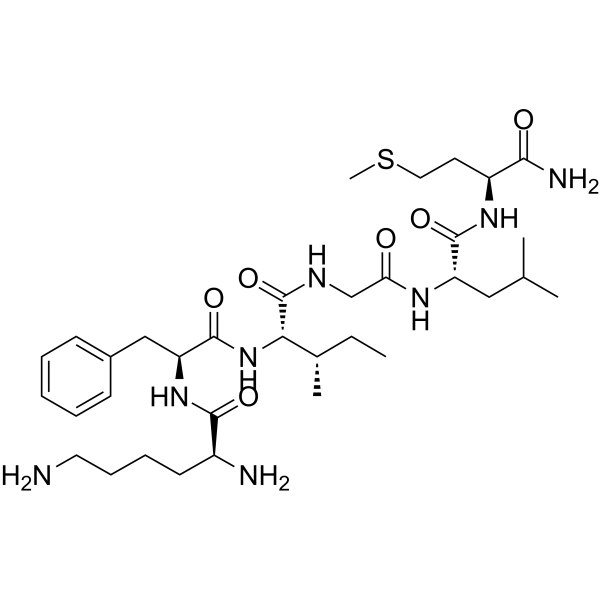
Eledoisin Related Peptide is a Substance P analog that excites neurons and triggers behavioral responses. Eledoisin Related Peptide is also a tachykinin receptor ligand.
For research use only. We do not sell to patients.
- Purity : 99.55%
- CAS No.: 2990-43-4
- Formula: C34H58N8O6S
- Molecular Weight:706.94
-
Storage:
Sealed storage, away from moisture and light, under nitrogen.
Powder -80°C, 2 years , -20°C, 1 year* In solvent : -80°C, 6 months; -20°C, 1 month (sealed storage, away from moisture and light, under nitrogen)

To place orders, for customer services and technical support, please contact: MedChemExpress USA
Tel: 609-228-6898 E-mail: [email protected] [email protected]


-
 Biological Activity
-
Chemical Information
-
Solvent & Solubility
- Protocol
- Purity & Documentation
- References
-
 Help & FAQs


-
HY-P0201
Substance P -
![[Leu5]-Enkephalin](https://file.medchemexpress.com/product_pic/hy-p0288.gif)
HY-P0288
[Leu5]-Enkephalin -
HY-100526
XMU-MP-1 -
HY-P0073
Tyr-Gly-Gly-Phe-Met-OH -

HY-P0197
Neurokinin A -

HY-P0242
Neurokinin B -
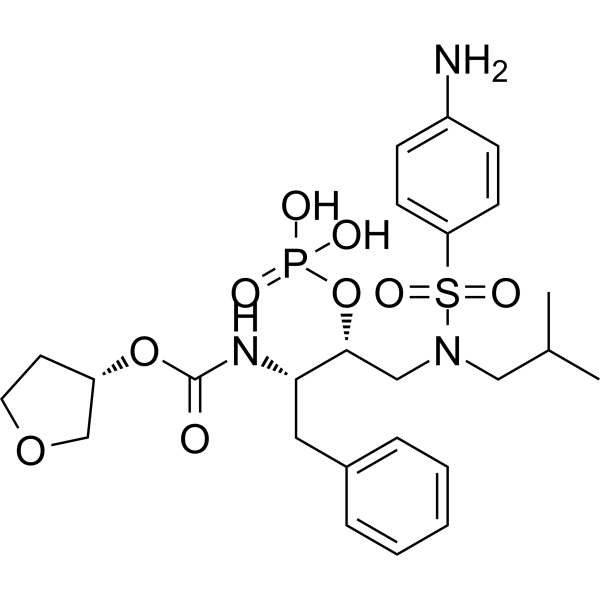
HY-78726
Fosamprenavir -
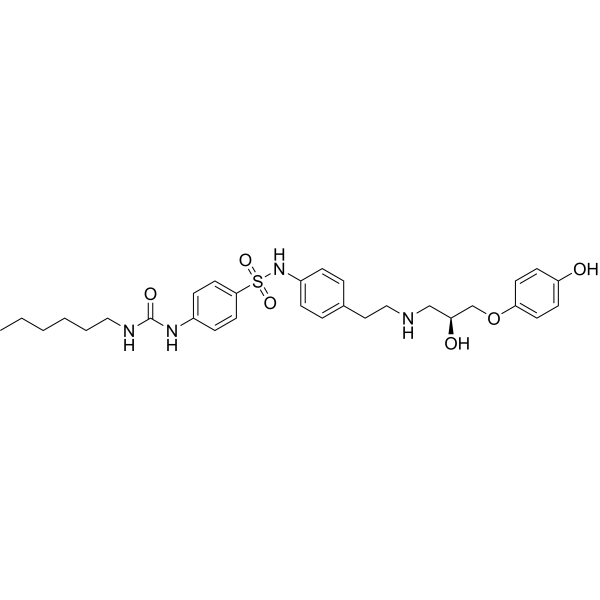
HY-19334
L755507 -
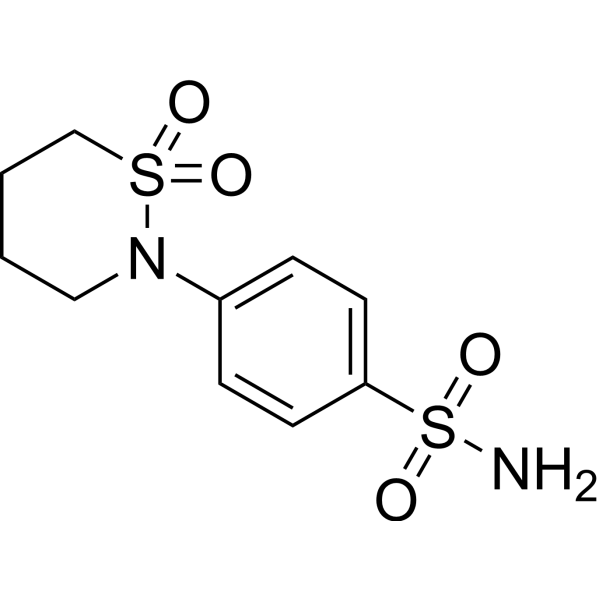
HY-108316
Sultiame -
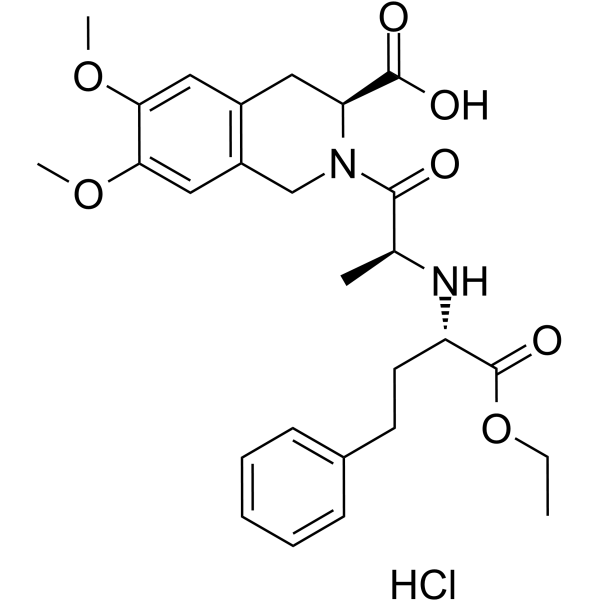
HY-B0378A
Moexipril hydrochloride -
HY-19964
Potassium clavulanate cellulose -
HY-P1183
Locustatachykinin I


Biological Activity
Description
IC50 & Target
Tachykinin receptor[1]
In Vivo
MedChemExpress (MCE) has not independently confirmed the accuracy of these methods. They are for reference only.


Chemical Information
-
CAS No. 2990-43-4
-
Appearance Solid
-
Molecular Weight 706.94
-
Formula C34H58N8O6S
-
Color White to off-white
-
Synonyms
Eledoisin-Related Peptide; Eledoisin RP
-
Sequence
Lys-Phe-Ile-Gly-Leu-Met-NH2
-
Sequence Shortening
KFIGLM-NH2
-
Shipping
Room temperature in continental US; may vary elsewhere.
-
Storage
Sealed storage, away from moisture and light, under nitrogen
Powder -80°C 2 years -20°C 1 year * In solvent : -80°C, 6 months; -20°C, 1 month (sealed storage, away from moisture and light, under nitrogen)


Solvent & Solubility
In Vitro:
DMSO : ≥ 100 mg/mL (141.45 mM; Hygroscopic DMSO has a significant impact on the solubility of product, please use newly opened DMSO)
* "≥" means soluble, but saturation unknown.
Please refer to the solubility information to select the appropriate solvent. Once prepared, please aliquot and store the solution to prevent product inactivation from repeated freeze-thaw cycles.
Storage method and period of stock solution: -80°C, 6 months; -20°C, 1 month (sealed storage, away from moisture and light, under nitrogen). When stored at -80°C, please use it within 6 months. When stored at -20°C, please use it within 1 month.
Please refer to the solubility information to select the appropriate solvent. Once prepared, please aliquot and store the solution to prevent product inactivation from repeated freeze-thaw cycles.
Storage method and period of stock solution: -80°C, 6 months; -20°C, 1 month (sealed storage, away from moisture and light, under nitrogen). When stored at -80°C, please use it within 6 months. When stored at -20°C, please use it within 1 month.
Concentration (start) × Volume (start) = Concentration (final) × Volume (final)

Protocol
Animal Administration[2]
Rats[2]
Twenty-two male albino rats (230-260 g) are anesthetized with chloral hydrate (400 mg/kg, i.p.) and prepared for recording. Briefly, a singlebarrel recording pipette (tip 1 μm) is glued alongside a conventional five-barrel micropipette (tip 15-25/μm) then filled with 2 M NaCI saturated with Fast Green (impedance 4-7 M). The distance between the tip of the recording electrode and that of the five-barrel micropipette is 15-25/zm. Fast Green is ejected at the end of the experiment to identify the recording site. One side barrel of the five-barrel micropipette is loaded with 4 M NaCI for automatic current balancing and the others with three of the following solutions: L-epinephrine bitartrate (0. l M, pH 4.0), L-norepinephrine bitartrate (0.1 M, pH 4.0), Substance P (2.75 mM), physalaemin (2.6 mM), substance P 4-11 octapeptide (3.1 mM), eledoisin-related peptide (20 mM), neurotensin, bradykinin triacetate (15 mM), met-enkephalin (6.5 mM), TRH (48 mM). Spontaneously active cells are recorded in the locus coeruleus or in the nearby mesencephalic nucleus of the fifth nerve whose cells are easily identified by their increased activity upon manipulation of the jaw[2].
MedChemExpress (MCE) has not independently confirmed the accuracy of these methods. They are for reference only.


Purity & Documentation
-
Data Sheet (277 KB)
-
SDS (252 KB)
- English - EN (252 KB)
- Français - FR (252 KB)
- Deutsch - DE (252 KB)
- Norwegian - NO (252 KB)
- Español - ES (252 KB)
- Swedish - SV (252 KB)
- Italian - IT (252 KB)
- Korean - KR (252 KB)
- Portuguese - PT (252 KB)
-
Handling Instructions (2659 KB)
References
[1]. Severini C, et al. The tachykinin peptide family. Pharmacol Rev. 2002 Jun;54(2):285-322. [Content Brief]
[2]. Guyenet PG, et al. Excitation of neurons in the nucleus locus coeruleus by substance P and related peptides. Brain Res. 1977 Nov 4;136(1):178-84. [Content Brief]
[3]. Henry JL, et al. Effects of glutamate, substance P and eledoisin-related peptide on solitary tract neurones involved in respiration and respiratory reflexes. Neuroscience. 1985 Mar;14(3):863-73. [Content Brief]


Complete Stock Solution Preparation Table
Please refer to the solubility information to select the appropriate solvent. Once prepared, please aliquot and store the solution to prevent product inactivation from repeated freeze-thaw cycles.
Storage method and period of stock solution: -80°C, 6 months; -20°C, 1 month (sealed storage, away from moisture and light, under nitrogen). When stored at -80°C, please use it within 6 months. When stored at -20°C, please use it within 1 month.
| Optional Solvent | Concentration Solvent Mass | 1 mg | 5 mg | 10 mg | 25 mg |
|---|---|---|---|---|---|
| DMSO | 1 mM | 1.4145 mL | 7.0727 mL | 14.1455 mL | 35.3637 mL |
| 5 mM | 0.2829 mL | 1.4145 mL | 2.8291 mL | 7.0727 mL | |
| 10 mM | 0.1415 mL | 0.7073 mL | 1.4145 mL | 3.5364 mL | |
| 15 mM | 0.0943 mL | 0.4715 mL | 0.9430 mL | 2.3576 mL | |
| 20 mM | 0.0707 mL | 0.3536 mL | 0.7073 mL | 1.7682 mL | |
| 25 mM | 0.0566 mL | 0.2829 mL | 0.5658 mL | 1.4145 mL | |
| 30 mM | 0.0472 mL | 0.2358 mL | 0.4715 mL | 1.1788 mL | |
| 40 mM | 0.0354 mL | 0.1768 mL | 0.3536 mL | 0.8841 mL | |
| 50 mM | 0.0283 mL | 0.1415 mL | 0.2829 mL | 0.7073 mL | |
| 60 mM | 0.0236 mL | 0.1179 mL | 0.2358 mL | 0.5894 mL | |
| 80 mM | 0.0177 mL | 0.0884 mL | 0.1768 mL | 0.4420 mL | |
| 100 mM | 0.0141 mL | 0.0707 mL | 0.1415 mL | 0.3536 mL |


Eledoisin Related Peptide Related Classifications
HY-P1186 Related Classifications
 Powered by Bioz