Cancer Targeted Therapy
Cancer targeted therapy is the foundation of precision medicine; it uses drugs or other substances to target specific genes and proteins that control cancer cells’ growth, division and spreading. Compared to traditional chemotherapy drugs, targeted-drugs can specifically act on cancer cells with high efficacy without damaging normal cells. Drugs used in cancer targeted therapy mainly includes small molecules and macromolecules (e.g., monoclonal antibodies), which can target cancer cells and constituents in the tumor microenvironment to activate the immune system. Anti-angiogenesis drugs, such as those targeting vascular endothelial growth factor (VEGF), epidermal growth factor receptor (EGFR), transforming growth factor (TGF)-α, TGF-β, Tumor necrosis factor (TNF)-α, and platelet-derived endothelial growth factor (PDGFR) inhibit the proliferation and metastasis of cancer cells. In recent years, the proportion of antibody drugs in cancer treatment has gradually become prominent. Antibody-drug conjugates (ADCs) are a new type of targeted drugs that are composed of monoclonal antibody, cytotoxic drug and linker. ADCs can deliver drugs to tumor cells and minimize the toxicity to normal tissues. Proteolysis-targeting chimera (PROTAC) is a useful technology for targeted protein degradation. PROTAC exploits the ubiquitin-proteasome system and forms a ternary complex with a hijacked E3 ubiquitin ligase and target protein, leading to polyubiquitination and degradation of the target protein.
Targeted therapy is a useful strategy in treatment of cancer either alone or in combination with standard chemotherapy. At present, targeted therapy has proved significant clinical success in the treatment of many types of cancer, including breast cancer, colorectal cancer, leukemia, ovarian cancer and lung cancer.
-
hsa-miR-133a-5p inhibitor
 0 ImagesCat. No.: HY-RI00252
hsa-miR-133a-5p inhibitors are chemically-modified oligonucleotides that hybridize with mature miRNAs. The miRNA inhibitors have full-length nucleotide 2'-methoxy modification. The miRNA inhibitors strongly compete with mature miRNAs to prevent the complementary pairing of miRNAs and their target genes, thereby inhibiting miRNAs from functioning.
-
VTP50469 (Standard)
 0 ImagesCat. No.: HY-114162RCAS No.: 2169916-18-9Synonyms: SNDX-50469 (Standard)
VTP50469 (Standard) is the analytical standard of VTP50469. This product is intended for research and analytical applications. VTP50469 is a potent, highly selective and orally active Menin-MLL interaction inhibitor with a Ki of 104 pM. VTP50469 has potently anti-leukemia activity.
-
AG01
 0 ImagesCat. No.: HY-P991664
AG01 is a monoclonal antibody against progranulin (GP88). AG01 inhibits triple-negative breast cancer (TNBC) cell proliferation and migration, reduces the expression of phosphorylated protein kinases p-Src, p-AKT, and p-ERK, and reduces the expression of oncogenic proteins such as Axl, c-MET, HIF-1α, and VEGF. AG01 inhibits tumor growth and Ki67 expression in a TNBC xenograft mouse model. AG01 can be used in the research of TNBC and other cancers.
-
N1,N6-Dimethylhexane-1,6-diamine
 0 ImagesCat. No.: HY-W098350CAS No.: 13093-04-4
-
cis-3-Aminocyclobutanecarbonitrile hydrochloride
 0 ImagesCat. No.: HY-W057861CAS No.: 1638765-32-8
-
CRBN ligand-704
 0 ImagesCat. No.: HY-W592698CAS No.: 2446913-97-7
-
(R)-(+)-O-Demethylbuchenavianine
 0 Images
(R)-(+)-O-Demethylbuchenavianine is an inhibitor for Cyclin-dependent kinases (CDK). (R)-(+)-O-Demethylbuchenavianine inhibits CDK1, CDK5, glycogen synthase kinase-3 (GSK3), cdc2-like kinase (CLK1) and dual specificity tyrosine-phosphorylation-regulated kinase 1A (DYRK1A), with IC50s of 1.1, 0.95, >10, >10 and >10 μM, respectively.
-
PD 169316 (Standard)
 0 Images
PD 169316 (Standard) is the analytical standard of PD 169316 (HY-10578). This product is intended for research and analytical applications. PD 169316 is a potent, cell-permeable and selective p38 MAP kinase inhibitor, with IC50 of 89 nM. PD169316 selectively inhibits the kinase activity of the phosphorylated p38 without hindering upstream kinases to phosphorylate p38. PD169316 shows antiviral activity against Enterovirus71. PD169316 shows antiviral activity against Enterovirus71.

-
T338C Src-IN-1
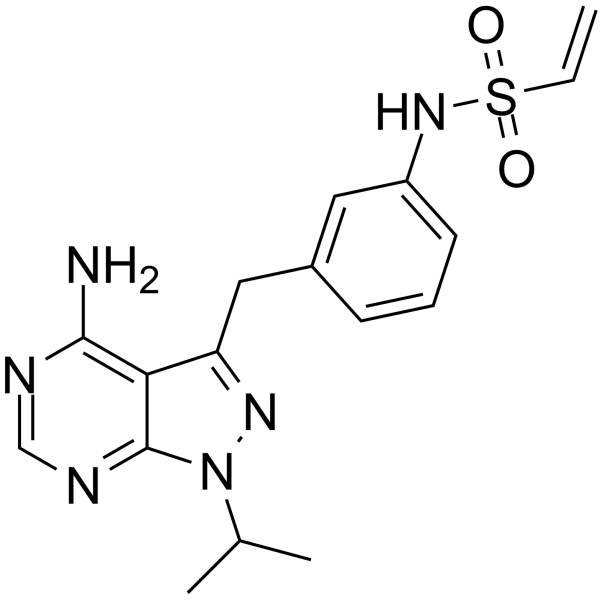 0 ImagesCat. No.: HY-16905CAS No.: 1351926-90-3
T338C Src-IN-1 is a potent mutant-Src T338C inhibitor; exhibited the most potent inhibition of T338C(IC50=111 nM) relative to WT c-Src (10-fold increase).
-
3’-O-Me-C(Bz)-2’-phosphoramidite
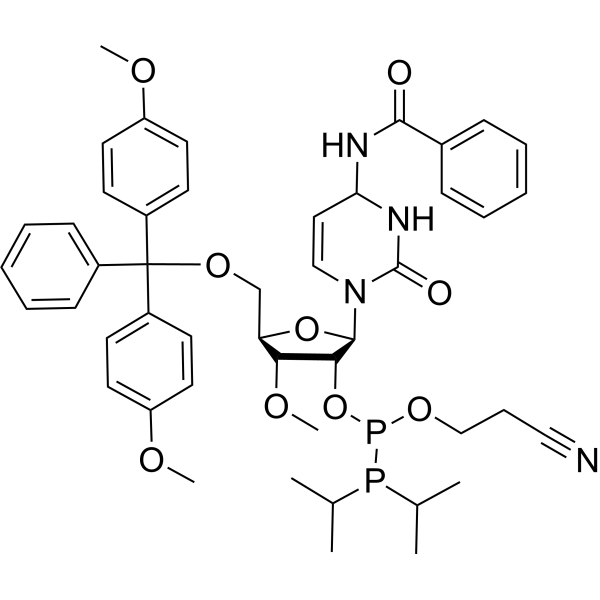 0 ImagesCat. No.: HY-154481CAS No.: 179479-03-9
3’-O-Me-C(Bz)-2’-phosphoramidite is a purine nucleoside analog. Purine nucleoside analogs have broad antitumor activity targeting indolent lymphoid malignancies. Anticancer mechanisms in this process rely on inhibition of DNA synthesis, induction of apoptosis, etc.
-
Bemcentinib (Standard)
 0 ImagesCat. No.: HY-15150RCAS No.: 1037624-75-1Synonyms: R428 (Standard); BGB324 (Standard)
Bemcentinib (Standard) is the analytical standard of Bemcentinib. This product is intended for research and analytical applications. Bemcentinib (R428) is a selective and orally active Axl inhibitor with an IC50 of 14 nM. Bemcentinib retards cancer cell migration and invasion. Bemcentinib exhibits >100-fold selectivity for Axl versus Abl and 50- and >100-fold selectivity over TAM family kinases Mer and Tyro3, respectively, in cells. Bemcentinib blocks tumor spread and prolongs survival in models of metastatic breast cancer.
-
Anti-Mouse ICOS Antibody (7E.17G9)
 0 ImagesCat. No.: HY-P990237Purity: 98%
Anti-Mouse ICOS Antibody (7E.17G9) is a mouse ICOS agonist IgG2b monoclonal antibody. Anti-Mouse ICOS Antibody (7E.17G9) can upregulate ICOS expression and enhance T cell function. Anti-Mouse ICOS Antibody (7E.17G9) can significantly inhibit the immune regulatory function of dendritic cells (DCs). Anti-Mouse ICOS Antibody (7E.17G9) can eliminate transplant tolerance. Anti-Mouse ICOS Antibody (7E.17G9) can be used for researches on inflammation conditions, cancer and xenotransplantation such as nephritis and pancreatic cancer.
-
Cys-MC-GGFG-Dxd-d5 TFA
 0 ImagesCat. No.: HY-176415S1Synonyms: Cys-MC-GGFG-Dxd-d5 TFA
Cys-MC-GGFG-Dxd-d5 TFA (Cys-MC-GGFG-Dxd-d5 TFA) is the deuterium labeled Cys-MC-GGFG-Dxd (HY-176415). Cys-MC-GGFG-Dxd-d5 TFA is a conjugate of Cys and Deruxtecan (HY-13631E). Cys-MC-GGFG-Dxd-d5 TFA is a linker-toxin building block in antibody-drug conjugates (ADCs) used to link antibody Cys residues to cytotoxic drugs. Cys-MC-GGFG-Dxd-d5 TFA can be used in cancer research.
-
18-Bromooctadecanoic acid
 0 ImagesCat. No.: HY-W613392CAS No.: 2536-38-1
-
Brilacidin
 0 ImagesCat. No.: HY-19892CAS No.: 1224095-98-0Synonyms: PMX 30063
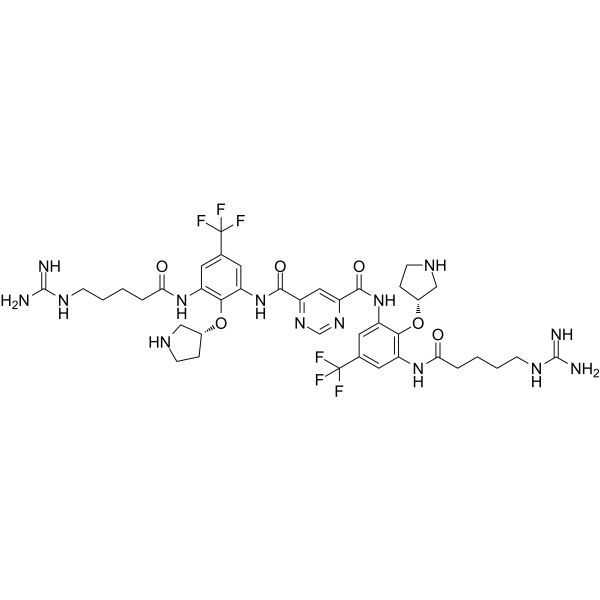
Brilacidin (PMX 30063) is an anti-infective antimicrobial with MIC90s of 1 and 8 μg/mL for Gram-positive bacteria Streptococcus pneumonia and Streptococcus viridans, and MIC90 of 8 and 4 μg/mL for Gram-negative bacteria Haemophilus influenza and Pseudomonas aeruginosa. Brilacidin is a defensin mimetic antibiotic compound.
-
tert-Butyl (4-aminobut-2-en-1-yl)carbamate hydrochloride
 0 ImagesCat. No.: HY-W034462CAS No.: 1914155-12-6
-
Lanerkitug
 0 ImagesCat. No.: HY-P991942Synonyms: BAY3375968; TPP-23411