



Myosin
Myosins are mechanoenzymes that interact with actin filaments and hydrolyse ATP to generate movement and force. This enables myosins to propel the sliding of actin filaments, to produce tension on actin filaments and to walk along these filaments. As a result, myosins can regulate the structure and dynamics of the actin cytoskeleton and affect the localization and transport of cellular components. The different myosins are grouped into classes on the basis of their motor domains. There are 35 known classes of myosin, and humans have 40 myosin genes that fall into 13 classes (I, II, III, V, VI, VII, IX, X, XV, XVI, XVIII, XIX and XXXV).
Myosins are actin-dependent motors that participate in a diverse range of crucial activities, including muscle contraction, intracellular trafficking, cell division, motility, actin cytoskeletal organisation and cell signaling. Myosin malfunction has been implicated in a variety of disorders including deafness, hypertrophic cardiomyopathy, Usher syndrome, Griscelli syndrome and cancer.
Myosin light chain kinase (MLCK) is an enzyme that activates the myosin light chain to exert its function related to cytoskeleton contraction and tight junction regulation. In most cells, MLCK is a transducer for signalling MLC phosphorylation in response to Ca2+ binding to MLCK-associated calmodulin. MLCK-mediated MLC phosphorylation and actomyosin contractility is important in muscle contraction, cell migration, and endo/exocytic processes, and is recognized for its central role in signalling endothelial cell-cell adhesion and barrier function.
Myosin Isoform Specific Products
All Product Categories
-
Myosin Related Products (105)
Related Products (105)

-
Antibodies (20)
-
Myosin Isoform Comparison
-
MS-347a
 0 ImagesCat. No.: HY-N19735CAS No.: 144678-18-2MS-347a is an inhibitor of myosin light chain kinase (MLCK) and protein kinase C (PKC), with IC50 values of 9.2 μM, 31 μM and 16 μM against calmodulin-dependent MLCK, calmodulin-independent MLCK and PKC, respectively. MS-347a binds to the catalytic domain of MLCK and blocks both calmodulin-dependent and calmodulin-independent MLCK activity. MS-347a inhibits the growth of drug-sensitive fission yeast and multiple ascomycete phytopathogenic fungi. MS-347a exhibits fungicidal activity against a variety of phytopathogenic fungi and protective activity against Magnaporthe oryzae in rice seedlings. MS-347a shows antibacterial activity against specific Gram-positive bacteria and Proteus vulgaris. MS-347a can be used in studies related to rice blast, bacterial infections and phytopathogenic fungal diseases.
-
Adhibin
 0 ImagesCat. No.: HY-170318Adhibin is an allosteric inhibitor for RhoGAP class IX myosin, that inhibits Myo9 ATPase in mammalian and invertebrate with IC50 of 2.5 µM and 2.6 µM. Adhibin binds to the ATPase of myosin, interfers with its motor function, blocks the RhoGTPase related signaling pathway, and affects the cell migration, adhesion and cell division. Adhibin can be used in research about cancer metastasis.
-
ME 3407
 0 ImagesCat. No.: HY-19133CAS No.: 133903-90-9Synonyms: EF-4040ME-3407 (EF-4040) is a H+-K+-ATPase redistribution disruptor and myosin light chain kinase (MLCK) and protein kinase A inhibitor. ME-3407 blocks gastric acid secretion and aminopyrine accumulation by inhibiting microsomal-to-apical membrane redistribution of H+-K+-ATPase and suppressing MLCK-mediated myosin light chain phosphorylation. ME-3407 is promising for research of peptic ulcer.
-
Danicamtiv-d3
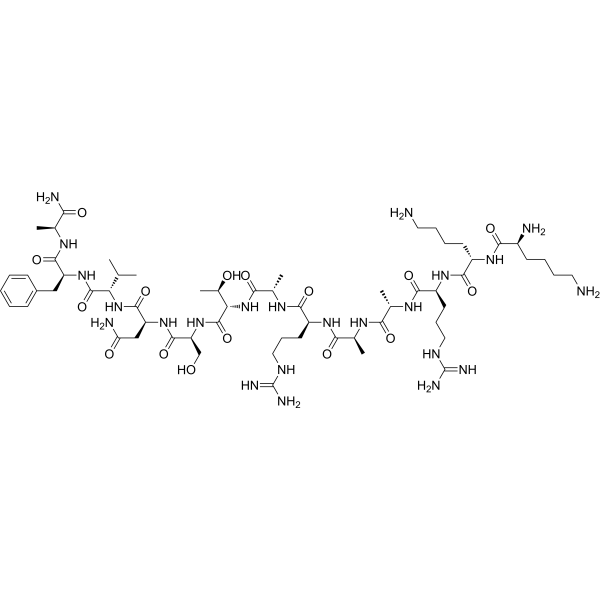
 0 ImagesCat. No.: HY-109128S1CAS No.: 2925925-82-0Synonyms: MYK-491-d3Danicamtiv-d3 (MYK-491-d3) is a deuterated labeled Danicamtiv (HY-109128). Danicamtiv (MYK-491), an inotropic agent, is a selective allosteric activator of cardiac myosin. Danicamtiv increases cardiac systolic function and preserves mechanical efficiency.
-
Blebbistatin (Standard)
 0 ImagesBlebbistatin (Standard) is the analytical standard of Blebbistatin. This product is intended for research and analytical applications. Blebbistatin is a selective non-muscle myosin II (NMII) inhibitor, promotes directional migration of corneal endothelial cells (CECs) and accelerates wound healing, and better preserves cell junctional integrity and barrier function. Blebbistatin blocks cell migration.
-
ZJS178
 0 ImagesCat. No.: HY-179120CAS No.: 3095661-21-2ZJS178 is a novel inhibitor of myosin I. ZJS178 is a fungicide that has inhibitory activity against Fusarium graminearum and can reduce DON toxin synthesis. ZJS178 can be used for research on plant diseases such as wheat scab.
-
ML-7
 0 ImagesCat. No.: HY-119038CAS No.: 109376-83-2ML-7 is a selective and highly specific myosin light chain kinase (MLCK) inhibitor that acts as a trabecular meshwork (TM) relaxant. ML-7 enhances Quinocetone (HY-123581)-induced phosphorylation of ERK, p38 MAPK and JNK, attenuates Akt activation, and promotes apoptosis of hepatocellular carcinoma cells. ML-7 reduces Th2 cytokine secretion by inhibiting MLCK, while alleviating smooth muscle hyperplasia and collagen deposition. As a non-antibiotic adjuvant, ML-7 restores the sensitivity of drug-resistant bacteria to Tigecycline (HY-B0117). ML-7 can be used in research related to glaucoma, hepatocellular carcinoma, asthma, and Klebsiella pneumoniae infection.
-
Mavacamten-d6
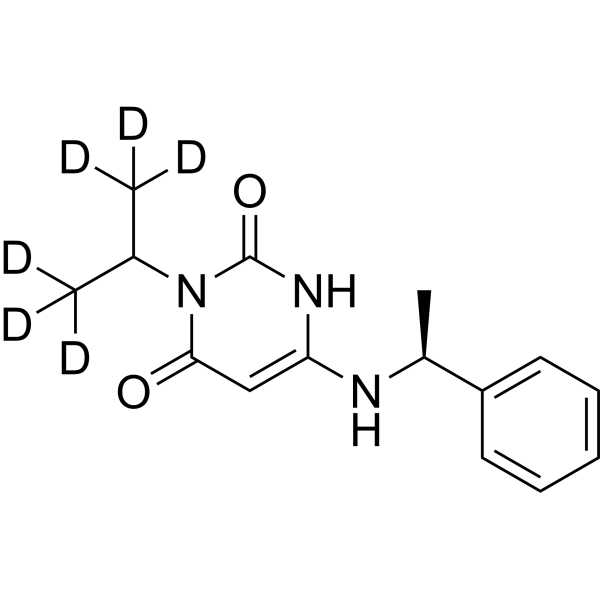 0 ImagesCat. No.: HY-109037SCAS No.: 2453251-18-6Synonyms: MYK461-d6; SAR439152-d6Mavacamten-d6 (MYK461-d6; SAR439152-d6) is deuterium labeled Mavacamten (HY-109037). Mavacamten (MYK461) is an orally active modulator of cardiac myosin, with IC50s of 490, 711 nM for bovine cardiac and human cardiac, respectively.
-
R-(-)-7-Desmethyl-8-nitro blebbistatin
 0 ImagesCat. No.: HY-133885ACAS No.: 1217619-62-9R-(-)-7-Desmethyl-8-nitro blebbistatin is an analog of (-)-Blebbistatin (HY-13441). (-)-Blebbistatin is a selective non-muscle myosin II inhibitor.
-
Tubercidin 5'-triphosphate tetrasodium
 0 ImagesCat. No.: HY-134248ASynonyms: 7-Deazaadenosine 5'-triphosphate tetrasodium
-
Ruberythric acid
 0 ImagesCat. No.: HY-W718178CAS No.: 152-84-1Ruberythric acid is a natural product found in madder (Rubia tinctorum). Acid treatment induces hydrolysis of Ruberythric acid, producing pentose-containing sugar residues and alizarin. Ruberythric acid inhibits stimulus-induced phosphorylation of IKK, IκBα and p65 in the NF-κB pathway, regulates tight junction integrity, suppresses stimulus-induced MLCK activation and myosin light chain phosphorylation, reduces tight junction disruption associated with cytoskeletal contraction, alleviates stimulus-induced increase in intestinal permeability, and prevents stimulus-induced redistribution of tight junction proteins. Ruberythric acid forms red salts when dissolved in alkali and can be used as a dye. Ruberythric acid is applicable to research related to inflammatory bowel disease.
-
W-7 hydrochloride (Standard)
 0 ImagesCat. No.: HY-100912RCAS No.: 61714-27-0W-7 (hydrochloride) (Standard) is the analytical standard of W-7 (hydrochloride) (HY-100912). This product is intended for research and analytical applications. W-7 hydrochloride is a selective calmodulin antagonist. W-7 hydrochloride inhibits the Ca2+-calmodulin-dependent phosphodiesterase and myosin light chain kinase with IC50 values of 28 μM and 51 μM, respectively. W-7 hydrochloride induces apoptosis and has antitumor and vascular relaxing activity. W-7 hydrochloride is a blocker of Kv4.3 and can be used for research of arrhythmias.
-
(+)-Blebbistatin (Standard)
 0 ImagesCat. No.: HY-107657RCAS No.: 1177356-70-5(+)-Blebbistatin (Standard) is the analytical standard of (+)-Blebbistatin (HY-107657). This product is intended for research and analytical applications. (+)-Blebbistatin is the inactive enantiomer of (-)-Blebbistatin (HY-13441). (-)-Blebbistatin is a selective inhibitor of non-muscle myosin II ATPase activity.
-
Mavacamten-d1
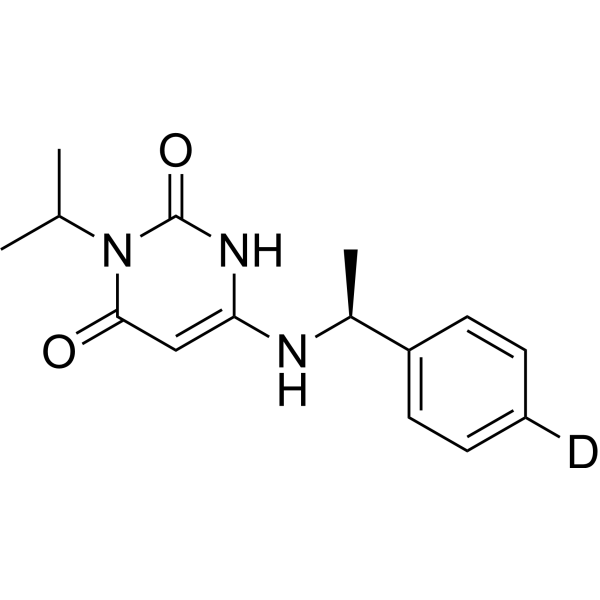 0 ImagesCat. No.: HY-109037S2CAS No.: 2453251-02-8Synonyms: MYK461-d1; SAR439152-d1Mavacamten-d1 (MYK461-d1; SAR439152-d1) is deuterium labeled Mavacamten (HY-109037). Mavacamten (MYK461) is an orally active modulator of cardiac myosin, with IC50s of 490, 711 nM for bovine cardiac and human cardiac, respectively.
-
Danicamtiv (Standard)
 0 ImagesCat. No.: HY-109128RCAS No.: 1970972-74-7Synonyms: MYK-491 (Standard)Danicamtiv (Standard) is the analytical standard of Danicamtiv (HY-109128). This product is intended for research and analytical applications. Danicamtiv (MYK-491), an inotropic agent, is a selective allosteric activator of cardiac myosin. Danicamtiv increases cardiac systolic function and preserves mechanical efficiency.
-
HA-100 (Standard)
 0 ImagesCat. No.: HY-100984RCAS No.: 84468-24-6HA-100 (Standard) is the analytical standard of HA-100 (HY-100984). This product is intended for research and analytical applications. HA-100 is a potent protein kinase inhibitor, with IC50s of 4 μM, 8 μM, 12 μM and 240 μM for cGMP-dependent protein kinase (PKG), cAMP-dependent protein kinase (PKA), protein kinase C (PKC) and MLC-kinase, respectively. HA-100 also used as a ROCK inhibitor.
-
(-)-Blebbistatin (Standard)
 0 ImagesCat. No.: HY-13441RCAS No.: 856925-71-8(-)-Blebbistatin (Standard) is the analytical standard of (-)-Blebbistatin (HY-13441). This product is intended for research and analytical applications. (-)-Blebbistatin is a selective inhibitor of the ATPase activity of non-muscle myosin II.
-
ATM-3507 (Standard)
 0 ImagesCat. No.: HY-100948RCAS No.: 1861449-70-8
-
Myosin-5-IN-2
 0 ImagesCat. No.: HY-175647Myosin-5-IN-2 (Compound G19) is a Myosin-5 inhibitor. Myosin-5-IN-2 has an antifungal activity against Fusarium graminearum (Fg), Botrytis cinerea and Rhizoctonia solani with an EC50 s of 0.326 μg/mL for Fg. Myosin-5-IN-2 has effective protective and curative control efficiency for wheat leaves. Myosin-5-IN-2 severely damages the surface integrity of mycelial cells and induces cytoplasmic leakage. Myosin-5-IN-2 can be used for fungal infections like fusarium head blight (FHB) research.




