



PLD
Phospholipase D (PLD) is a phospholipid-hydrolyzing enzyme that primarily converts phosphatidylcholine into phosphatidic acid (PA) and choline, thereby generating a key lipid second messenger involved in cellular signaling networks[1][2]. Mechanistically, PA produced by PLD regulates multiple biological processes, including vesicular trafficking, exocytosis, autophagy, cellular metabolism, and stress-responsive signaling pathways, and can further influence downstream effectors such as mTOR and Akt signaling cascades[2][3]. Through these functions, PLD contributes to the control of cell migration, membrane dynamics, endocytosis, cytoskeletal remodeling, and secretory processes that are essential for normal cellular homeostasis[1][4]. Disease relevance is supported by evidence linking altered PLD activity or expression to tumor growth, metastasis, neurodegeneration, thrombotic disorders, inflammation, diabetes, and other pathological conditions characterized by dysregulated signaling and membrane trafficking[1][4]. Compared with related isoforms, mammalian PLD1 and PLD2 share conserved catalytic domains but differ in regulatory architecture, subcellular localization, and basal activity, with PLD1 containing a unique internal regulatory loop and requiring stronger activation by regulatory proteins, whereas PLD2 exhibits higher constitutive activity and distinct membrane-associated regulation[1][5]. For experimental applications, the availability of isoform-selective small-molecule PLD inhibitors has enabled mechanistic dissection of PLD1- and PLD2-dependent signaling pathways and has strengthened the evaluation of PLD as a therapeutic target in cancer and other diseases[1].
References:
- [1]. Bowling FZ, et al. Structure and regulation of human phospholipase D. Adv Biol Regul. 2021 Jan;79:100783. [Content Brief]
- [2]. Bruntz RC, et al. Phospholipase D signaling pathways and phosphatidic acid as therapeutic targets in cancer. Pharmacol Rev. 2014 Oct;66(4):1033-79. [Content Brief]
- [3]. Tang L, et al. Phospholipase D: emerging therapeutic targets in signaling, metabolism, and immune-oncology. Cell Commun Signal. 2025 Dec 20;24(1):42. [Content Brief]
- [4]. Brandenburg LO, et al. Role of Phospholipase D in G-Protein Coupled Receptor Function. Membranes (Basel). 2014;4(3):302-318.
- [5]. Nelson RK, et al. Thematic Review Series: Phospholipases: Central Role in Lipid Signaling and Disease: Physiological and pathophysiological roles for phospholipase D. J Lipid Res. 2015;56(12):2229-2237.
All Product Categories
-
PLD Related Products (3)
Related Products (3)

-
OXA(17-33)
 0 ImagesCat. No.: HY-P1341CAS No.: 343268-91-7Synonyms: Orexin A (17-33) (human, mouse, rat, bovine)OXA (17-33) (Orexin A (17-33) (human, mouse, rat, bovine)) is the shortest active orexin peptide that selectively targets OX1 (EC50=8.29 nM), with 23-fold selectivity for the OX1 receptor over the OX2 receptor. The activity of OXA (17-33) depends on the Tyr17, Leu20, Asn25, His26 residues and the spatial conformation of the α-helix. OXA (17-33) activates signaling pathways involving inositol-1,4,5-trisphosphate receptor (IP3R), phospholipase D (PL-D) and choline-Sigma-1R, thereby increasing the cytoplasmic Ca2+ level in nucleus accumbens neurons, an effect that is blocked by Sigma-1R antagonists. OXA (17-33) serves as an important biological probe for investigating the function of the OX1 receptor. OXA (17-33) can be modified via incorporation of mixed disulfide bonds of homocysteine and cysteamine, and is widely used in studies related to insomnia and narcolepsy.
-
VU533
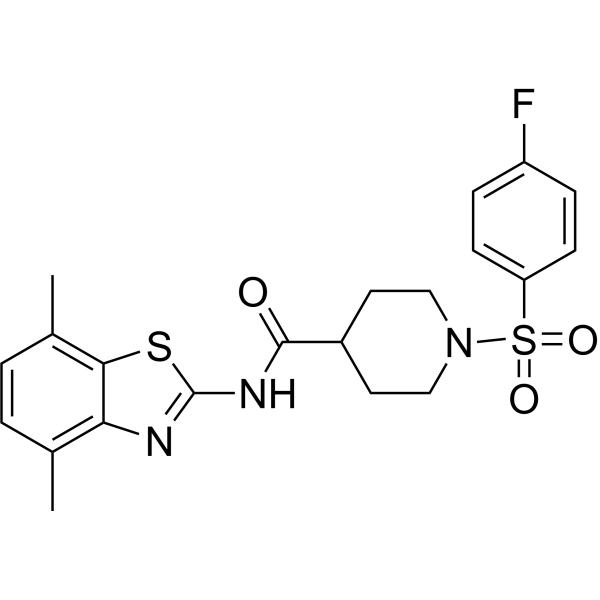 0 ImagesAPE-PLD (VU533) activator is a potent NAPE-PLD activator with an EC50 value of 0.30 µM. NAPE-PLD activator (VU533) can enhance NAPE-PLD activity and increase efferocytosis by macrophages. NAPE-PLD activator (VU533) can be used for cardiometabolic diseases research.
-
A3373
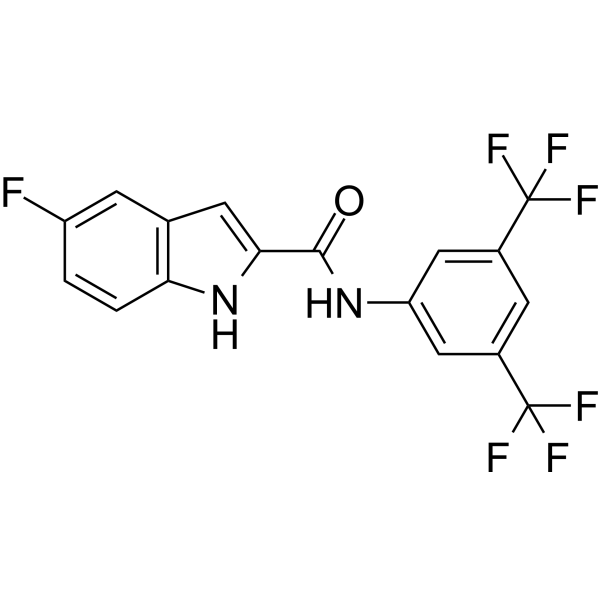 0 ImagesA3373, a novel chemical inhibitor of Phospholipase D1 (PLD1) and PLD2, with IC50 of 325 nM and 15.15?μM, respectively, inhibits LPS-induced immune response and plays important roles in autoimmune arthritis, bone demineralization and osteoclastogenesis.



