



A3373

Based on 1 Customer Validation
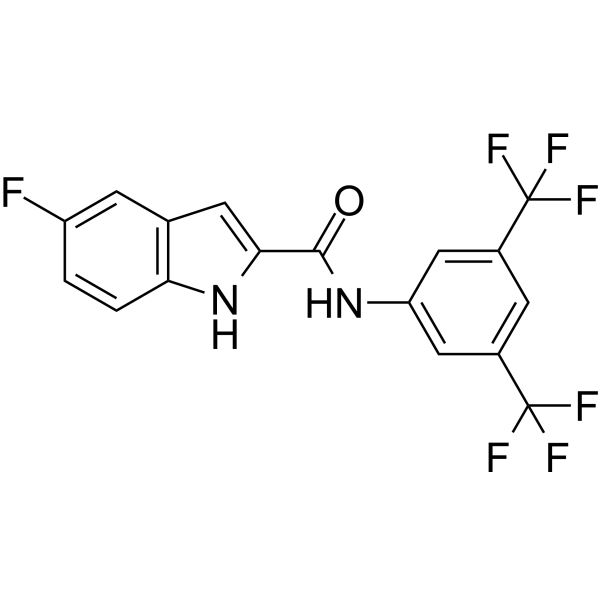
A3373, a novel chemical inhibitor of Phospholipase D1 (PLD1) and PLD2, with IC50 of 325 nM and 15.15?μM, respectively, inhibits LPS-induced immune response and plays important roles in autoimmune arthritis, bone demineralization and osteoclastogenesis.
商品は「研究用試薬」です。人や動物の医療用・臨床診断用・食品用の製品ではありません。
研究用途以外に使用した場合、当社は一切の責任を負いかねます。
- 純度 : 99.57%
- CAS 番号: 2324948-66-3
- 分子式: C17H9F7N2O
- 分子量:390.25
-
保管条件:Powder -20°C, 3 years , 4°C, 2 years ; In solvent -80°C, 6 months , -20°C, 1 month

To place orders, for customer services and technical support, please contact: MedChemExpress USA
Tel: 609-228-6898 E-mail: [email protected] [email protected]


-
 生物活性
生物活性
-
化学情報
-
溶剤 & 溶解度
- プロトコル
- 純度とドキュメンテーション
- 参考文献
-
 Help & FAQs


Phospholipase アイソフォーム固有の製品をすべて表示
More

生物活性
製品説明
IC50 & Target
|
PLD1 325 nM (IC50) |
PLD2 15.15 μM (IC50) |


化学情報
-
CAS 番号 2324948-66-3
-
性状 Solid
-
分子量 390.25
-
分子式 C17H9F7N2O
-
Color White to off-white
-
SMILES
O=C(NC1=CC(C(F)(F)F)=CC(C(F)(F)F)=C1)C2=CC3=C(N2)C=CC(F)=C3
-
輸送条件
Room temperature in continental US; may vary elsewhere.
-
保管条件
Powder -20°C 3 years 4°C 2 years In solvent -80°C 6 months -20°C 1 month


溶剤 & 溶解度
体外:
DMSO : 100 mg/mL (256.25 mM; ultrasonic and warming and heat to 60°C; Hygroscopic DMSO has a significant impact on the solubility of product, please use newly opened DMSO)
Please refer to the solubility information to select the appropriate solvent. Once prepared, please aliquot and store the solution to prevent product inactivation from repeated freeze-thaw cycles.
Storage method and period of stock solution: -80°C, 6 months; -20°C, 1 month. When stored at -80°C, please use it within 6 months. When stored at -20°C, please use it within 1 month.
Please refer to the solubility information to select the appropriate solvent. Once prepared, please aliquot and store the solution to prevent product inactivation from repeated freeze-thaw cycles.
Storage method and period of stock solution: -80°C, 6 months; -20°C, 1 month. When stored at -80°C, please use it within 6 months. When stored at -20°C, please use it within 1 month.
濃度 (開始) × 体積 (開始) = 濃度 (終了) × 体積 (終了)
体内:
Select the appropriate dissolution method based on your experimental animal and administration route.
- For the following dissolution methods, please ensure to first prepare a clear stock solution using an In Vitro approach and then sequentially add co-solvents:
- To ensure reliable experimental results, the clarified stock solution can be appropriately stored based on storage conditions. As for the working solution for In Vivo experiments, it is recommended to prepare freshly and use it on the same day.
- The percentages shown for the solvents indicate their volumetric ratio in the final prepared solution. If precipitation or phase separation occurs during preparation, heat and/or sonication can be used to aid dissolution.
In Vivo Dissolution Calculator
Please enter the basic information of animal experiments:
-
-
-
-
Recommended: Prepare an additional quantity of animals to account for potential losses during experiments.
Please enter your animal formula composition:
-
%DMSO +
Recommended: Keep the proportion of DMSO in working solution below 2% if your animal is weak.
-
%+
-
+%Tween-80 + +
-
%Saline +
The co-solvents required include: DMSO, . All of co-solvents are available by MedChemExpress (MCE). , Tween 80. All of co-solvents are available by MedChemExpress (MCE).
Working solution concentration: 0.22 mg/mL
Method for preparing stock solution: mg drug dissolved in μL DMSO. Stock solution concentration: mg/mL.
1. Take μL DMSO stock solution;
2. Add μL .
μL , mix evenly;
3. Then add μL Tween 80, mix evenly;
4. Then add μL
Please ensure that the stock solution in the first step is dissolved to a clear state, and add co-solvents in sequence. You can use ultrasonic heating (ultrasonic cleaner, recommended frequency 20-40 kHz), vortexing, etc. to assist dissolution.


純度とドキュメンテーション
-
データシート (272 KB)
-
SDS (251 KB)
- English - EN (251 KB)
- Français - FR (251 KB)
- Deutsch - DE (251 KB)
- Norwegian - NO (251 KB)
- Español - ES (251 KB)
- Swedish - SV (251 KB)
- Italian - IT (251 KB)
- Korean - KR (251 KB)
- Portuguese - PT (251 KB)
-
取扱説明書 (2659 KB)
参考文献
[1]. Won Chan Hwang, et al. Inhibition of phospholipase D1 induces immunogenic cell death and potentiates cancer immunotherapy in colorectal cancer.Exp Mol Med. 2022 Sep;54(9):1563-1576. [Content Brief]
[2]. Jin-Sil Park, et al. A newly developed PLD1 inhibitor ameliorates rheumatoid arthritis by regulating pathogenic T and B cells and inhibiting osteoclast differentiation. Immunol Lett. 2023 Sep 16:263:87-96. [Content Brief]


Complete Stock Solution Preparation Table
Please refer to the solubility information to select the appropriate solvent. Once prepared, please aliquot and store the solution to prevent product inactivation from repeated freeze-thaw cycles.
Storage method and period of stock solution: -80°C, 6 months; -20°C, 1 month. When stored at -80°C, please use it within 6 months. When stored at -20°C, please use it within 1 month.
| Optional Solvent | Concentration Solvent Mass | 1 mg | 5 mg | 10 mg | 25 mg |
|---|---|---|---|---|---|
| DMSO | 1 mM | 2.5625 mL | 12.8123 mL | 25.6246 mL | 64.0615 mL |
| 5 mM | 0.5125 mL | 2.5625 mL | 5.1249 mL | 12.8123 mL | |
| 10 mM | 0.2562 mL | 1.2812 mL | 2.5625 mL | 6.4061 mL | |
| 15 mM | 0.1708 mL | 0.8542 mL | 1.7083 mL | 4.2708 mL | |
| 20 mM | 0.1281 mL | 0.6406 mL | 1.2812 mL | 3.2031 mL | |
| 25 mM | 0.1025 mL | 0.5125 mL | 1.0250 mL | 2.5625 mL | |
| 30 mM | 0.0854 mL | 0.4271 mL | 0.8542 mL | 2.1354 mL | |
| 40 mM | 0.0641 mL | 0.3203 mL | 0.6406 mL | 1.6015 mL | |
| 50 mM | 0.0512 mL | 0.2562 mL | 0.5125 mL | 1.2812 mL | |
| 60 mM | 0.0427 mL | 0.2135 mL | 0.4271 mL | 1.0677 mL | |
| 80 mM | 0.0320 mL | 0.1602 mL | 0.3203 mL | 0.8008 mL | |
| 100 mM | 0.0256 mL | 0.1281 mL | 0.2562 mL | 0.6406 mL |


A3373 関連分類
HY-155342 関連分類
 Powered by Bioz