



Biochemical Assay Reagents
Biochemical agents refers to the life science research related to biological material or organic compounds. Due to a wide range of life sciences, rapid development, and therefore a wide variety of such agents, complex in nature. There are electrophoresis reagents, chromatography reagents, centrifuged reagents, immunological reagent, labeled reagent, staining agents, penetration agents and carcinogens variable, insecticides, culture, buffering agents, electron microscopy reagents, protein and nucleic acid precipitating agent, condensing agent ultrafiltration membrane, clinical diagnostic reagents, dyes, antioxidants, preservatives, detergents and surfactants, standard biochemical reagents, biochemical reagents quality control materials, separation material, etc..
All Product Categories
-
Biochemical Assay Reagents Inhibitors
(10)
View all products
-
Biochemical Assay Reagents Modulator
(1)
View all products
-
Biochemical Assay Reagents Chemicals
(7)
View all products
-
Biochemical Assay Reagents Inducer
(1)
View all products
-
Biochemical Assay Reagents Controls
(59)
View all products
-
Biochemical Assay Reagents Substrates
(4)
View all products
-
Biochemical Assay Reagents Ligands
(2)
View all products
-
Biochemical Assay Reagents Related Products (16057)
Related Products (16057)

-
Antibodies (44)


-
4-Methylaminobutanoate oxidase (methylamine-forming)
 0 ImagesCat. No.: HY-E71866A4-Methylaminobutanoate oxidase (methylamine-forming) (EC 1.5.3.21) is an oxidoreductase that can convert 4-(methylamino)butanoate, O2 and H2O into succinate semialdehyde, methylamine and H2O2.

-
2-Octenal
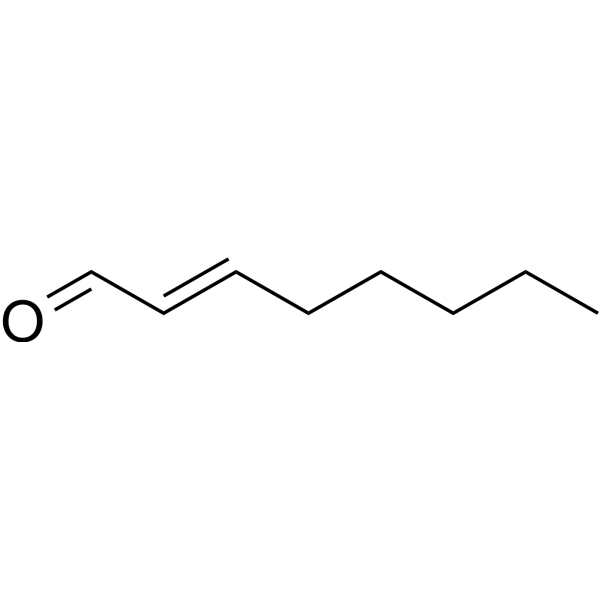 0 Images2-Octenal is an unsaturated aldehyde commonly found in essential oils of various plants, especially citrus fruits. 2-Octenal has unique chemical properties that make it an important ingredient in many applications where a strong, sweet and fruity aroma is desired. It is commonly used as a flavoring agent in food and beverages, and as a fragrance in perfumes, soaps, and cosmetics.
-
18:0-18:2 PG sodium
 0 ImagesCat. No.: HY-170458CAS No.: 474943-26-5Synonyms: 1-Stearoyl-2-linoleoyl-sn-glycero-3-phospho-(1'-rac-glycerol) sodium18:0-18:2 PG (1-Stearoyl-2-linoleoyl-sn-glycero-3-phospho-(1'-rac-glycerol)) sodium is a glycerophospholipid contains Stearic acid (HY-B2219), Linolenic acid (HY-N0728) and phospho-rac-(1-glycerol).
-
3,6-Dimethylsalicylyl-CoA
 0 ImagesCat. No.: HY-CE00753CAS No.: 958871-82-4Synonyms: 3,6-Dimethylsalicylyl-coenzyme A3,6-Dimethylsalicylyl-CoA (3,6-Dimethylsalicylyl-coenzyme A) is a coenzyme A derivative.
-
DOPE-PEG2000-WYRGRL
 0 ImagesCat. No.: HY-184571ADOPE-PEG2000-WYRGRL is a functionalized PEGylated lipid conjugate composed of three modular components: dioleoylphosphatidylethanolamine (DOPE) as the lipid anchoring group, a polyethylene glycol (PEG) spacer arm with a molecular weight of 2000 Da, and WYRGRL peptide (HY-P10739)as the terminal targeting/functional ligand. DOPE-PEG2000-WYRGRL can be incorporated into liposomes, lipid nanoparticles (LNPs), or other nanocarriers to confer ligand-directed targeting capability against specific cell surface receptors in tumor and inflammatory microenvironments.
-
GelMA, 90% methacrylation, Green Fluorescent
 0 ImagesCat. No.: HY-158217BSynonyms: Gelatin Methacryloyl, 90% methacrylation, Green FluorescentGreen Fluorescent Gelatin Methacryloyl (Green Fluorescent GelMA) is methacryloyl gelatin (GelMA) with green fluorescence, which is obtained by "grafting" fluorescent molecules on GelMA. Green Fluorescent Gelatin Methacryloyl acts as a scaffold and can be used to engineer tissue analogs from the vasculature to cartilage and bone, allowing cells to proliferate and spread. GelMA, 90% methacrylation, Green Fluorescent needs to self-assemble into fibrous hydrogel under the action of photoinitiator LAP (HY-44076), and target bioactive adhesion sites, play an inherent supporting role for tissue cells and biodegradable activity.
Application: cell culture, biological 3D printing, tissue engineering, etc.
-
3-Indoxyl caprylate
 0 ImagesCat. No.: HY-W351759CAS No.: 133950-66-03-Indoxyl caprylate is a chemiluminescent substrate used to detect bacterial activity, which can be used together with appropriate enzyme reactions.

-
3-Hydroxy-5-methyl-1-naphthoate 3-O-methyltransferase
 0 ImagesCat. No.: HY-E717023-Hydroxy-5-methyl-1-naphthoate 3-O-methyltransferase (EC 2.1.1.302) from the bacterium Streptomyces sahachiroi is involved in the biosynthesis of 3-methoxy-5-methyl-1-naphthoate, a component of of the the antitumor antibiotic azinomycin B.
-
Tetracycline/OVA
 0 ImagesCat. No.: HY-158296Tetracycline/OVA is an tetracycline-carrier protein conjugate of Tetracycline (HY-A0107) and ovalbumin (OVA). Tetracycline/OVA can be used to determine the titer of tetracycline polyclonal antibodies in serum samples.
-
Strawberry Nutrient Solution
 0 ImagesCat. No.: HY-182733JStrawberry Nutrient Solution is a nutrient solution specifically designed for hydroponics of strawberries, composed of calcium salts, ammonium salts, potassium salts, phosphates, magnesium sulfate, etc.

-
4-Arm-PEG5000-Vinyl sulfone
 0 ImagesCat. No.: HY-W1048867ACAS No.: 860027-46-9Synonyms: 4-Arm-PEG5000-VS4-Arm-PEG5000-Vinyl sulfone (4-Arm-PEG5000-VS) is a four-armed PEG derivative. The core structure of 4-Arm-PEG5000-Vinyl sulfone consists of four PEG chains, each modified at the end with a vinyl sulfone (Vinyl sulfone) group. 4-Arm-PEG5000-Vinyl sulfone can be used for bioconjugation and drug delivery.
-
(S)-1-Boc-3-hydroxypiperidine-d4
 0 ImagesCat. No.: HY-W749794(S)-1-Boc-3-hydroxypiperidine-d4 is the deuterium labeled (S)-1-Boc-3-hydroxypiperidine (HY-40023). (S)-1-Boc-3-hydroxypiperidine is a biochemical reagent that can be used as a biological material or organic compound for life science related research.
-
PEG900000
 0 ImagesCat. No.: HY-Y0873A7CAS No.: 25322-68-3Synonyms: Polyethylene glycol 900000PEG900000 (Polyethylene glycol 900000) is a polymer compound with good biocompatibility and biodegradability, and is widely used in drug controlled release systems and bioadhesive materials.

-
3-Methylheptadecanoyl-CoA
 0 ImagesCat. No.: HY-CE01124Synonyms: 3-Methylheptadecanoyl-coenzyme A3-Methylheptadecanoyl-CoA (3-Methylheptadecanoyl-coenzyme A) is a derivative of coenzyme A.




