



Fluorescent Dye
Fluorescence is a phenomenon of photoluminescence in luminescence. When an atom is irradiated by light, some electrons around the nucleus jump from their original orbitals to higher energy orbitals under the influence of light energy, i.e., from the ground state to the first or second excited single-line state, etc. Due to the instability of the first or second excited singlet state, the electron returns from the excited singlet state to the ground state accompanied by released energy, resulting in fluorescence.
Fluorescent dyes can be covalently bound or physically adsorbed in the structure of the substance. The fluorescence properties allow for the characterization, localization and quantitative analysis of the labeled object. Fluorescent dyes have shown great potential for the detection of proteins, nucleic acids, cells, and immunoassays, attributed to the advantages in non-radioactive contamination, simple experimental operation and easy observation.
Fluorescent dyes have penetrated many fields such as pharmacology, physiology, environmental science, and information science, as well as functional studies of proteins and drug screening.
All Product Categories
-
Fluorescent Dye Related Products (4914)
Related Products (4914)

-
Antibodies (4)
-
RB-PEG3400-COOH
 0 ImagesCat. No.: HY-D2881DSynonyms: Rhodamine B-PEG3400-COOHRB-PEG3400-COOH (Rhodamine B-PEG3400-COOH) is a fluorescent dye composed of Rhodamine B (HY-Y0016), PEG and a COOH. RRB-PEG3400-COOH can be used for fluorescent labeling and imaging (Ex/Em=546/610 nm).
-
SNAP-505
 0 ImagesCat. No.: HY-D2933SNAP-505 is a cell-permeable green fluorescent dye (Ex/Em ≈504/532 nm). It binds specifically and covalently to SNAP-tag fusion proteins, and is used for pulse-chase labeling and localization tracking of proteins in living cells. SNAP-505 can be applied to studies related to insulin granule formation, ER-Golgi protein trafficking, and other relevant processes.
-
FITC-DEAE-Polysucrose 70
 0 ImagesCat. No.: HY-179080FITC-DEAE-Polysucrose 70 is FITC-labeled DEAE-Polysucrose 70 (HY-179072). DEAE-Polysucrose 70 is a polysucrose substituted with diethylaminoethyl (DEAE) groups. FITC-DEAE-Polysucrose 70 is mainly used for permeability and microcirculation studies (Ex/Em = 488/525 nm).
-
Concanavalin A-Cy5.5
 0 ImagesCat. No.: HY-NP164ASynonyms: Con A-Cy5.5Concanavalin A-Cy5.5 (Con A-Cy5.5) is a Cy5.5 (HY-D0924)-labled Concanavalin A (HY-P2149). Concanavalin A is a Ca2+/Mn2+-dependent and mannose/glucose-binding plant lectin. Concanavalin A binds the N- and O-glycosylated proteins of head and neck carcinoma cells glycoproteins.
-
C6 Biotin dihydro ceramide (d18:0/6:0)
 0 ImagesCat. No.: HY-172666FSynonyms: Biotin ceramide (d18:0/6:0)C6 Biotin dihydro ceramide is an affinity probe that allows C6 dihydro ceramide to be detected or immobilized through interaction with the biotin ligand.
-
JF629-HTL
 0 ImagesCat. No.: HY-D3445CAS No.: 3029700-80-6JF629-HTL is a far-red fluorogenic HaloTag ligand. Binding of JF629-HTL to HaloTag protein alters the local environment of the dye, promoting the transition of rhodamine from a non-fluorescent state to a fluorescent state, thereby generating a fluorescence enhancement signal. In the light-controlled psHaloTag system, JF629-HTL shows a 6.7-fold fluorescence enhancement after irradiation at 450 nm. JF629-HTL serves as a research tool for far-red fluorescence imaging and the development of chemogenetic biosensors.
-
Cyanine3.5 azide chloride
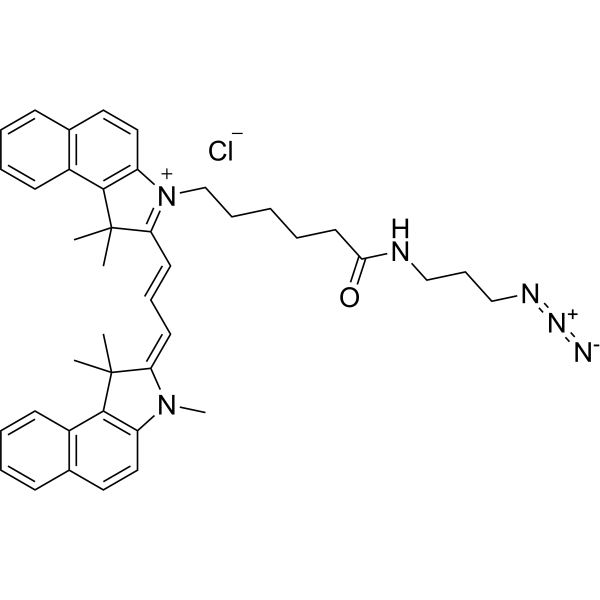 0 ImagesCat. No.: HY-D1597Cyanine3.5 azide chloride, an analog of Cyanine3.5 azide, is a potent green fluorescent dye. Cyanine3.5 azide chloride uses click chemistry to tag the ethylidene group. (λex=591 nm, λem=604 nm). Cyanine3.5 azide (chloride) is a click chemistry reagent, it contains an Azide group and can undergo copper-catalyzed azide-alkyne cycloaddition reaction (CuAAc) with molecules containing Alkyne groups. It can also undergo strain-promoted alkyne-azide cycloaddition (SPAAC) reactions with molecules containing DBCO or BCN groups.
-
FAM labled Ozisiran sodium
 0 ImagesCat. No.: HY-177654CFAM labled Ozisiran sodiumis a FAM labled Ozisiran sodium.
-
BP Fluor 488 acid triTEA
 0 ImagesBP Fluor 488 acid triTEA is a powerful labeling dye. It will react with the amine group in antibody, proteins, peptides, amino-modified oligos, and other target molecules. The dye has an excitation peak at 499 nm and an emission peak at 520 nm. The conjugates are widely used in microscopy, flow cytometry, and other applications.
-
Cy3 labled Senvesiran sodium
 0 ImagesCat. No.: HY-177664DCy3 labled Senvesiran sodium is a Cy3 labled Senvesiran sodium.
-
Sulfo-Cyanine7 carboxylic acid
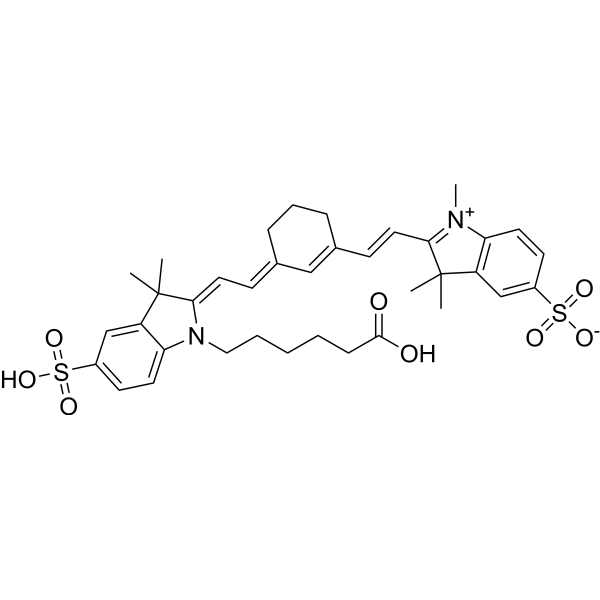 0 ImagesCat. No.: HY-D1367CAS No.: 2104632-29-1Sulfo-Cyanine7 carboxylic acid is a near-infrared fluorescent dye. Sulfo-Cyanine7 carboxylic acid is applicable to ex vivo histological imaging of the trigeminal nerve in rats as well as studies on the distribution and retention in brain tissues. Sulfo-Cyanine7 carboxylic acid can serve as a model hydrophilic probe for multiplex biomedical fluorescence imaging (Ex=750 nm, Em=773 nm).
-
Griffonia Simplicifolia Lectin I (Biotinylated)
 0 ImagesCat. No.: HY-NP151Synonyms: GSL I (Biotinylated)Griffonia Simplicifolia Lectin I Biotinylated is a plant lectin that can be used as a probe to specifically bind biomolecules (such as polysaccharides, peptides, etc.). Griffonia Simplicifolia Lectin I Biotinylated is a biological material or organic compound that can be used in life science research.
-
Chlorantine yellow
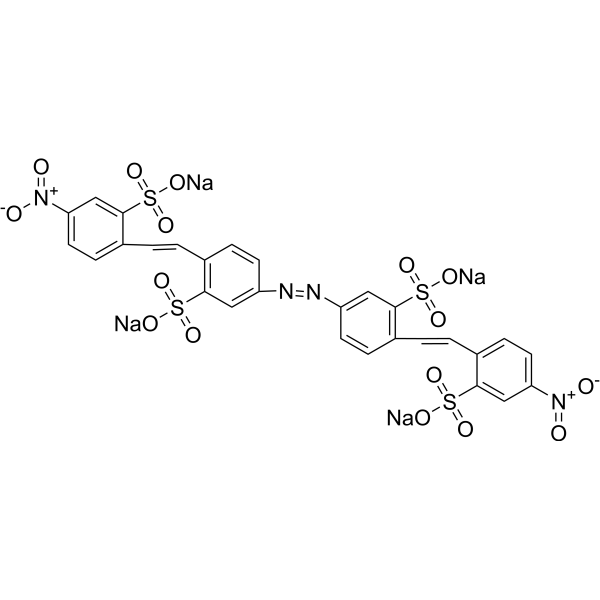 0 ImagesChlorantine yellow is a multifunctional dye. Dyes are important tools in biological experiments. They can help researchers observe and analyze cell structures, track biomolecules, evaluate cell functions, distinguish cell types, detect biomolecules, study tissue pathology and monitor microorganisms. Their applications range from basic scientific research to clinical A wide range of diagnostics. Dyes are also widely used in traditional fields such as textile dyeing, as well as in emerging fields such as functional textile processing, food pigments and dye-sensitized solar cells.
-
Ferfluor-1
 0 ImagesFerfluor-1 is a Ferroptosis inhibitor (EC50 of 57 nM in HT108 cells; EC50 of 75 nM in OS-RC-2 cells; EC50 of 2.3 nM in SH-SY5Y neuroblastoma cells), and ratiometric photoluminescent probe with blood-brain barrier permeability. Ferfluor-1 is a specific indicator for the fluctuation of Ferroptosis. Ferfluor-1 alleviates brain disorder diseases of in vivo stroke and PD models.
-
Mem-RhoNox
 0 ImagesCat. No.: HY-D3122Mem-RhoNox is a fluorescent probe used to detect labile Fe (II) on the plasma membrane surface and inside endosomes during iron uptake in live cells. Mem-RhoNox can anchor to the extracellular surface of the plasma membrane; upon contact with Fe (II), its N-oxide group undergoes a deoxygenation reaction, converting weakly fluorescent Mem-RhoNox into strongly fluorescent Mem-Rhodamine. During transferrin-mediated endocytosis, Mem-RhoNox enters endosomes together with the transferrin-transferrin receptor complex, and reacts with Fe (II) released by transferrin to enable detection of endosomal Fe (II).
-
FAM labled Cofirasersen sodium
 0 ImagesCat. No.: HY-139786DFAM labled Cofirasersen sodiumis a FAM labled Cofirasersen sodium.

-
Cy5.5-PEG5000-Biotin
 0 ImagesCat. No.: HY-D2570Cy5.5-PEG5000-Biotin is a polyethylene glycol derivative containing Cy5.5 (HY-D0924) fluorescent dye and polyethylene glycol (PEG) and a Biotin. Biotin can bind with high affinity to streptavidin or avidin. Cy5.5-PEG5000-Biotin plays an important role in the specific capture and detection of biomolecules.

-
FAM labled Egaptivon pegol sodium
 0 ImagesCat. No.: HY-147079DFAM labled Egaptivon pegol sodiumis a FAM labled Egaptivon pegol sodium.




