



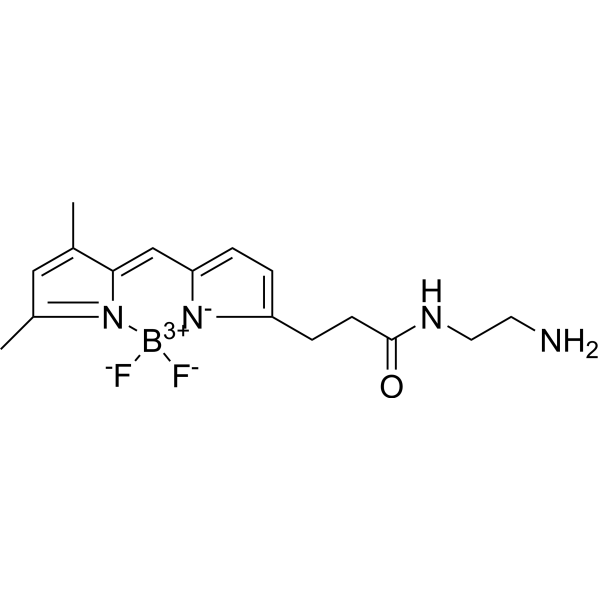
BODIPY FL EDA free base
ODIPY FL EDA free base is an amine-based, green fluorescent probe. The R-NH2 of ODIPY FL EDA free base can be coupled with aldehydes or ketones to form reversible Schiff base products. Convert to stable amine derivatives using reducing agents such as sodium borohydride or sodium cyanoborohydride. ODIPY FL EDA free base can be used to detect modified or normal deoxynucleotides and demonstrate DNA damage and genomic DNA methylation.
연구목적의 판매만을 진행합니다. 환자를 대상으로 한 판매는 하지 않습니다.
- CAS No.: 220524-70-9
- 화학식: C16H21BF2N4O
- 분자량:334.17
-
보관:
Please store the product under the recommended conditions in the Certificate of Analysis.

To place orders, for customer services and technical support, please contact: MedChemExpress USA
Tel: 609-228-6898 E-mail: [email protected] [email protected]


-
 Biological Activity
-
Chemical Information
- Protocol
- 순도&문서
-
 Help & FAQs




Biological Activity
제품 설명


Chemical Information
-
CAS No. 220524-70-9
-
분자량 334.17
-
화학식 C16H21BF2N4O
-
SMILES
O=C(NCCN)CCC1=CC=C(C=C(C(C)=C2)[N]3=C2C)[N-]1[B+3]3([F-])[F-]
-
선적
Room temperature in continental US; may vary elsewhere.
-
보관
Please store the product under the recommended conditions in the Certificate of Analysis.

Protocol
-
Research Protocol for Epigenomic Data Analysis
Epigenomic data analysis identifies genome-wide regulatory features that influence gene expression, chromatin state, and phenotype without changing the underlying DNA sequence. In this strategy, the core regulatory layer includes chromatin accessibility, transcription-factor or histone-mark occupancy, DNA methylation, and chromatin-state patterns; these features are measured by sequencing-based assays and interpreted as regulatory elements, promoters, enhancers, repressive domains, methylated cytosines, or candidate phenotype-associated chromatin programs. The literature links epigenomic features to phenotype by showing that functional genomic elements can be mapped across human cell types and tissues, and that integrated epigenomic maps reveal cell-type-specific regulatory programs. ENCODE integrated transcription, chromatin accessibility, transcription-factor occupancy, and histone modification data to annotate functional elements in the human genome, while the Roadmap Epigenomics Co
-
Protocol for Southern Blot
Southern blot is a DNA hybridization assay used to detect a defined DNA sequence within restriction-digested or otherwise fragmented genomic DNA. The method separates DNA fragments by agarose gel electrophoresis, transfers the size-resolved DNA pattern onto a solid support, denatures the DNA to permit base pairing, and detects fragments that hybridize with a complementary labeled probe; the readout is a band, smear, or fragment-size distribution corresponding to the target sequence and its restriction-fragment context. The assay reflects sequence presence, restriction fragment length, gene copy pattern, structural rearrangement, insertion or deletion affecting restriction sites, and some repeat-length or terminal restriction fragment applications when the experimental design links the probe to those genomic features. Classic applications include Southern blot-based telomere terminal restriction fragment analysis and minisatellite-based DNA fingerprinting, which illustrate how the same
-
Genotoxicity/Mutagenicity Study
The bacterial reverse mutation assay detects point mutations that restore amino-acid prototrophy in auxotrophic Salmonella typhimurium or Escherichia coli tester strains; after exposure to a test article, mutagenic activity is read out as an increased number of revertant colonies on minimal agar compared with the vehicle control. The assay uses tester strains with different mutation targets so that base-substitution and frameshift mutagens can be detected, and testing is performed with and without exogenous mammalian metabolic activation because some chemicals require biotransformation to become mutagenic.


순도&문서

Calculators
Concentration (start) × Volume (start) = Concentration (final) × Volume (final)


BODIPY FL EDA free base Related Classifications
HY-114346A Related Classifications
 Powered by Bioz