



Fluorescent Dye
Fluorescence is a phenomenon of photoluminescence in luminescence. When an atom is irradiated by light, some electrons around the nucleus jump from their original orbitals to higher energy orbitals under the influence of light energy, i.e., from the ground state to the first or second excited single-line state, etc. Due to the instability of the first or second excited singlet state, the electron returns from the excited singlet state to the ground state accompanied by released energy, resulting in fluorescence.
Fluorescent dyes can be covalently bound or physically adsorbed in the structure of the substance. The fluorescence properties allow for the characterization, localization and quantitative analysis of the labeled object. Fluorescent dyes have shown great potential for the detection of proteins, nucleic acids, cells, and immunoassays, attributed to the advantages in non-radioactive contamination, simple experimental operation and easy observation.
Fluorescent dyes have penetrated many fields such as pharmacology, physiology, environmental science, and information science, as well as functional studies of proteins and drug screening.
All Product Categories
-
Fluorescent Dye Related Products (4894)
Related Products (4894)

-
Antibodies (4)
-
AF488 C5 Maleimide
 0 ImagesCat. No.: HY-D3573AF488 C5 Maleimide is a thiol-reactive Fluorescent dye used to label target proteins and bacterial structures. AF488 C5 Maleimide irreversibly forms covalent thioether conjugates with cysteine thiol groups. AF488 C5 Maleimide stabilizes pre-formed globular low-molecular-weight Tau protein oligomers by blocking cysteine-dependent tau protein aggregation, allowing observation of the internalization process of tau protein oligomers into neuronal cells via confocal microscopy. AF488 C5 Maleimide can label cysteine-modified pili; the outer membrane permeability varies among different bacterial species, allowing imaging via epifluorescence microscopy using a FITC filter set.
-
DCA
 0 ImagesCat. No.: HY-D3105DCA is a Fluorescent probe for visualization of phase behavior in ER membranes. DCA is an ER-targeting, polarity-responsive NIR ratiometric probe, with its p-toluenesulfonamide group responsible for ER localization; its sensitivity to polarity relies on its donor-π-acceptor (D-π-A) structure, where aniline acts as the donor and dicyanomethylene acts as the acceptor, driving an intramolecular charge transfer (ICT) process upon excitation. In environments with low polarity, such as the closely packed, low water content ERₒ phase of ER membranes, DCA emits at a shorter wavelength, while in high polarity environments like the loosely packed, higher water content ERd phase, ICT leads to a red-shifted emission, allowing discrimination of the two phases via dual NIR emission colors and ratiometric imaging. Ex/Em = 488/570–620 nm and 488/665–735 nm; additional excitation/emission pairs include Ex/Em = 488/631 nm in low polarity 1,4-dioxane and Ex/Em = 488/677 nm in 1,4-dioxane with 30% water, the higher polarity condition. It shows a large Stokes shift of ~170 nm, and pH, viscosity, and biologically relevant species including Cys, GSH, H₂O₂, and metal ions do not exert marked interference on its fluorescence spectra[1].
-
Glut-Phe-AMC
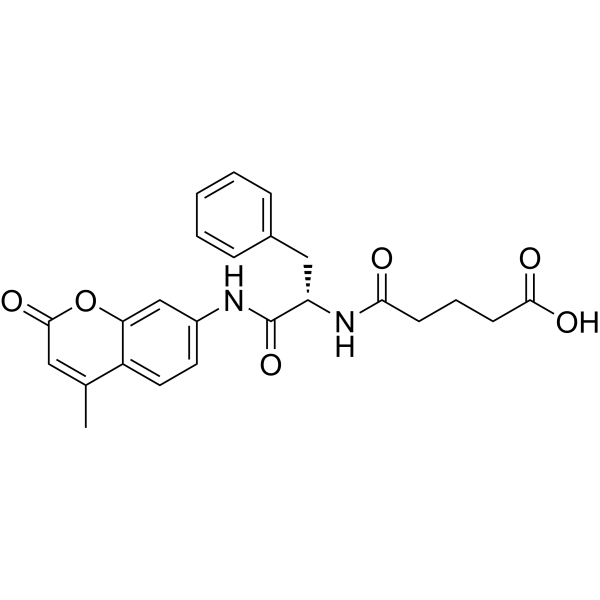 0 ImagesCat. No.: HY-D1503CAS No.: 58632-47-6Glut-Phe-AMC is a fluorescent dye.
-
3-Acetylumbelliferyl β-D-Glucopyranoside
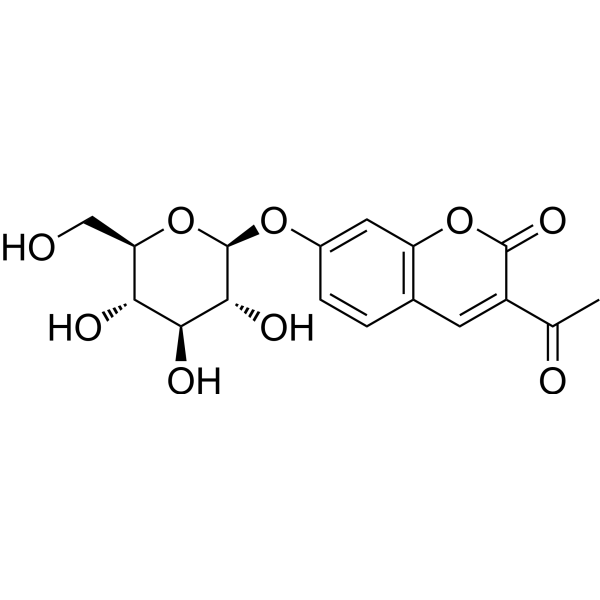 0 ImagesCat. No.: HY-W357142CAS No.: 20943-16-23-Acetylumbelliferyl β-D-Glucopyranoside is a fluorogenic substrate for β-glucosidase and can be used as a positive control substrates for β-D-glucosidase.


-
Ds-HAPP
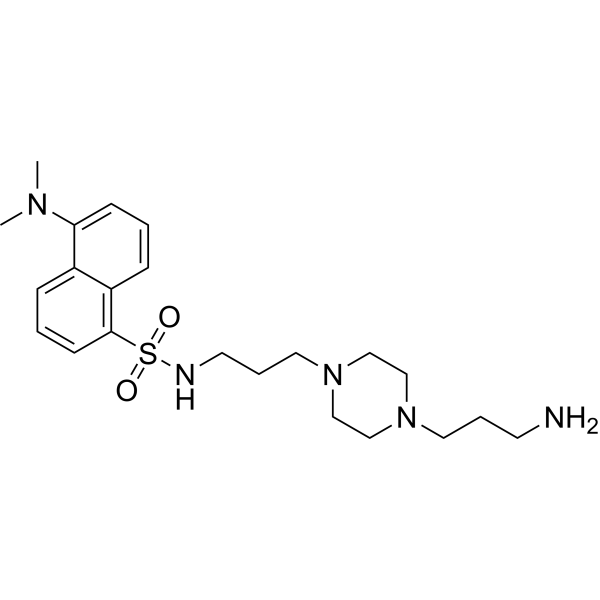 0 ImagesCat. No.: HY-112797CAS No.: 330163-26-3Ds-HAPP is an anthrancenyl and dansyl fluorophore ligand.
-
Mucilage Staining Solution (Ruthenium Red Method)
 0 ImagesCat. No.: HY-DY2040Mucilage Staining Solution (Ruthenium Red Method) is a staining solution used to localize mucopolysaccharides in plant tissues. In the staining of plant disease and pest tissue sections, pathogens decompose mucilage substances, which thus cannot be stained, while the cell walls of healthy tissues stain red.
-
8-Methoxypyrene-1,3,6-trisulfonate trisodium
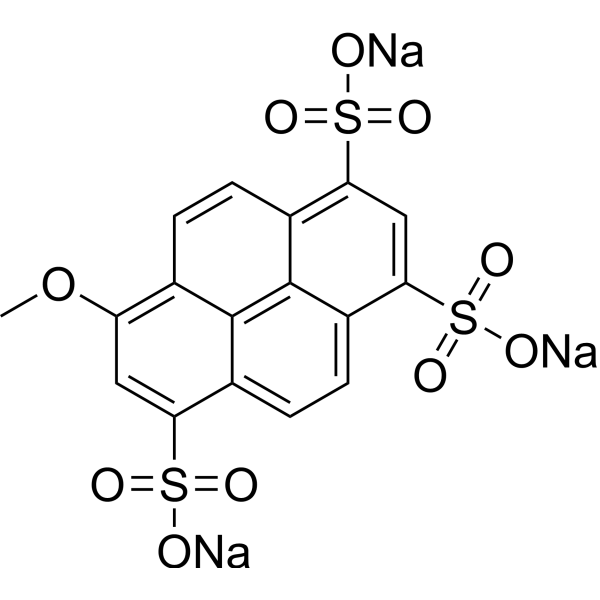 0 ImagesCat. No.: HY-D0129CAS No.: 82962-86-5Synonyms: MPTS8-Methoxypyrene-1,3,6-trisulfonate trisodium (MPTS) is a highly water-soluble superpolar fluorescent probe.

-
FAM labled Pegaptanib sodium
 0 ImagesCat. No.: HY-109561BFAM labled Pegaptanib sodiumis a FAM labled Pegaptanib sodium.
-
Indocyanine green (solution)
 0 ImagesIndocyanine green (Foxgreen) (solution) is a low toxicic fluorescent agent that has been widely used in medical diagnostics, such as determining cardiac output, hepatic function, and liver blood flow, and for ophthalmic angiography (Ex/Em = 785/813 nm) .
Solvent and concentration: DMSO: 10 mM
-
BCN-PEG2000-Rhodamine
 0 ImagesCat. No.: HY-D3059BCN-PEG2000-Rhodamine is a red fluorescent dye.
-
DTNP
 0 ImagesCat. No.: HY-163465CAS No.: 3010266-66-4DTNP is a BchE -activated near infrared (NIR) probe with blood-brain permeability. DTNP can be activated by BchE and inhibit its enzyme activity. DTNP can be used in Alzheimer's disease (AD) research.
-
RB-PEG600-RB
 0 ImagesCat. No.: HY-D2893Synonyms: Rhodamine B-PEG600-Rhodamine BRB-PEG600-RB (Rhodamine B-PEG600-Rhodamine B) a fluorescent dye composed of two Rhodamine B (HY-Y0016) and PEG. RB-PEG600-RB can be used for fluorescent labeling and imaging (Ex/Em=546/610 nm).
-
Pegulicianine
 0 ImagesCat. No.: HY-163539ACAS No.: 2230217-17-9Synonyms: LUM015 free basePegulicianine is an activatable fluorescent imaging agent and can be used for fluorescence-guided surgery in breast cancer.
-
IR 680LT NHS ester
 0 ImagesCat. No.: HY-D3272IR 680LT NHS ester is a fluorescent dye with an NHS ester moiety, which can be used to label antibodies, proteins, etc (Ex/Em = 675/694 nm).
-
Dolichos Biflorus Agglutinin (Biotinylated)
 0 ImagesCat. No.: HY-NP0176Synonyms: DBA,BiotinylatedDolichos Biflorus Agglutinin (DBA,Biotinylated) is a plant lectin that can be used as a probe to specifically bind biomolecules (such as polysaccharides, peptides, etc.).Dolichos Biflorus Agglutinin (DBA,Biotinylated) is a biological material or organic compound that can be used in life science research.
-
PF-06649283
 0 ImagesCat. No.: HY-124317CAS No.: 1621585-17-8PF-06649283 is a drug with potential intracellular activity. The effects of PF-06649283 may be affected by factors such as cellular metabolism, protein-protein interactions, post-translational modifications, and asymmetric intracellular localization. The potency of PF-06649283 at the cellular level may show different activity compared to the recombinant enzyme, and this difference needs to be considered in the drug discovery process. Increased intracellular potency of PF-06649283 may be critical for the development of this drug as a probe or drug.




