



Fluorescent Dye
Fluorescence is a phenomenon of photoluminescence in luminescence. When an atom is irradiated by light, some electrons around the nucleus jump from their original orbitals to higher energy orbitals under the influence of light energy, i.e., from the ground state to the first or second excited single-line state, etc. Due to the instability of the first or second excited singlet state, the electron returns from the excited singlet state to the ground state accompanied by released energy, resulting in fluorescence.
Fluorescent dyes can be covalently bound or physically adsorbed in the structure of the substance. The fluorescence properties allow for the characterization, localization and quantitative analysis of the labeled object. Fluorescent dyes have shown great potential for the detection of proteins, nucleic acids, cells, and immunoassays, attributed to the advantages in non-radioactive contamination, simple experimental operation and easy observation.
Fluorescent dyes have penetrated many fields such as pharmacology, physiology, environmental science, and information science, as well as functional studies of proteins and drug screening.
All Product Categories
-
Fluorescent Dye Related Products (4888)
Related Products (4888)

-
Antibodies (4)
-
Rhod-590 AM Ester
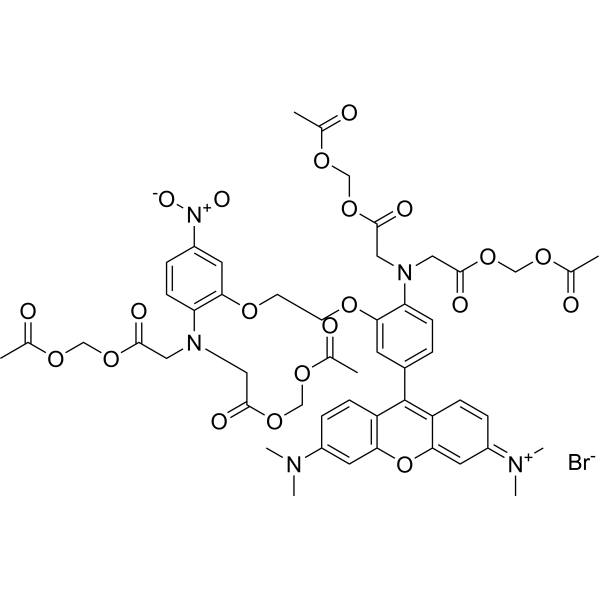 0 ImagesCat. No.: HY-D1681Rhod-590 AM Ester is a fluorescent dye. Rhod-590 AM Ester can be used as a fluorescent indicator for calcium determination.

-
Tetrabromorhodamine 123 bromide
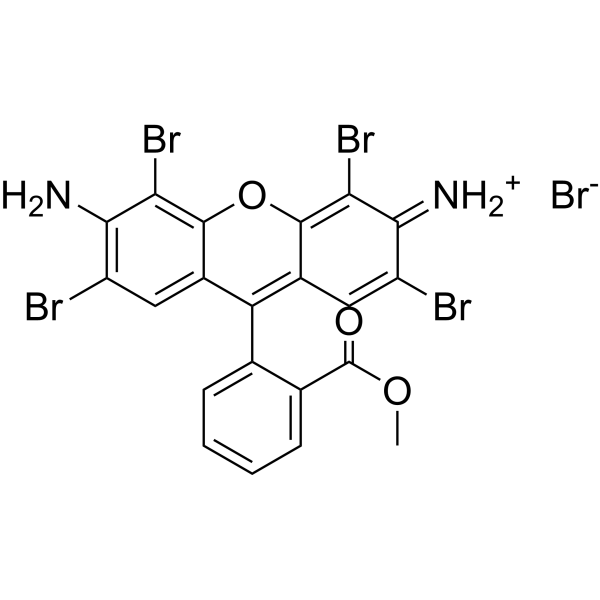 0 ImagesCat. No.: HY-D1673CAS No.: 623903-26-4Tetrabromorhodamine 123 (TBR) bromide is a photosensitizer. Tetrabromorhodamine 123 bromide can be used for the research of photo dynamic therapy (PDT) and cancer.
-
VIC
 0 ImagesCat. No.: HY-D3356CAS No.: 327174-91-4VIC is a yellow-green fluorescent dye belonging to the xanthracene class of fluorescent dyes. It is mainly used in research on fluorescently labeled oligonucleotides (such as 5' end labeling), TaqMan qPCR probes, and nucleic acid detection. VIC dye can directly generate a stable fluorescent signal upon light excitation, without relying on enzyme catalysis, pH, or membrane potential activation mechanisms.
-
Fluorescein (Standard)
 0 ImagesFluorescein (Standard) is the analytical standard of Fluorescein. This product is intended for research and analytical applications. Fluorescein (Uranine) is widely used as a fluorescent tracer in medicinal and biological applications and tumor infected tissues tracer. Fluorescein (Uranine) is a representative green fluorophore that has been widely used as a scaffold of practically useful green fluorescent probes.
-
DDAO-C6
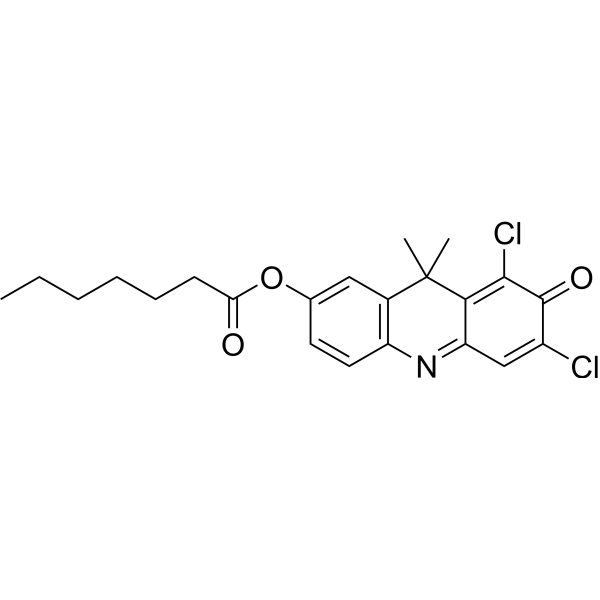 0 ImagesCat. No.: HY-150978CAS No.: 2102418-89-1DDAO-C6 is a cridone ester derivative, highly specific fluorescence for detecting human serum albumin (HSA). DDAO-C6 acts as an enzymatic activatable near-infrared fluorescent probe in visually sensing endogenous lipase from gut microbes (Ex/Em=600/658 nm).
-
RB-PEG2000-NH2
 0 ImagesCat. No.: HY-D2895CSynonyms: Rhodamine B-PEG2000-NH2RB-PEG2000-NH2 (Rhodamine B-PEG2000-NH2) is a fluorescent dye composed of Rhodamine B (HY-Y0016), PEG and an amino group. The reactive primary amine or NH2 groups can react rapidly with activated carboxylic acids such as NHS esters to form stable amide bonds (Ex/Em=546/610 nm).
-
Starch Staining Solution (Iodine Method)
 0 ImagesCat. No.: HY-DY2039Starch Staining Solution (Iodine Method), also known as Iodine Starch Staining Solution, stains starch in plants blue or dark blue-purple within a few minutes of staining with iodine solution. Glycogen accumulated in fungal cells turns red after staining with iodine solution. Starch appears blue or purplish-red when hydrolyzed into dextrins, and turns red when further decomposed into smaller-molecular-weight dextrins.
-
Cy3 labled Etidaligide sodium
 0 ImagesCat. No.: HY-177631DCy3 labled Etidaligide sodium is a Cy3 labled Etidaligide sodium.

-
Z-IETD-R110
 0 ImagesCat. No.: HY-P10322Z-IETD-R110 is a fluorescent substrate of caspases. Z-IETD-R110 acts as a substrate for caspase-8. When caspase-8 is activated, it can recognize and cut Z-IETD-R110, releasing fluorophore, which can be detected by fluorescence microscopy. Z-IETD-R110 can be used to study oxidative stress-induced apoptosis, particularly in pancreatic acinar cells.
-
Concanavalin A-AF405
 0 ImagesCat. No.: HY-NP164DSynonyms: Con A-AF405Concanavalin A-AF405 (Con A-AF405) is an AF405-labled Concanavalin A (HY-P2149). Concanavalin A is a Ca2+/Mn2+-dependent and mannose/glucose-binding plant lectin. Concanavalin A binds the N- and O-glycosylated proteins of head and neck carcinoma cells glycoproteins.
-
PP-biotin
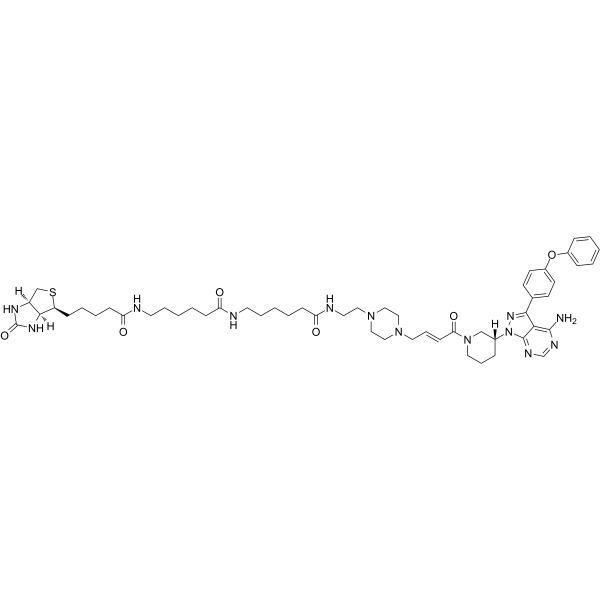 0 ImagesCat. No.: HY-145057CAS No.: 1801423-93-7PP-biotin is an irreversible, biotin-labeled probe.
-
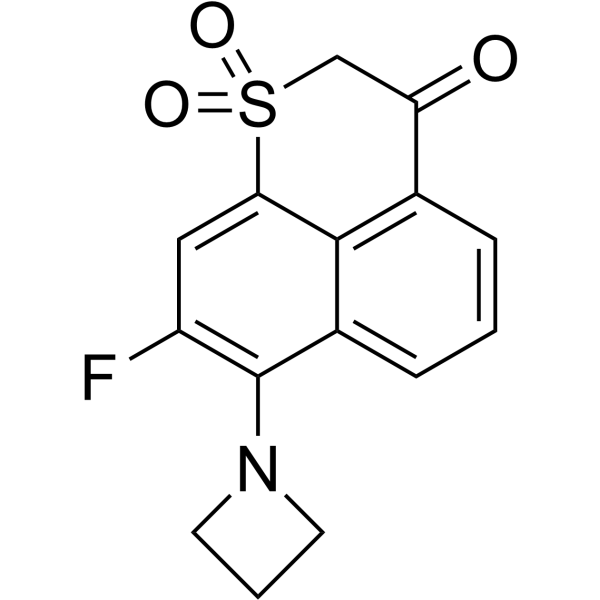
Green DND-26 (solution)
 0 ImagesCat. No.: HY-DY1082CAS No.: 220524-71-0Green DND-26 (solution) is a green fluorescently labeled lysosomal probe with a maximum excitation/emission wavelength of 504/511 nm. The structure is composed of a fluorescein group and linked weak bases, which can freely cross the cell membrane and generally gather on spherical organelles. Green DND-26 is suitable for observing the internal biosynthesis and related pathogenesis of lysosomes.
Solvent and concentration: DMSO: 2 mM
-
Ulex Europaeus Agglutinin I-AF488
 0 ImagesCat. No.: HY-NP090DSynonyms: UEA I-AF488Ulex Europaeus Agglutinin I-AF488 (UEA I-AF488) is an AF488-labeled glehnia littoralis lectin I (UEA-I). Ulex Europaeus Agglutinin I exhibits specificity for cell surface glycoconjugates containing α-L-fucosylate. Ulex Europaeus Agglutinin I-AF488 can be used for vascular endothelial labeling, glycan imaging, and tissue staining studies (Ex/Em = 470/520 nm).
-
NBD-FTY720 phenoxy hydrochloride
 0 ImagesCat. No.: HY-158638CAS No.: 2319882-09-0NBD-FTY720 phenoxy hydrochloride is a fluorescently-labeled analog of FTY720. FTY720 (HY-12005) is a potent sphingosine 1-phosphate (S1P) receptors modulator.
-
FGGH
 0 ImagesCat. No.: HY-P11057Purity: 98.18%FGGH is a water-soluble peptide-based probe. FGGH performs the sequential detection of Cu2+ and S2- by fluorescence and colorimetry with high sensitivity (LOD: 1.42 and 22.2 nM for Cu2+ and S2-, respectively) (Ex=488 nm, Em=525 nm), and images both two ions in living cells and zebrafish models with low cytotoxicity. FGGH can be used for in vivo imaging and environmental pollution monitoring research.
-
Cy3 labled GEM-231 sodium
 0 ImagesCat. No.: HY-148827ECy3 labled GEM-231 sodium is a Cy3 labled GEM-231 sodium.
-
A3 glycan, procainamide labelled
 0 ImagesCat. No.: HY-158531Synonyms: A3 N-linked oligosaccharide, procainamide labelledA3 glycan, procainamide labelled (A3 N-linked oligosaccharide, procainamide labelled) is a N-polysaccharide protein and a multifunctional fluorescent linker. The resulting conjugates exhibit high sensitivity and specificity by mimicking the antennal elements of N-glycans.




