



Insecticide
Insecticide
Insecticides refer to any toxic substances used to kill insects, which exert toxic effects on pests through different mechanisms, thereby achieving the purpose of controlling pest populations and protecting crops and human health. Insecticides have both chemical and biological origins and can be classified into organochlorine insecticides, organophosphorus insecticides, carbamate insecticides, and mineral insecticides based on their chemical properties. Insecticides interact with different target and non-target sites, including receptors, enzymes, and many other known and unknown molecules. Most insecticides are neurotoxicants that target the nervous system, but they can also affect other organs and body systems. Insecticides are metabolized through different metabolic pathways and often serve as biomarkers of exposure in the form of their parent compounds or metabolites. The toxicity of insecticides can be acute, subacute, or chronic, depending on the duration of exposure and the dose involved. Therefore, selecting sensitive, accurate, and validated biomarkers of exposure, effects, and susceptibility appears to be a challenging task.
Insecticides are widely used in agriculture, horticulture, forestry, gardening, homes, offices, and other fields[1][2].
All Product Categories
-
Insecticide Related Products (529)
Related Products (529)

-
SCPI-1
 0 ImagesCat. No.: HY-180460CAS No.: 339231-67-3SCPI-1 is a potent and competitive mosquito sterol carrier protein-2 (SCP-2) inhibitor (AeSCP-2 IC50 = 0.347 µM; AeSCP-x IC50 = 0.527 µM). SCPI-1 exhibits physiological effects on cholesterol metabolism in cultured insect cells (IC50 of 5.53 µM in Aag-2 cells). SCPI-1 shows insecticidal activity against Aedes aegypti with a LD50 of 4.8 µM.
-
Bistrifluron (Standard)
 0 ImagesCat. No.: HY-119902RCAS No.: 201593-84-2Bistrifluron (Standard) is the analytical standard of Bistrifluron. This product is intended for research and analytical applications. Bistrifluron is a benzoylphenylurea compound and orally active insecticide with activity against termites. At a concentration of 5,000 ppm, Bistrifluron acts as a bait toxicant against workers of the Formosan subterranean termite (Coptotermes formosanus), and also inhibits the grooming behavior of termites and impairs their motor ability prematurely.
-
(1S,3S)-λ-Cyhalothrin
 0 ImagesCat. No.: HY-B0836ACAS No.: 76703-65-6(1S,3S)-λ-Cyhalothrin is an isomer of λ-Cyhalothrin (HY-B0836). λ-Cyhalothrin is a highly potent, broad-spectrum, Type II synthetic pyrethroid Insecticide.
-
Pirimiphos-methyl (Standard)
 0 ImagesCat. No.: HY-B1881RCAS No.: 29232-93-7Pirimiphos-methyl (Standard) is the analytical standard of Pirimiphos-methyl (HY-B1881). This product is intended for research and analytical applications. Pirimiphos-methyl is an organophosphorus insecticide and acaricide that can inhibit AChE in target organisms. Pirimiphos-methyl is often used for prevention and control of beetles, snout beetles, moths and Ephestia cautella during storage of agricultural grains.
-
Tetraniliprole
 0 ImagesCat. No.: HY-135862CAS No.: 1229654-66-3Tetraniliprole is an insecticide that can be used in the study of tobacco cutworms (TCW).
-
(4′-Hydroxy)phenoxybenzoic acid
 0 Images(4′-Hydroxy)phenoxybenzoic acid is a pyrethroid insecticide metabolite.
-
Insecticidal agent 27
 0 ImagesCat. No.: HY-178337Insecticidal agent 27 (Compound D36) is an insecticide agent. Insecticidal agent 27 shows superior activity against P. xylostella, with a LC50 value of 0.025 mg/L. Insecticidal agent 27 exhibits LC50 values of 0.934 and 0.601 mg/L against Spodoptera frugiperda and Ostrinia furnacalis,respectively.
-
Alanycarb
 0 ImagesCat. No.: HY-133848CAS No.: 83130-01-2Synonyms: OK-135Alanycarb (OK-135) is a broad-spectrum oxime carbamate insecticide with contact and oral toxicity. Alanycarb is effective against a wide variety of insect pests and is a pro-insecticide. The principal active molecule produced by the biological modification of Alanycarb within target organisms is methomyl.
-
Destruxins C
 0 ImagesCat. No.: HY-N14917CAS No.: 27482-49-1Destruxins C is found in the strain of Hyphomycetes and Metarrhiziurn anosopliae. Destruxins C has insecticidal activity.
-
Desmedipham (Standard)
 0 ImagesCat. No.: HY-116482RCAS No.: 13684-56-5Desmedipham (Standard) is the analytical standard of Desmedipham. This product is intended for research and analytical applications. Desmedipham is a selective systemic phenyl-carbamate herbicide. Desmedipham acts by disrupting CO2 fixation and the production of intermediary energy components-ATP and NADPH2 and inhibition of Hill reaction.
-
Insecticidal agent 35
 0 ImagesCat. No.: HY-208558CAS No.: 183992-51-0Insecticidal agent 35 is an insecticide that inhibits the growth of tobacco budworms. When applied via foliar spray, Insecticidal agent 35 controls tobacco budworms, cabbage loopers and beet armyworms. Insecticidal agent 35 can be used in studies related to tobacco budworm infestation.
-
p,p'-DDD (Standard)
 0 ImagesSynonyms: 4,4'-DDD (Standard); p,p'-Dichlorodiphenyl dichloroethane (Standard)p,p'-DDD (Standard) is the analytical standard of p,p'-DDD (HY-B1984) . This product is intended for research and analytical applications. p,p'-DDD (4,4’-DDD) is an organochlorine insecticide, a major metabolite of p,p'-DDT. p,p'-DDD is an agonist at estrogen receptor α(ERα) and ERβ. p,p'-DDD increases DNA damage, apoptosis and necrosis in peripheral blood. p,p'-DDD stimulates cell proliferation in SKBR3 cells. p,p'-DDD activates the AP-1 transcription factor. p,p'-DDD decreases sleep times of barbiturates and steroids in rats.
-
Angulatin A
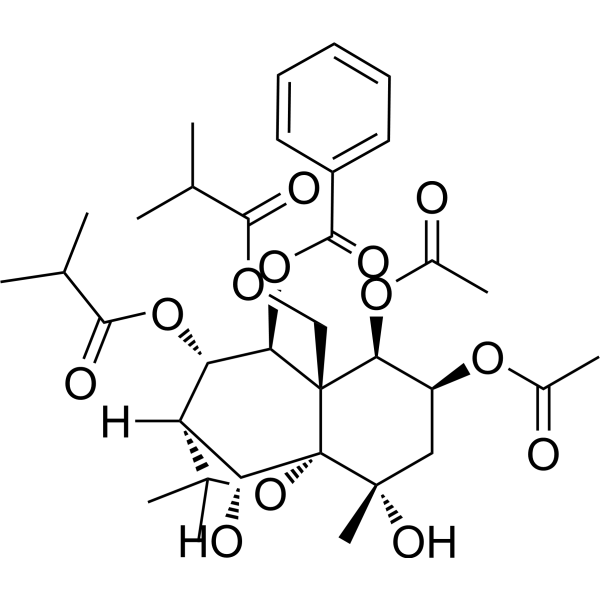 0 ImagesCat. No.: HY-N7202CAS No.: 139979-81-0Synonyms: (-)-Angulatin A; Celangulin VAngulatin A (Celangulin V) is a natural product that can be found in Celastrus angulatus. Angulatin A is a novel botanical insecticide with a toxic activity against agricultural insect pests. Angulatin A can bind to subunits a, H, and B of the vacuolar ATPase (V-ATPase) in the midgut epithelial cells of insects.

-
Cyclaniliprole
 0 ImagesCat. No.: HY-W719559CAS No.: 1031756-98-5Cyclaniliprole is an insecticide and insect ryanodine receptor modulator with higher selectivity for insect ryanodine receptors than for mammalian ones. Cyclaniliprole exerts lethal effects on larvae and adults of various agricultural pests. Cyclaniliprole exhibits broad-spectrum insecticidal activity against pests of the orders Lepidoptera, Thysanoptera, Diptera, Hemiptera and Coleoptera.

-
Benfuracarb
 0 ImagesCat. No.: HY-B2041CAS No.: 82560-54-1Benfuracarb is a broad-spectrum carbamate insecticide with crop protection activity. Benfuracarb is used to control springtails, aphids, and other pests, typically on sugar beet crops. Benfuracarb exhibits toxicity to humans and aquatic organisms. Benfuracarb exposure to zebrafish embryos resulted in a reduction in the body length of zebrafish larvae. Superoxide dismutase (SOD) activity was significantly increased after Benfuracarb treatment. Benfuracarb also interfered with the transcriptional levels of marker genes associated with early embryonic development.
-
Butyl decanoate
 0 ImagesSynonyms: Decanoic acid, butyl esterButyl decanoate (Decanoic acid) serves as an effective insect repellent.
-
SCPI-3
 0 ImagesCat. No.: HY-180500CAS No.: 349561-46-2SCPI-3 is a potent and competitive mosquito sterol carrier protein-2 (SCP-2) inhibitor (AeSCP-2 IC50 = 0.159 µM; AeSCP-x IC50 = 0.285 µM). SCPI-3 exhibits physiological effects on cholesterol metabolism in cultured insect cells (IC50 of 3.09 µM in Aag-2 cells). SCPI-3 shows insecticidal activity against Aedes aegypti with a LD50 of 12.3 µM.
-
GPCR antagonist-1
 0 ImagesCat. No.: HY-187424GPCR antagonist-1 is an orally active G protein-coupled receptor (GPCR) antagonist as well as an insecticide. GPCR antagonist-1 induces intestinal microvillus destruction, reduces microfilarial secretion, increases the proportion of malformed embryos, inhibits nematode motility and L3-stage molting, and exerts L4-stage larvicidal activity. GPCR antagonist-1 can be used for the research of filarial infections.



