



ADRA1D receptor antagonist 1 free base
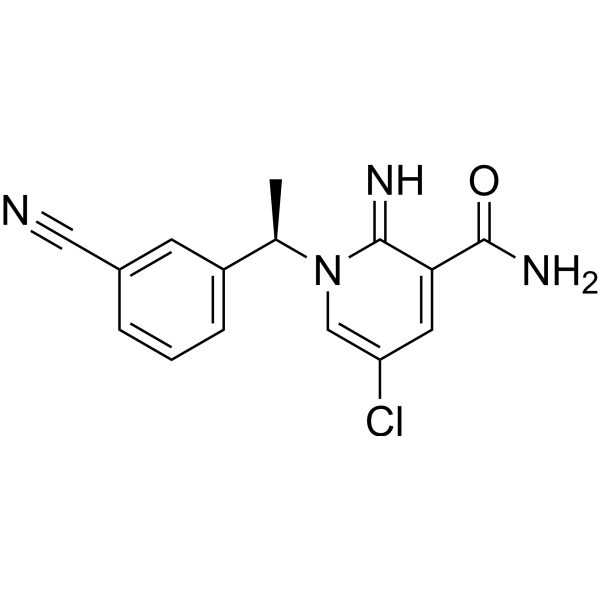
ADRA1D receptor antagonist 1 (free base) (compound (R)-9s) is an orally active, potent and selective human α1D-adrenoceptor (α1D-AR) antagonist (Ki=1.6 nM). ADRA1D receptor antagonist 1 (free base) dose-dependently inhibits bladder contraction with an IC30 value of 15 nM. ADRA1D receptor antagonist 1 (free base) can be used in studies of overactive bladder disorders such as urinary urgency, frequency and incontinence.
For research use only. We do not sell to patients.
- CAS No.: 1191908-24-3
- Formula: C15H13ClN4O
- Molecular Weight:300.74
-
Storage:
Please store the product under the recommended conditions in the Certificate of Analysis.

To place orders, for customer services and technical support, please contact: MedChemExpress USA
Tel: 609-228-6898 E-mail: [email protected] [email protected]


-
 Biological Activity
-
Chemical Information
- Purity & Documentation
- References
-
 Help & FAQs


All Adrenergic Receptor Isoforms
More

Biological Activity
Description
In Vivo
ADRA1D receptor antagonist 1 (free base) (4.4 µg/kg; i.v.; single) inhibits bladder contraction with an IC 30 value of 15 nM in rats[1].
MedChemExpress (MCE) has not independently confirmed the accuracy of these methods. They are for reference only.
-
Animal Model:Rats with cyclophosphamide-induced cystitis[1].
-
Dosage:10 µg/kg
-
Administration:Oral administration; single
-
Result:Increased voiding intervals.
-
Animal Model:Rats with BOO (bladder outlet obstruction)[1].
-
Dosage:4.4 µg/kg
-
Administration:Intravenous injection; single
-
Result:Dose-dependently decreased the non-voiding bladder contractions during urinary storage phase.


Chemical Information
-
CAS No. 1191908-24-3
-
Molecular Weight 300.74
-
Formula C15H13ClN4O
-
SMILES
O=C(C1=CC(Cl)=CN([C@@H](C2=CC=CC(C#N)=C2)C)C1=N)N
-
Shipping
Room temperature in continental US; may vary elsewhere.
-
Storage
Please store the product under the recommended conditions in the Certificate of Analysis.


Purity & Documentation
References
[1]. Sakauchi N, et al. Discovery of 5-Chloro-1-(5-chloro-2-(methylsulfonyl)benzyl)-2-imino-1,2-dihydropyridine-3-carboxamide (TAK-259) as a Novel, Selective, and Orally Active α1D Adrenoceptor Antagonist with Antiurinary Frequency Effects: Reducing Human Ether-a-go-go-Related Gene (hERG) Liabilities. J Med Chem. 2016 Apr 14;59(7):2989-3002. [Content Brief]

Calculators
Concentration (start) × Volume (start) = Concentration (final) × Volume (final)


ADRA1D receptor antagonist 1 free base Related Classifications
HY-148252 Related Classifications
 Powered by Bioz