



Ocular Hypertension
-
Ocular Hypertension (10)

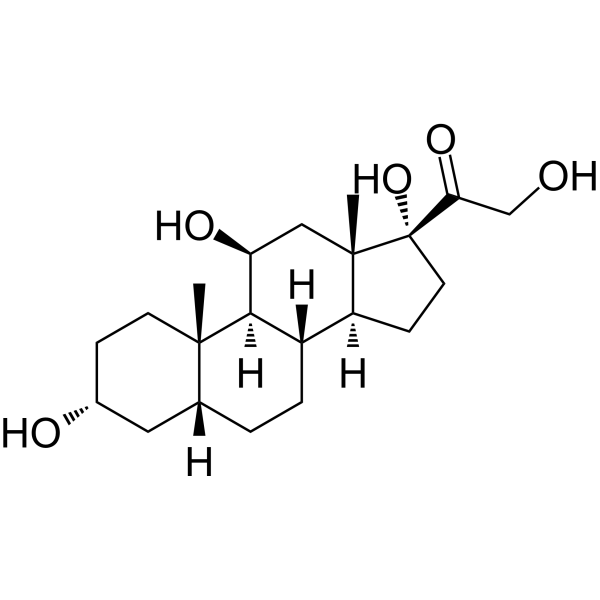
- Formula: C21H34O5
- Molecular Weight: 366.49
Tetrahydrocortisol is a metabolite of Hydrocortisone (HY-N0583) that fails to activate glucocorticoid receptor. Tetrahydrocortisol inhibits Dexamethasone (HY-14648)-induced formation of cross-linked actin networks. Tetrahydrocortisol acts as a synergist to enhance the activity of anticancer agents. Tetrahydrocortisol can be used in the research of primary open-angle glaucoma, ocular hypertension, lung cancer and breast cancer.
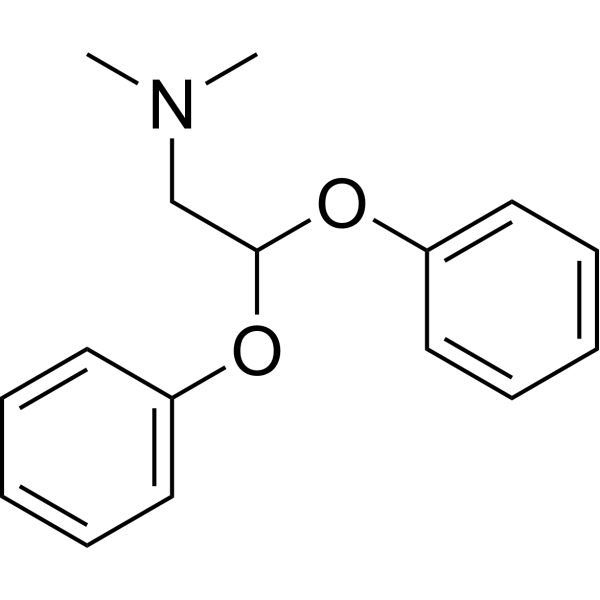
- Formula: C16H19NO2
- Molecular Weight: 257.33
Medifoxamine is an orally active monoamine reuptake inhibitor and antidepressant. Medifoxamine preferentially inhibits presynaptic dopamine reuptake. Medifoxamine acts as an intraocular pressure-lowering agent to reduce intraocular pressure, and also functions as a miotic agent to decrease pupil diameter. Medifoxamine exhibits characteristic properties of antidepressant compounds, including preventing hypothermia induced by Reserpine (HY-N0480) or Apomorphine (HY-12723), potentiating the toxic effects of Yohimbine (HY-N0127) in mice, and reducing immobility behavior in mice and rats in the "behavioral despair" model. Medifoxamine has no anticholinergic activity. Medifoxamine can be used in research related to depression.

- Formula: C26H36F2O6
- Molecular Weight: 482.56
Sepetaprost (ONO-9054) is a dual agonist of the prostaglandin E3 receptor and prostaglandin F receptor. Sepetaprost reduces intraocular pressure in animal models. Sepetaprost is applicable for research on ocular hypertension and open-angle glaucoma.

- Formula: C10H16N2O4S3
- Molecular Weight: 324.44
(4R,6R)-Dorzolamide ((4R,6R)-L671152; (4R,6R)-MK507) is a carbonic anhydrase II (CAII) inhibitor and the undesired chiral enantiomer of Dorzolamide. (4R,6R)-Dorzolamide inhibits CAII isoenzymes, thereby modulating the rate of aqueous humor formation. (4R,6R)-Dorzolamide serves as a stereoisomeric reference standard in chiral HPLC separation studies. (4R,6R)-Dorzolamide can be used for research on ocular hypertension and glaucoma.

- Formula: C20H33ClO5
- Molecular Weight: 388.93
AL-6556 is a full agonist of the DP receptor and a partial agonist of the EP2 receptor. AL-6556 has an EC50 of 799 nM for bovine DP, a Ki of 3200 nM for human DP, and an EC50 of 1180 nM for human EP2, with selectivity over EP3, FP, IP, TP and 19 non-prostaglandin receptors. AL-6556 stimulates cAMP production via receptor activation and reduces intraocular pressure through aqueous humor inflow and outflow mechanisms. AL-6556 can be used in research related to ocular hypertension and glaucoma.

- Formula: C7H7N3O2S2
- Molecular Weight: 229.27
Aminozolamide is a carbonic anhydrase inhibitor. Aminozolamide regulates intraocular pressure by inhibiting carbonic anhydrase activity. Aminozolamide exerts local ocular effects, exhibits good retention in the ciliary body of rabbit eyes, and prevents rapid elimination from the eye. Aminozolamide is applicable to the research of ocular hypertension.

- Formula: C11H18N2O4S3
- Molecular Weight: 338.47
Sezolamide (MK 417 free base) is a potent topical carbonic anhydrase inhibitor. Sezolamide can be used in studies to reduce intraocular pressure.

- Formula: C17H27NO2
- Molecular Weight: 277.40
Zenidolol (ICI-118551) (Standard) is the analytical standard of Zenidolol (HY-100543). This product is intended for research and analytical applications. Zenidolol is a selective β2-adrenergic receptor antagonist with Ki values of Zenidolol for β2, β1 and β3 adrenergic receptors of 0.7, 49.5 and 611 nM, respectively. Zenidolol exerts antitumor effects via inducing apoptosis, inhibiting tumor sphere formation, and downregulating the HIF pathway by blocking β2-AR on tumor cells. Zenidolol exhibits a unique pulmonary vessel-specific vasodilatory effect in mouse models. Zenidolol can be used as an intraocular pressure-lowering agent in ophthalmic disease research.

- Formula: C16H23Cl2N3O2S
- Molecular Weight: 392.34
Cotosudil hydrochloride is a ROCK kinase inhibitor that can be used in studies on glaucoma or ocular hypertension.

- Formula: C16H19NO2
- Molecular Weight: 257.33
Medifoxamine (Standard) is the analytical standard of Medifoxamine (HY-119468). This product is intended for research and analytical applications. Medifoxamine is an orally active monoamine reuptake inhibitor and antidepressant. Medifoxamine preferentially inhibits presynaptic dopamine reuptake. Medifoxamine acts as an intraocular pressure-lowering agent to reduce intraocular pressure, and also functions as a miotic agent to decrease pupil diameter. Medifoxamine exhibits characteristic properties of antidepressant compounds, including preventing hypothermia induced by Reserpine (HY-N0480) or Apomorphine (HY-12723), potentiating the toxic effects of Yohimbine (HY-N0127) in mice, and reducing immobility behavior in mice and rats in the "behavioral despair" model. Medifoxamine has no anticholinergic activity. Medifoxamine can be used in research related to depression.



