



ER alpha/ESR1 Protein, Human (His)
Based on 1 publication(s) in Google Scholar
The ER α/ESR1 protein is a nuclear receptor that plays a critical regulatory role in gene expression, affecting cell proliferation and differentiation. Ligand-dependent transactivation involves binding of homodimers to estrogen response elements or association with transcription factors. ER alpha/ESR1 Protein, Human (His) is the recombinant human-derived ER alpha/ESR1 protein, expressed by E. coli , with N-6*His labeled tag.
- Species: Human
- Source: E. coli
-
Storage:Stored at -20°C for 2 years from date of receipt. After reconstitution, it is stable at 4°C for 1 week or -20°C for longer (with carrier protein). It is recommended to freeze aliquots at -20°C or -80°C for extended storage.


To place orders, for customer services and technical support, please contact: MedChemExpress USA
Tel: 609-228-6898 E-mail: [email protected] [email protected]


-
 Biological Activity
-
Technical Parameters
-
Product Properties
- Documentation
- Help & FAQs




Biological Activity
Description
The ER α/ESR1 protein is a nuclear receptor that plays a critical regulatory role in gene expression, affecting cell proliferation and differentiation. Ligand-dependent transactivation involves binding of homodimers to estrogen response elements or association with transcription factors. ER alpha/ESR1 Protein, Human (His) is the recombinant human-derived ER alpha/ESR1 protein, expressed by E. coli , with N-6*His labeled tag.
Background
ER alpha/ESR1 Protein, a nuclear hormone receptor, plays a pivotal role in the regulation of eukaryotic gene expression, influencing cellular proliferation and differentiation in target tissues. Ligand-dependent nuclear transactivation involves direct homodimer binding to palindromic estrogen response element (ERE) sequences or association with DNA-binding transcription factors like AP-1/c-Jun, c-Fos, ATF-2, Sp1, and Sp3, facilitating ERE-independent signaling. Upon ligand binding, ER alpha undergoes a conformational change, enabling subsequent association with multiprotein coactivator complexes through LXXLL motifs. Mutual transrepression occurs between ER alpha and NF-kappa-B in a cell-type specific manner, leading to decreased NF-kappa-B DNA-binding activity and inhibition of NF-kappa-B-mediated transcription. ER alpha is recruited to NF-kappa-B response elements, displacing coregulators and mediating transcriptional activation synergistically with NF-kappa-B. Moreover, ER alpha participates in membrane-initiated estrogen signaling through various kinase cascades, and is essential for MTA1-mediated transcriptional regulation of BRCA1 and BCAS3. Additionally, ER alpha is involved in the activation of NOS3 and endothelial nitric oxide production. Isoforms lacking specific functional domains are believed to modulate transcriptional activity through competitive ligand or DNA binding, as well as heterodimerization with the full-length receptor. Furthermore, ER alpha binds to ERE and inhibits isoform 1.
Verified Bioactivity
Measured by its binding ability in a functional ELISA. When Recombinant Human ESR1 is present at 10 μg/mL can bind Anti- ESR1 antibody. The ED50 for this effect is 0.445 μg/mL.
MCE Validation Data
-
Purity - SDS-PAGE
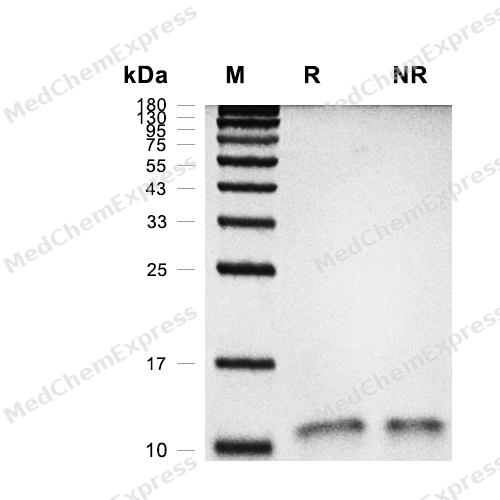
Purity - SDS-PAGE
-
Bioactivity - ELISA
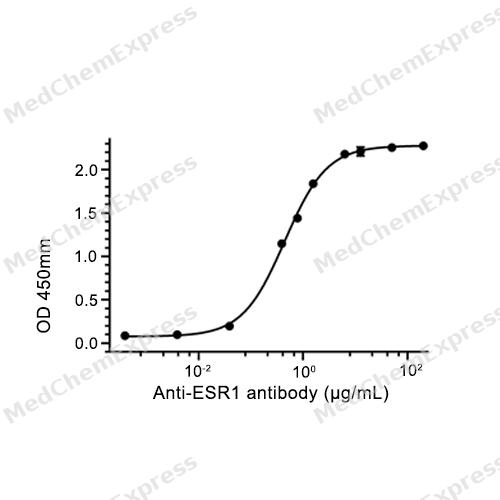
Bioactivity - ELISA


Publications (1)
-
Journal Impact Factor
-
Most Recent
-
Anal Chem
Assembly of Dye Molecules in Covalent Organic Frameworks for Enhanced Colorimetric Biosensing. [Abstract]2024 Oct 1;96(39):15720-15727. PMID: 39283703


Technical Parameters
-
Species Human
-
Source E. coli
-
Tag N-6*His
-
Accession
P03372-1 (M1-Q116)
-
Molecular Construction
-
N-term
-
6*His
-
ESR1 (M1-Q116)
Accession # P03372-1 -
C-term
-
-
Protein Length
Full Length of Isoform-1
-
Synonyms
ESR1; Estrogen Receptor Alpha Delta 4*,5,6,7*/654 Isoform; Prev. ESR; Estrogen Receptor Alpha 3*,4,5,6,7,8*/1032 Isoform; ER-Alpha; Estrogen Receptor Alpha 3*,4,5,6,7,8*/1068 Isoform; ER; Estrogen Receptor Alpha 3*,4,5,6,7,8*/984 Isoform; Nuclear Receptor
-
AA Sequence
MTMTLHTKASGMALLHQIQGNELEPLNRPQLKIPLERPLGEVYLDSSKPAVYNYPEGAAYEFNAAAAANAQVYGQTGLPYGPGSEAAAFGSNGLGGFPPLNSVSPSPLMLLHPPPQ
-
Molecular Weight
Approximately 14 kDa, based on SDS-PAGE under reducing conditions.
-
Purity
≥ 90%, as determined by reducing SDS-PAGE.


Product Properties
Lyophilized powder.
1.Lyophilized from a 0.22 μm filtered solution of 20 mM Glycine-HCl, 8% sucrose, 0.05% Tween 80, pH 3.5.
2.Lyophilized from a 0.22 μm filtered solution of 50 mM Tris-HCl, 150 mM NaCl, pH 8.0.
Please refer to the lot-specific COA for specific buffer information.
Note: For SPR assay, please replace the buffer. Primary amine components (e.g., Tris, imidazole) can affect protein-coupled chips.
<1 EU/μg, determined by LAL method.
It is not recommended to reconstitute to a concentration less than 100 μg/mL in ddH2O. For long term storage it is recommended to add a carrier protein (0.1% BSA, 5% HSA, 10% FBS or 5% Trehalose).
Stored at -20°C for 2 years from date of receipt. After reconstitution, it is stable at 4°C for 1 week or -20°C for longer (with carrier protein). It is recommended to freeze aliquots at -20°C or -80°C for extended storage.
Room temperature in continental US; may vary elsewhere.


Documentation
-
Data Sheet (237 KB)
-
SDS (255 KB)
- English - EN (255 KB)
- Français - FR (255 KB)
- Deutsch - DE (255 KB)
- Norwegian - NO (255 KB)
- Español - ES (255 KB)
- Swedish - SV (255 KB)
- Italian - IT (255 KB)
- Korean - KR (255 KB)
- Portuguese - PT (255 KB)
-
Handling Instructions (2659 KB)

Calculators
Concentration (start) × Volume (start) = Concentration (final) × Volume (final)


 Powered by Bioz

