



c-Fos
c-Fos is an immediate-early gene product and transcription factor that functions as a central mediator of stimulus-dependent gene expression, linking transient extracellular signals to long-term cellular responses through regulation of downstream target genes[1]. Mechanistically, c-Fos belongs to the Fos family and forms the activator protein-1 (AP-1) transcription factor complex through dimerization with Jun family proteins, thereby regulating genes involved in cellular differentiation, proliferation, development, plasticity, and survival[4][3][2]. c-Fos expression is rapidly induced by neuronal activity, calcium- and cAMP-dependent signaling, and other environmental stimuli, making it a widely used molecular marker of cellular activation and stimulus-transcription coupling in experimental systems[1][3]. In disease and experimental models, c-Fos has been extensively employed to map activated neuronal populations during seizures, learning, memory formation, and behavioral responses, providing a framework for investigating neural circuit function and activity-dependent transcriptional programs[1][3]. Compared with related Fos family members, including FosB, Fra-1 (FOSL1), and Fra-2 (FOSL2), c-Fos contains a C-terminal transactivation domain and exhibits distinctive transcriptional regulatory properties within AP-1 complexes[4]. For experimental applications, c-Fos is primarily used as an activity-dependent biomarker rather than a direct pharmacological target, enabling quantitative assessment of cellular activation, neural network recruitment, and stimulus-responsive signaling pathways in neuroscience and molecular biology research[3][5].
References:
- [1]. Curran T, et al. Fos: an immediate-early transcription factor in neurons. J Neurobiol. 1995 Mar;26(3):403-12. [Content Brief]
- [2]. Gallo FT, et al. Immediate Early Genes, Memory and Psychiatric Disorders: Focus on c-Fos, Egr1 and Arc. Front Behav Neurosci. 2018;12:79.
- [3]. Lara Aparicio SY, et al. Current Opinion on the Use of c-Fos in Neuroscience. NeuroSci. 2022;3(4):687-702.
- [4]. Cruz-Mendoza F, et al. Immediate early gene c-fos in the brain: focus on glial cells. Brain Sci. 2022;12(6):687. [Content Brief]
- [5]. Lara Aparicio SY, et al. Current opinion on the use of c-Fos in neuroscience. NeuroSci. 2022;3(4):687-702. [Content Brief]
- [6]. Srivastava SK, et al. Genetic regulation of spy gene expression in Escherichia coli in the presence of protein unfolding agent ethanol. Gene. 2014 Sep 10;548(1):142-8. [Content Brief]
All Product Categories
-
c-Fos Related Products (3)
Related Products (3)

-
T-5224
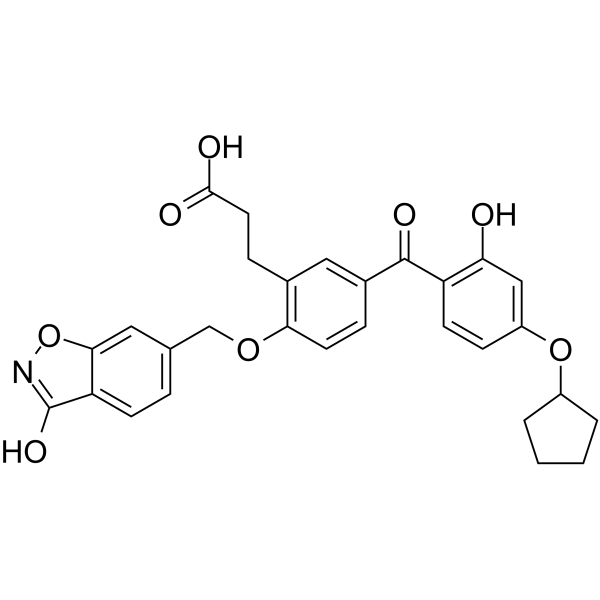 0 ImagesT-5224 is a transcription factor c-Fos/activator protein (AP)-1 inhibitor with anti-inflammatory effects, which specifically inhibits the DNA binding activity of c-Fos/c-Jun without affecting other transcription factors. T-5224 inhibits the IL-1β-induced up-regulation of Mmp-3, Mmp-13 and Adamts-5 transcription.
-
c-Fos-IN-1
 0 ImagesCat. No.: HY-168895CAS No.: 3125025-31-9c-Fos-IN-1 (Compound P16) is a c-Jun inhibitor, and decreases mRNA levels and protein levels of c-Fos. c-Fos-IN-1 also inhibits the phosphorylation activity of ERK and the transcriptional activity of AP-1. c-Fos-IN-1 shows anticancer activity by inhibiting ERK/c-Fos/Jun pathway. c-Fos-IN-1 inhibits the proliferation and migration of gastric cancer cells (IC50: 2.31 μM for MGC-803 cell). c-Fos-IN-1 arrests cell cycle at G2/M phase and induces cancer cell apoptosis. c-Fos-IN-1 inhibits gastric cancer tumor growth.
-
Amorphigenin
 0 ImagesAmorphigenin is a trothotenone compound. Amorphigenin inhibits osteoclast differentiation by suppressing the expression of c-Fos and NFATc1 in activated T cells. Amorphigenin degrades melanosome proteins by activating the AMPK-dependent autophagy pathway, but not in dependence of the mTOR pathway. Amorphigenin significantly protects bone mass and reduces bone erosion in a mouse model of inflammatory bone loss. Amorphigenin can be used to study inflammatory bone diseases, postmenopausal osteoporosis, and skin pigmentation disorders.



