



FGF-21 Protein, Mouse
Based on 4 publication(s) in Google Scholar
FGF-21 Protein, Mouse emerges as a metabolic hormone involved in the regulation of glucose, lipid, bile acid, and phosphate metabolism.
- Species: Mouse
- Source: E. coli
-
Storage:Stored at -20°C for 2 years from date of receipt. After reconstitution, it is stable at 4°C for 1 week or -20°C for longer (with carrier protein). It is recommended to freeze aliquots at -20°C or -80°C for extended storage.


To place orders, for customer services and technical support, please contact: MedChemExpress USA
Tel: 609-228-6898 E-mail: [email protected] [email protected]


-
 Biological Activity
-
Technical Parameters
-
Product Properties
- Documentation
- References
- Help & FAQs





Biological Activity
Description
FGF-21 Protein, Mouse emerges as a metabolic hormone involved in the regulation of glucose, lipid, bile acid, and phosphate metabolism.
Background
Fibroblast growth factor (FGF) 21 is a member of the FGF superfamily. It is most closely related to FGF19 and FGF23, sharing 30–35% amino acid sequence homology. The FGF19 subfamily comprises FGF19, FGF21, and FGF23, and all three FGF19 subfamily members have recently emerged as metabolic hormones involved in the regulation of glucose, lipid, bile acid, and phosphate metabolism[1]. FGF21 provides sustained glucose and lipid control, amelioration of insulin resistance, improvements in β-cell function and mass, and beneficial changes in other lipoprotein and cardiovascular risk factor profiles[2].
Verified Bioactivity
1. The ED50 is <0.5 μg/mL as measured by a cell proliferation assay using NIH-3T3 cells in the presence of 1.25 µg/mL mouse Klotho and 10.0 µg/mL heparin, corresponding to a specific activity of >2.0 × 10³ units/mg.
2. Measured in a cell proliferation assay using NIH-3T3 mouse embryonic fibroblast cells. The ED50 for this effect is ≤1.001 μg/mL in the presence of 1 μg/mL Recombinant Human Klotho beta, corresponding to a specific activity is ≥ 989.12 units/mg.
3. Measured in a cell proliferation assay using NIH-3T3 mouse embryonic fibroblast cells. The ED50 for this effect is 1.153 μg/mL in the presence of 1.25 μg/mL Recombinant Mouse Klotho beta, corresponding to a specific activity is 867.303 units/mg.
MCE Validation Data
-
Purity - SDS-PAGE
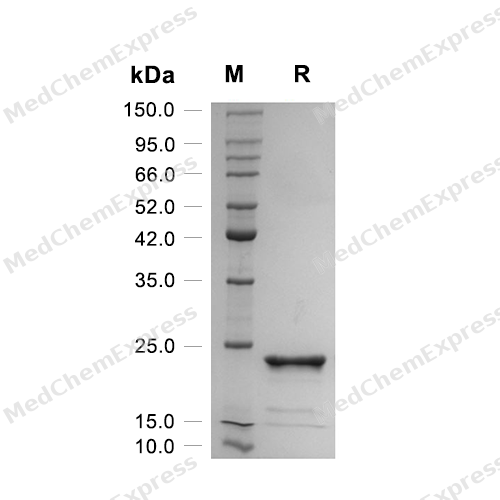
Purity - SDS-PAGE
-
Bioactivity - Cell-Based Assay
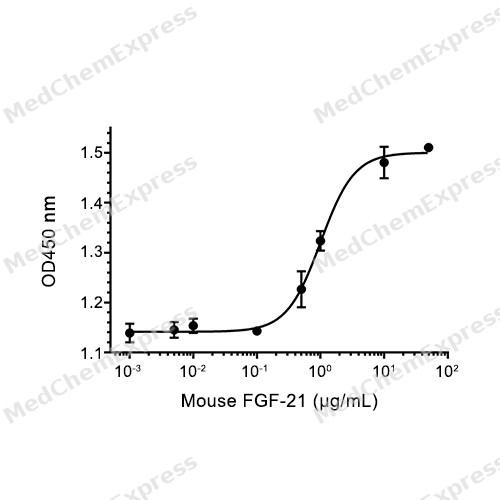
Bioactivity - Cell-Based Assay


Publications (4)
-
Journal Impact Factor
-
Most Recent
-
Crit Care
Fibroblast growth factor 21 attenuates ventilator-induced lung injury by inhibiting the NLRP3/caspase-1/GSDMD pyroptotic pathway. [Abstract]2023 May 22;27(1):196. PMID: 37218012 -
Mater Today Bio
Cadherin-responsive hydrogel combined with dental pulp stem cells and fibroblast growth factor 21 promotes diabetic scald repair via regulating epithelial-mesenchymal transition and necroptosis. [Abstract]2023 Dec 22:24:100919. PMID: 38298888 -
Reproduction
2026 Feb 5;171(2):xaag001. PMID: 41575507 -


Technical Parameters
-
Species Mouse
-
Source E. coli
-
Tag Tag Free
-
Accession
Q9JJN1 (A29-S210)
-
Molecular Construction
-
N-term
-
FGF-21 (A29-S210)
Accession # Q9JJN1 -
C-term
-
-
Protein Length
Full Length of Mature Protein
-
Synonyms
FGF21; FGF-21; Fibroblast Growth Factor 21; FGF; Fibroblast Growth Factor
-
AA Sequence
AYPIPDSSPLLQFGGQVRQRYLYTDDDQDTEAHLEIREDGTVVGAAHRSPESLLELKALKPGVIQILGVKASRFLCQQPDGALYGSPHFDPEACSFRELLLEDGYNVYQSEAHGLPLRLPQKDSPNQDATSWGPVRFLPMPGLLHEPQDQAGFLPPEPPDVGSSDPLSMVEPLQGRSPSYAS
-
Predicted Molecular Mass
20 kDa
-
Molecular Weight
Approximately 20 kDa, based on SDS-PAGE under reducing conditions.
-
Purity
≥ 95%, as determined by reducing SDS-PAGE.


Product Properties
Lyophilized powder
1.Lyophilized from a 0.22 μm filtered solution of PBS.
2.Lyophilized from a 0.22 μm filtered solution of PBS, pH 7.4.
Please refer to the lot-specific COA for specific buffer information.
<0.2 EU/μg, determined by LAL method.
It is not recommended to reconstitute to a concentration less than 100 μg/mL in sterile distilled water or aqueous buffer containing 0.1% BSA.
Stored at -20°C for 2 years from date of receipt. After reconstitution, it is stable at 4°C for 1 week or -20°C for longer (with carrier protein). It is recommended to freeze aliquots at -20°C or -80°C for extended storage.
Room temperature in continental US; may vary elsewhere.


Documentation
-
Data Sheet (262 KB)
-
SDS (251 KB)
- English - EN (251 KB)
- Français - FR (251 KB)
- Deutsch - DE (251 KB)
- Norwegian - NO (251 KB)
- Español - ES (251 KB)
- Swedish - SV (251 KB)
- Italian - IT (251 KB)
- Korean - KR (251 KB)
- Portuguese - PT (251 KB)
-
Handling Instructions (2659 KB)


References
[1]. Xu J, et al. Fibroblast growth factor 21 reverses hepatic steatosis, increases energy expenditure, and improves insulin sensitivity in diet-induced obese mice. Diabetes. 2009 Jan;58(1):250-9. [Content Brief]
[2]. Coskun T, et al. Fibroblast growth factor 21 corrects obesity in mice. Endocrinology. 2008 Dec;149(12):6018-27. [Content Brief]

Calculators
Concentration (start) × Volume (start) = Concentration (final) × Volume (final)


 Powered by Bioz

