



FGF-21 Protein, Human
Based on 3 publication(s) in Google Scholar
FGF-21 Protein, Human is an atypical member of the fibroblast growth factor (FGF) subfamily, acts as a metabolic regulator with pleiotropic effects.
- Species: Human
- Source: E. coli
-
Storage:Stored at -20°C for 2 years from date of receipt. After reconstitution, it is stable at 4°C for 1 week or -20°C for longer (with carrier protein). It is recommended to freeze aliquots at -20°C or -80°C for extended storage.


To place orders, for customer services and technical support, please contact: MedChemExpress USA
Tel: 609-228-6898 E-mail: [email protected] [email protected]


-
 Biological Activity
-
Technical Parameters
-
Product Properties
- Documentation
- References
- Help & FAQs




Biological Activity
Description
FGF-21 Protein, Human is an atypical member of the fibroblast growth factor (FGF) subfamily, acts as a metabolic regulator with pleiotropic effects.
Background
Human Fibroblast Growth Factor 21 (FGF21) acts in an endocrine mannerand and is a metabolic regulator with pleiotropic effects. FGF21 possesses protective effects in the cardiovascular system, primarily due to metabolic effects other thanmaintaining energy homoeostasis. FGF21 is also involved inseveral processes, including reducing arteriosclerotic plaque formation in major vessels and protecting themyocardium from injuries caused by infarction, ischaemia-reperfusion, isoproterenol-induced hypertrophy anddiabetic lipotoxicity. In addition, FG2F1 induces these effects by atten-uating remodelling-related inflammation and oxidativestress and promoting myocardial energy metabolism, as well as by preventing lipid- or diabetes-induced cardiaccell apoptosis. FGF21 functions via its interaction with FGF receptors (FGFRs), with the assistance of the co-receptor β-Klotho. Structurally, the FGFRs are divided into four isoforms, FGFR1-FGFR4[1].
Verified Bioactivity
The ED50 is <0.5 μg/mL as measured by FGF-receptors transfected BaF3 cells, corresponding to a specific activity of > 2.0 × 10³ units/mg.
MCE Validation Data
-
Purity - SDS-PAGE
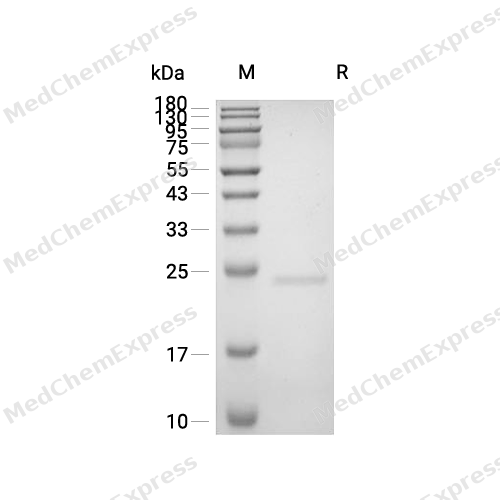
Purity - SDS-PAGE


Publications (3)
-
Journal Impact Factor
-
Most Recent
-
Autophagy
FGF21 rejuvenates aged human adipose-derived mesenchymal stem cells via enhancement of TFE3-mediated autophagy flux. [Abstract]2026 May 19:1-22. PMID: 42157427 -
Biomaterials
Local release of fibroblast growth factor 21 and cannabidiol promoting spinal cord nerve injury repair through activation of cannabinoid receptor 2. [Abstract]2026 Feb:325:123609. PMID: 40782447 -


Technical Parameters
-
Species Human
-
Source E. coli
-
Tag Tag Free
-
Accession
Q9NSA1 (H29-S209, with an N-terminal Gly)
-
Molecular Construction
-
N-term
-
Gly
-
FGF-21 (H29-S209)
Accession # Q9NSA1 -
C-term
-
-
Protein Length
Full Length of Mature Protein
-
Synonyms
FGF21; FGF-21; Fibroblast Growth Factor 21; FGF; Fibroblast Growth Factor
-
AA Sequence
GHPIPDSSPLLQFGGQVRQRYLYTDDAQQTEAHLEIREDGTVGGAADQSPESLLQLKALKPGVIQILGVKTSRFLCQRPDGALYGSLHFDPEACSFRELLLEDGYNVYQSEAHGLPLHLPGNKSPHRDPAPRGPARFLPLPGLPPALPEPPGILAPQPPDVGSSDPLSMVGPSQGRSPSYAS
-
Molecular Weight
Approximately 20 kDa, based on SDS-PAGE under reducing conditions.
-
Purity
≥ 95%, as determined by reducing SDS-PAGE.


Product Properties
Lyophilized powder.
Lyophilized from a 0.22 μm filtered solution of PBS.
<1.0 EU/μg, determined by LAL method.
It is not recommended to reconstitute to a concentration less than 100 μg/mL in ddH2O. For long term storage it is recommended to add a carrier protein (0.1% BSA, 5% HSA, 10% FBS or 5% Trehalose).
Stored at -20°C for 2 years from date of receipt. After reconstitution, it is stable at 4°C for 1 week or -20°C for longer (with carrier protein). It is recommended to freeze aliquots at -20°C or -80°C for extended storage.
Room temperature in continental US; may vary elsewhere.


Documentation
-
Data Sheet (261 KB)
-
SDS (251 KB)
- English - EN (251 KB)
- Français - FR (251 KB)
- Deutsch - DE (251 KB)
- Norwegian - NO (251 KB)
- Español - ES (251 KB)
- Swedish - SV (251 KB)
- Italian - IT (251 KB)
- Korean - KR (251 KB)
- Portuguese - PT (251 KB)
-
Handling Instructions (2659 KB)


References

Calculators
Concentration (start) × Volume (start) = Concentration (final) × Volume (final)


 Powered by Bioz

