



GRO-alpha/CXCL1 Protein, Human (CHO)
Based on 1 Customer Validation
CXCL1 (Chemokine (C-X-C motif) ligand 1), also known as GRO alpha, NAP-3 or MGSA, belongs to the sub-family of CXC chemokine. CXCL1 is involved in the development of many inflammatory diseases, including the induction of angiogenesis and recruitment of neutrophils. CXCL1 is produced by many cell types, and activates CXCR2 and, at high levels, CXCR1. GRO-alpha/CXCL1 Protein, Human (CHO) is produced in CHO cells, and consists of 73 amino acids (A35-N107).
- Species: Human
- Source: CHO
-
Storage:Stored at -20°C for 2 years from date of receipt. After reconstitution, it is stable at 4°C for 1 week or -20°C for longer (with carrier protein). It is recommended to freeze aliquots at -20°C or -80°C for extended storage.


To place orders, for customer services and technical support, please contact: MedChemExpress USA
Tel: 609-228-6898 E-mail: [email protected] [email protected]


-
 Biological Activity
-
Technical Parameters
-
Product Properties
- Documentation
- References
- Help & FAQs




Biological Activity
Description
CXCL1 (Chemokine (C-X-C motif) ligand 1), also known as GRO alpha, NAP-3 or MGSA, belongs to the sub-family of CXC chemokine. CXCL1 is involved in the development of many inflammatory diseases, including the induction of angiogenesis and recruitment of neutrophils. CXCL1 is produced by many cell types, and activates CXCR2 and, at high levels, CXCR1[1]. GRO-alpha/CXCL1 Protein, Human (CHO) is produced in CHO cells, and consists of 73 amino acids (A35-N107).
Background
CXCL1, also known as GRO-α, is a polypeptide that is initially isolated from human melanoma cells. CXCL1 acts as a key chemoattractant for neutrophils by binding specifically to its corresponding G-protein-coupled receptor CXCR2. CXCL1 modulates angiogenesis, tumorigenesis, and wound healing. In general, CXCL1 levels are extremely low under normal physiological conditions and greatly increased during inflammatory conditions[2][3].
The amino acid sequence of human CXCL1 protein has low homology between mouse and rat CXCL1 protein.
After translation, the synthesized CXCL1 precursor is 107aa long. A signal peptide is removed from its N-terminus, which shortens the precursor to 73aa. Two other amino acids can also be removed from the C-terminus. In addition, two disulfide bridges are formed from all four cysteine residues in CXCL1. The disulfide bridges give the appropriate structure to CXCL1, which determines the properties of this chemokine. After secretion, CXCL1 undergoes further proteolytic processing, which regulates the activity of this chemokine. From the N-terminus, three, four or five amino acids are removed, which produce CXCL1(4-73), CXCL1(5-73), and CXCL1(6-73), respectively. This increases CXCL1 activity 30 times, as measured by its ability to induce the chemotaxis of treated cells. To date, three CXCL1 receptors have been discovered-CXCR1, CXCR2 and atypical chemokine receptor 1 (ACKR1). Through NF-κB activation, CXCL1 expression is increased by cytokines such as IL-1β, TNF-α and IL-17. CXCL1 can associate into bioactive dimers and primarily signals through CXCR2/IL-8 RB[1].
After CXCL1 expression is induced by carcinogens, it participates in inflammatory responses by recruiting neutrophils. This leads to chronic inflammation. In addition to increasing proliferation, CXCL1 also induces cancer cell migration, particularly EMT. Produced by lymphatic endothelial cells (LECs), CXCL1 enables tumor cell migration into the lymphatic vessels during lymphangiogenesis, leading to lymph node metastasis. CXCL1 is a chemotactic factor for neutrophils. Additionally, it causes the mobilization of these cells from the bone marrow. CXCL1 can also induce recruitment of regulatory T cells (Treg) and MSCs into the tumor niche. Another no-less-important property of CXCL1 is its ability to induce angiogenesis[1].
In Vitro
Recombinant human CXCL1 (0, 1, 5, and 10 ng/mL; 6-24 h) promotes IL-6 expression in a dose- and time-dependent manner, and triggers the transcriptional activities of c-Jun in human primary synovial fibroblasts[2].
Recombinant human CXCL1 (50 and 100 ng/mL; 16 h) significantly induces HUVEC proliferation in a concentration-dependent manner[3].
Verified Bioactivity
1. Measured in a cell proliferation assay using HUVEC. The ED50 for this effect is 8.199 ng/mL, corresponding to a specific activity is 1.220×10⁵ units/mg.
2. Determined by its ability to chemoattract BaF3 mouse pro-B cells transfected with human CXCR2 .The ED50 for this effect is 3.066 ng/mL, corresponding to a specific activity is 3.26×10^5 U/mg.
MCE Validation Data
-
Purity - SDS-PAGE
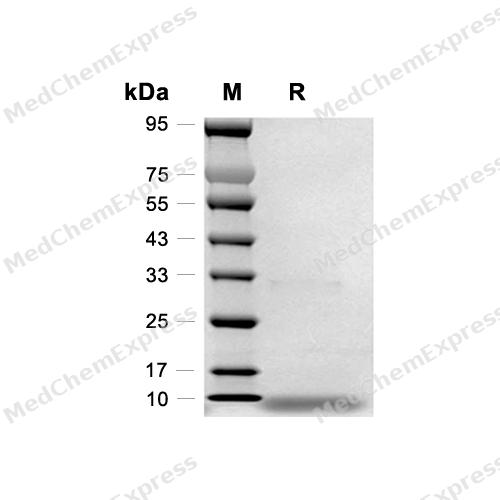
Purity - SDS-PAGE
-
Bioactivity - Cell-Based Assay
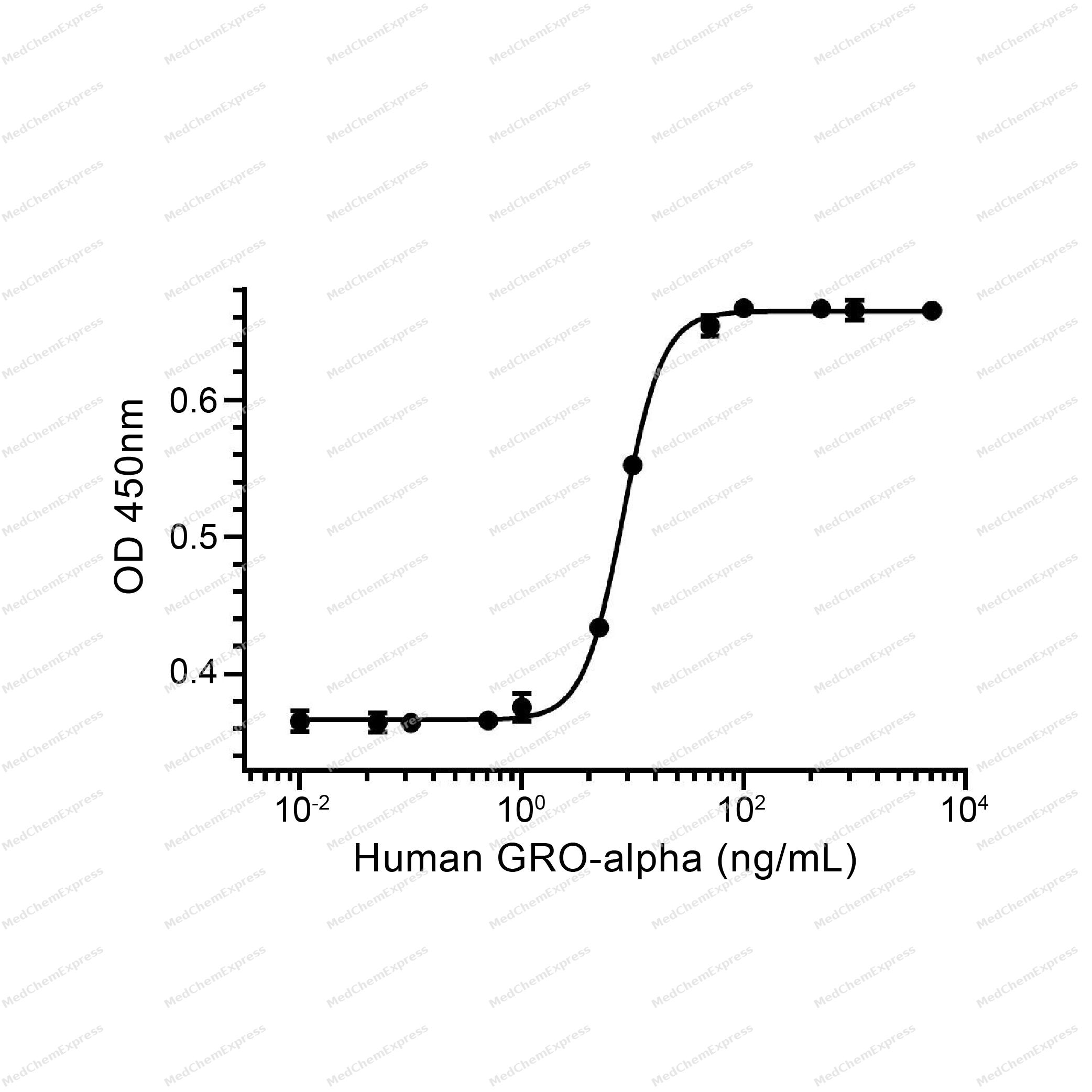
Bioactivity - Cell-Based Assay


Technical Parameters
-
Species Human
-
Source CHO
-
Tag Tag Free
-
Accession
P09341 (A35-N107)
-
Molecular Construction
-
N-term
-
CXCL1 (A35-N107)
Accession # P09341 -
C-term
-
-
Protein Length
Full Length of Mature Protein
-
Synonyms
CXCL1; Neutrophil-Activating Protein 3; Prev. GRO1; Fibroblast Secretory Protein; Prev. MGSA; C-X-C Motif Chemokine 1; Prev. FSP; GRO-Alpha(1-73); SCYB1; GRO1 Oncogene (Melanoma Growth-Stimulating Activity); NAP-3; Melanoma Growth Stimulatory Activity Alp
-
AA Sequence
ASVATELRCQCLQTLQGIHPKNIQSVNVKSPGPHCAQTEVIATLKNGRKACLNPASPIVKKIIEKMLNSDKSN
-
Predicted Molecular Mass
7.9 kDa
-
Molecular Weight
Approximately 8 kDa, based on SDS-PAGE under reducing conditions.
-
Purity
≥ 95%, as determined by reducing SDS-PAGE.


Product Properties
Lyophilized powder
Lyophilized after extensive dialysis against PBS.
<1 EU/μg, determined by LAL method.
It is not recommended to reconstitute to a concentration less than 100 μg/mL in ddH2O. For long term storage it is recommended to add a carrier protein (0.1% BSA, 5% HSA, 10% FBS or 5% Trehalose).
Stored at -20°C for 2 years from date of receipt. After reconstitution, it is stable at 4°C for 1 week or -20°C for longer (with carrier protein). It is recommended to freeze aliquots at -20°C or -80°C for extended storage.
Room temperature in continental US; may vary elsewhere.


Documentation
-
Data Sheet (264 KB)
-
SDS (251 KB)
- English - EN (251 KB)
- Français - FR (251 KB)
- Deutsch - DE (251 KB)
- Norwegian - NO (251 KB)
- Español - ES (251 KB)
- Swedish - SV (251 KB)
- Italian - IT (251 KB)
- Korean - KR (251 KB)
- Portuguese - PT (251 KB)
-
Handling Instructions (2659 KB)


References
[1]. Bayo J, et al. IL-8, GRO and MCP-1 produced by hepatocellular carcinoma microenvironment determine the migratory capacity of human bone marrow-derived mesenchymal stromal cells without affecting tumor aggressiveness. Oncotarget. 2016 Jun 25;8(46):80235-80248. [Content Brief]
[2]. Hou SM, et al. CXCL1 contributes to IL-6 expression in osteoarthritis and rheumatoid arthritis synovial fibroblasts by CXCR2, c-Raf, MAPK, and AP-1 pathway. Arthritis Res Ther. 2020 Oct 21;22(1):251. [Content Brief]
[3]. Matsuo Y, et al. CXC‐chemokine/CXCR2 biological axis promotes angiogenesis in vitro and in vivo in pancreatic cancer[J]. International journal of cancer, 2009 Feb, 125(5): 1027-1037. [Content Brief]

Calculators
Concentration (start) × Volume (start) = Concentration (final) × Volume (final)


 Powered by Bioz

