



HGFR Protein, Canine (HEK293, His)
Based on 1 Customer Validation
The HGFR protein is a receptor tyrosine kinase that transduces signals by binding to hepatocyte growth factor/HGF. It regulates proliferation, scattering, morphogenesis, and cell survival. HGFR Protein, Canine (HEK293, His) is the recombinant canine-derived HGFR protein, expressed by HEK293 , with N-His labeled tag.
- Species: Canine
- Source: HEK293
-
Storage:Stored at -20°C for 2 years from date of receipt. After reconstitution, it is stable at 4°C for 1 week or -20°C for longer (with carrier protein). It is recommended to freeze aliquots at -20°C or -80°C for extended storage.


To place orders, for customer services and technical support, please contact: MedChemExpress USA
Tel: 609-228-6898 E-mail: [email protected] [email protected]


-
 Biological Activity
-
Technical Parameters
-
Product Properties
- Documentation
- Help & FAQs




Biological Activity
Description
The HGFR protein is a receptor tyrosine kinase that transduces signals by binding to hepatocyte growth factor/HGF. It regulates proliferation, scattering, morphogenesis, and cell survival. HGFR Protein, Canine (HEK293, His) is the recombinant canine-derived HGFR protein, expressed by HEK293 , with N-His labeled tag.
Background
The HGFR protein, a receptor tyrosine kinase, serves as a critical transducer of signals from the extracellular matrix by binding to hepatocyte growth factor/HGF ligand. It plays a pivotal role in regulating various physiological processes, including proliferation, scattering, morphogenesis, and cell survival. Upon ligand binding at the cell surface, MET undergoes autophosphorylation on its intracellular domain, creating docking sites for downstream signaling molecules. Upon activation, HGFR interacts with PI3-kinase subunit PIK3R1, PLCG1, SRC, GRB2, STAT3, or the adapter GAB1, leading to the activation of multiple signaling cascades, such as RAS-ERK, PI3 kinase-AKT, and PLCgamma-PKC. RAS-ERK activation is associated with morphogenetic effects, while PI3K/AKT coordinates prosurvival effects. In embryonic development, HGFR signaling contributes to gastrulation, muscle and neuronal precursor development and migration, angiogenesis, and kidney formation. In adults, it participates in wound healing, organ regeneration, tissue remodeling, and promotes the differentiation and proliferation of hematopoietic cells. Additionally, in the context of microbial infection, HGFR acts as a receptor for Listeria monocytogenes internalin InlB, facilitating the entry of the pathogen into cells.
Verified Bioactivity
1.This product does not contain protein kinase domain.
2.Immobilized Canine HGFR at 5 μg/mL (100 μL/well) can bind Human HGF. The ED50 for this effect is 43.11 ng/mL.
MCE Validation Data
-
Purity - SDS-PAGE
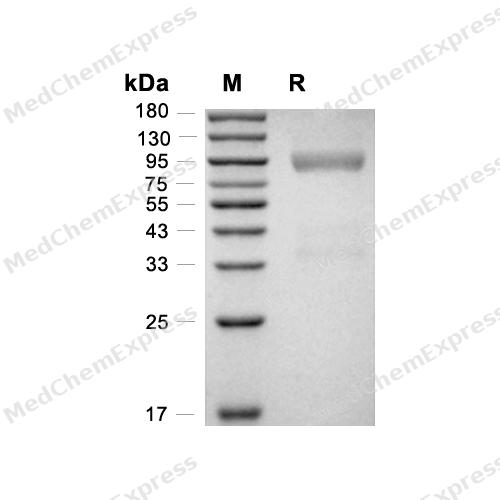
Purity - SDS-PAGE
-
Bioactivity - ELISA
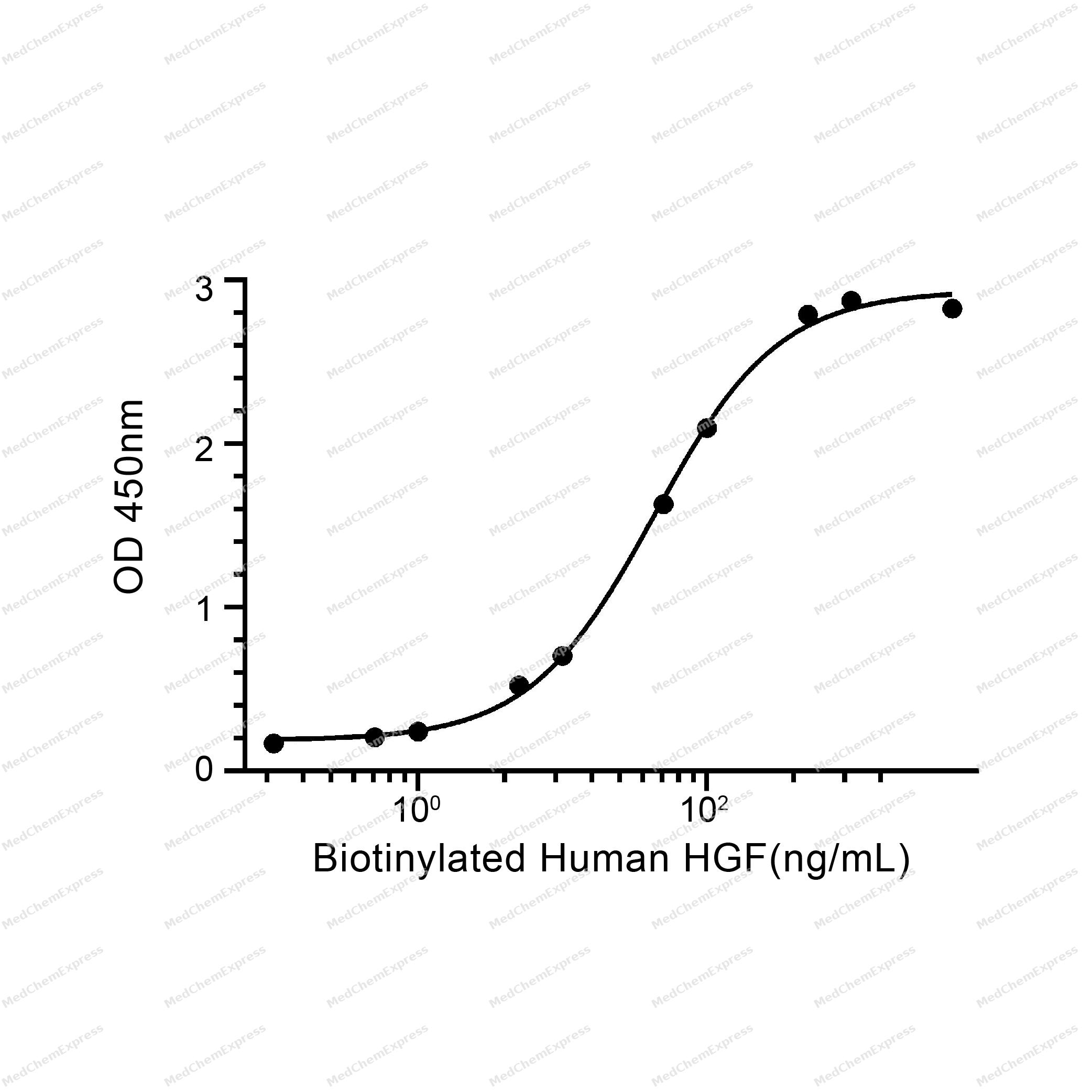
Bioactivity - ELISA


Technical Parameters
-
Species Canine
-
Source HEK293
-
Tag N-His
-
Accession
Q75ZY9 (E25-L935)
-
Molecular Construction
-
N-term
-
His
-
HGFR (E25-L935)
Accession # Q75ZY9 -
C-term
-
-
Protein Length
Extracellular Domain
-
Synonyms
MET; Soluble MET Variant 13; MET Proto-Oncogene, Receptor Tyrosine Kinase; Soluble MET Variant 14; Hepatocyte Growth Factor Receptor; Soluble MET Variant 15; DFNB97; Soluble MET Variant 1; RCCP2; Soluble MET Variant 2; HGFR; Soluble MET Variant 3; Tyrosin
-
AA Sequence
ECKEALVKSEMNVNMKYQLPNFTAETPIQNVVLHKHHIYLGAVNYIYVLNDKDLQKVAEYKTGPVLEHPDCSPCQDCSHKANLSGGVWEDNINMALLVDTYYDDQLISCGSVHRGTCQRHILPPSNIADIQSEVHCMYSSQADEEPSQCPDCVVSALGTKVLISEKDRFINFFVGNTINSSDHPDHSLHSISVRRLKETQDGFKFLTDQSYIDVLPEFRDSYPIKYVHAFESNHFIYFLTVQRETLDAQTFHTRIIRFCSVDSGLHSYMEMPLECILTEKRRKRSTREEVFNILQAAYVSKPGAHLAKQIGANLNDDILYGVFAQSKPDSAEPMNRSAVCAFPIKYVNEFFNKIVNKNNVRCLQHFYGPNHEHCFNRTLLRNSSGCEARNDEYRTEFTTALQRVDLFMGQFNQVLLTSISTFIKGDLTIANLGTSEGRFMQVVVSRSGLSTPHVNFRLDSHPVSPEAIVEHPLNQNGYTLVVTGKKITRIPLNGLGCEHFQSCSQCLSAPPFVQCGWCHDRCVHLEECPTGAWTQEVCLPAIYEVFPTSAPLEGGTVLTVCGWDFGFRRNNKFDLKKTKVFLGNESCTLTLSESTTNMLKCTVGPAVNEHFNISIIISNGRGTAQYSTFSYVDPIITSISPSYGPKNGGTLLTLTGKYLNSGNSRHISMGGKTCTLKSVSDSILECYTPAQATATEFPIKLKIDLANREMNSFSYQEDPIVYAIHPTKSFISGGSTITAVGKNLNSVSVLRMVIDVHETRRNFTVACQHRSNSEIICCTTPSLQQLNLQLPLKTKAFFMLDGIHSKYFDLIYVHNPVFKPFEKPVMISIGNENVLEIKGNDIDPEAVKGEVLKVGNKSCETIYSDSKAVLCKVPNDLLKLNNELNIEWKQAVSSTVLGKVIVQPDQNFTGL
-
Molecular Weight
Approximately 42-47 kDa & 85-95 kDa, based on SDS-PAGE under reducing conditions, due to the glycosylation.
-
Glycosylation
Yes
-
Purity
≥ 95%, as determined by reducing SDS-PAGE.


Product Properties
Lyophilized powder.
Lyophilized from a 0.2 μm filtered solution of PBS, pH 7.4. Normally 5 % - 8 % trehalose, mannitol and 0.01% Tween 80 are added as protectants before lyophilization.
<1 EU/μg, determined by LAL method.
It is not recommended to reconstitute to a concentration less than 100 μg/mL in ddH2O.
Stored at -20°C for 2 years from date of receipt. After reconstitution, it is stable at 4°C for 1 week or -20°C for longer (with carrier protein). It is recommended to freeze aliquots at -20°C or -80°C for extended storage.
Room temperature in continental US; may vary elsewhere.


Documentation
-
Data Sheet (242 KB)
-
SDS (254 KB)
- English - EN (254 KB)
- Français - FR (254 KB)
- Deutsch - DE (254 KB)
- Norwegian - NO (254 KB)
- Español - ES (254 KB)
- Swedish - SV (254 KB)
- Italian - IT (254 KB)
- Korean - KR (254 KB)
- Portuguese - PT (254 KB)
-
Handling Instructions (2659 KB)

Calculators
Concentration (start) × Volume (start) = Concentration (final) × Volume (final)


 Powered by Bioz

