



IL-13 Protein, Human
Based on 18 publication(s) in Google Scholar
IL-13 is a multifunctional cytokine. IL-13 activates the JAK-STAT6 signaling pathway and regulates gene expression by binding to the type II IL-4 receptor complex (IL-4Rα/IL-13Rα1) on the cell surface. IL-13 can induce monocyte CD23 expression, B cell IgE synthesis, fibroblast eotaxin secretion, and enhanced calcium flux in airway smooth muscle cells. IL-13 promotes airway inflammation in mice. IL-13 Protein, Human is a recombinant IL-13 protein expressed by E. coli without a tag.
- Species: Human
- Source: E. coli
-
Storage:Stored at -20°C for 2 years from date of receipt. After reconstitution, it is stable at 4°C for 1 week or -20°C for longer (with carrier protein). It is recommended to freeze aliquots at -20°C or -80°C for extended storage.


To place orders, for customer services and technical support, please contact: MedChemExpress USA
Tel: 609-228-6898 E-mail: [email protected] [email protected]


-
 Biological Activity
-
Technical Parameters
-
Product Properties
- Documentation
- References
- Help & FAQs


-

HY-P70445
IL-4 Protein, Human -
HY-18739
Phorbol 12-myristate 13-acetate -
HY-P7025
IFN-gamma Protein, Human -

HY-D1056
Lipopolysaccharides, from E. coli O55:B5 -
HY-13259
MG-132 -
HY-P7071
IFN-gamma Protein, Mouse -
HY-P70460
IL-13 Protein, Mouse -
HY-P70644
IL-4 Protein, Mouse -
HY-P7016A
GM-CSF Protein, Human -
HY-P7050
M-CSF Protein, Human -
HY-P7058
TNF-alpha/TNFSF2 Protein, Human -
HY-P7085
M-CSF Protein, Mouse


Biological Activity
Description
IL-13 is a multifunctional cytokine. IL-13 activates the JAK-STAT6 signaling pathway and regulates gene expression by binding to the type II IL-4 receptor complex (IL-4Rα/IL-13Rα1) on the cell surface. IL-13 can induce monocyte CD23 expression, B cell IgE synthesis, fibroblast eotaxin secretion, and enhanced calcium flux in airway smooth muscle cells. IL-13 promotes airway inflammation in mice. IL-13 Protein, Human is a recombinant IL-13 protein expressed by E. coli without a tag.
Background
IL-13 belongs to the interleukin (IL) family[1]. IL-13 is a multifunctional cytokine[1][2][5]. IL-13 binds to the type II IL-4 receptor complex (IL-4Rα/IL-13Rα1) on the cell surface, activates the JAK-STAT6 signaling pathway, and regulates gene expression. Its effects are cell type specific (e.g., dependent on the γc chain in hematopoietic cells and dependent on IL-13Rα1 in non-hematopoietic cells)[1][5]. IL-13 can induce monocyte CD23 expression, B cell IgE synthesis, fibroblast eotaxin secretion, and enhanced calcium flux in airway smooth muscle cells. IL-13 can promote airway eosinophil infiltration, AHR, and liver fibrosis in mice[1][3][5]. IL-13 is expressed in a variety of tissues and cells, including immune cells (such as macrophages, monocytes, B cells) and structural cells (such as fibroblasts, airway smooth muscle cells) in the lung, liver, esophagus, etc[1][3][5]. IL-13, Human has approximately 60% homology with mouse IL-13 in amino acid sequence, but there are species differences in function (such as human IL-13 does not activate mouse IL-13 receptor)[5]. IL-13, Human is a non-glycosylated protein composed of 132 amino acids with a molecular weight of approximately 10 kDa[4].
In Vitro
IL-13 Protein, Human (0.8 nM) induces eotaxin-1 production in normal human lung fibroblasts (NHLF)[5].
In Vivo
IL-13 Protein, Human (2 μg) induces inflammation in the mouse air pouch model, resulting in infiltration of leukocytes and eosinophils[5].
Verified Bioactivity
The cell proliferation assay using human TF-1 cells has an ED50 value of less than 5 ng/mL.
MCE Validation Data
-
Purity - SDS-PAGE
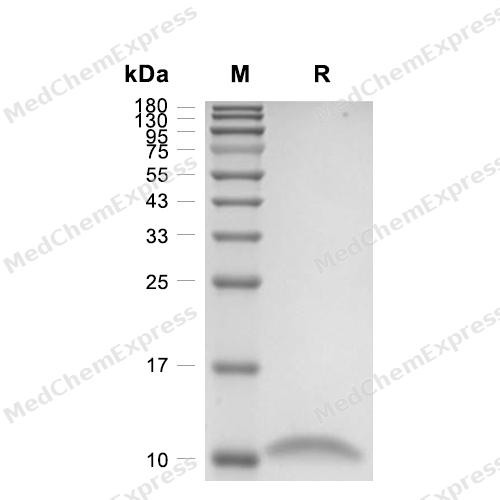
Purity - SDS-PAGE
-
Bioactivity - Cell-Based Assay
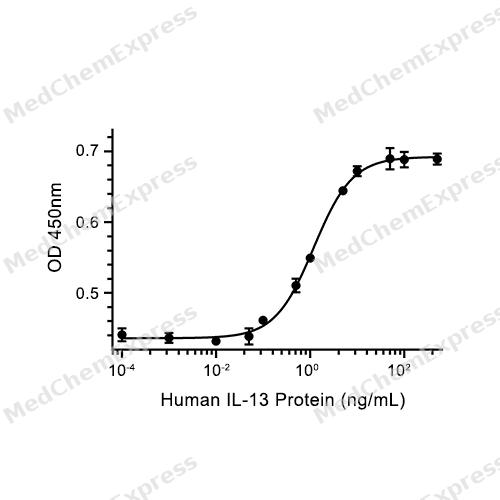
Bioactivity - Cell-Based Assay


Publications (18)
-
Journal Impact Factor
-
Most Recent
-
J Allergy Clin Immunol
Role of APE1 redox function in chronic rhinosinusitis pathogenesis: Implications for targeted therapy. [Abstract]2025 Jul 17:S0091-6749(25)00775-4. PMID: 40683569 -
Allergy
Identification of Key Genes Associated With Epithelial Barrier Dysfunction by Comprehensive Analysis and Experimental Validation. [Abstract]2026 Feb 27. PMID: 41755794 -
-
Chin Med J (Engl)
IRAK1 promotes gastric cancer progression by activating the PI3K/AKT/mTOR pathway and inducing the M2 polarization of tumor-associated macrophages. [Abstract]2025 Dec 19. PMID: 41424035 -
Int J Surg
Single-cell transcriptomics uncovers malignant potential of gallbladder adenomyomatosis and identifies PRDX1+ immunosuppressive macrophages in gallbladder carcinoma. [Abstract]2026 Jan 23. PMID: 41570280 -
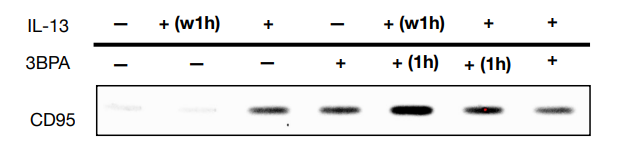
IL-13 Protein, Human purchased from MedChemExpress. Usage Cited in: MedComm-Oncology. 2024 Apr 24.
Maintaining IL-13 (4 ng/mL) is crucial for maintaining memory homeostasis, and drug exposure can lead to a decrease in IL-13 levels, thereby increasing the number of cellular sclerosis cells (CSCs).
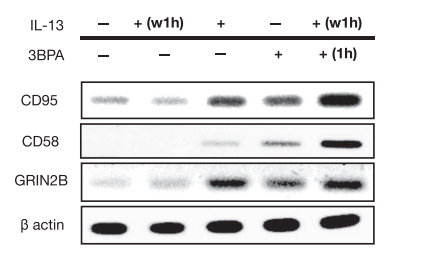
IL-13 Protein, Human purchased from MedChemExpress. Usage Cited in: MedComm-Oncology. 2024 Apr 24.
IL-13 and long-term potentiation (LTP) using semi-quantitative PCR analysis. IL-13-mediated LTP desensitizes drug effect and enhances stemness markers (CD95 and CD58) and memory marker (GRIN2B) (+(w1 h) indicates that cells were replaced with fresh media after 1 h of incubation with IL-13 (4 ng/mL) and +(1 h) indicates 3BPA addition post 1h treatment initiation with IL-13).
-
Am J Pathol
SCG2 Transcriptionally Activated by SP1 Promotes Nasal Epithelial Cell Proliferation and Epithelial Mesenchymal Transition. [Abstract]2025 Sep 12:S0002-9440(25)00333-5. PMID: 40946800 -
Mol Cell Biochem
Integrative single-cell and spatial transcriptome analysis reveals the functions of TREM2high macrophages and infarct border dynamics post-myocardial infarction. [Abstract]2025 Aug 1. PMID: 40750734 -
Cell Signal
Single-cell analysis reveals that TCF7L2 facilitates the progression of ccRCC via tumor-associated macrophages. [Abstract]2024 Dec:124:111453. PMID: 39366533 -
Expert Rev Clin Immunol
AQP9 weakens the cytotoxicity of CD8+ T cells in colon adenocarcinoma by boosting M2 polarization of macrophages under hypoxia conditions. [Abstract]2025 Jun;21(6):803-814. PMID: 40329438 -
Breast Cancer (Dove Med Press)
IFI44 Orchestrates an IL-10-Driven M2 Macrophage Program in Breast Cancer: An Immune Prognostic Signature. [Abstract]2026 Apr 8:18:579301. PMID: 41982222 -
Exp Cell Res
Pseudane V alleviates ox-LDL-induced macrophage M1 polarization by inhibiting m6A modification of PPARGC1A. [Abstract]2025 Nov 25;454(2):114842. PMID: 41297622 -
Mol Biol Rep
Fucoxanthin regulates macrophage pyroptosis through the PI3K/AKT/mTOR signalling pathway. [Abstract]2026 Jan 3;53(1):250. PMID: 41483374 -
Tissue Cell
Exosomes secreted from M2-polarized macrophages inhibit osteoclast differentiation via CYLD. [Abstract]2025 Apr:93:102645. PMID: 39671756 -
Tissue Cell
Bromodomain containing 4 inhibition combats gastric precancerous lesions via modulating macrophage polarization. [Abstract]2024 Dec:91:102580. PMID: 39396437 -
BMC Pulm Med
Angiotensin-(1-7) suppresses airway inflammation and airway remodeling via inhibiting ATG5 in allergic asthma. [Abstract]2023 Nov 2;23(1):422. PMID: 37919667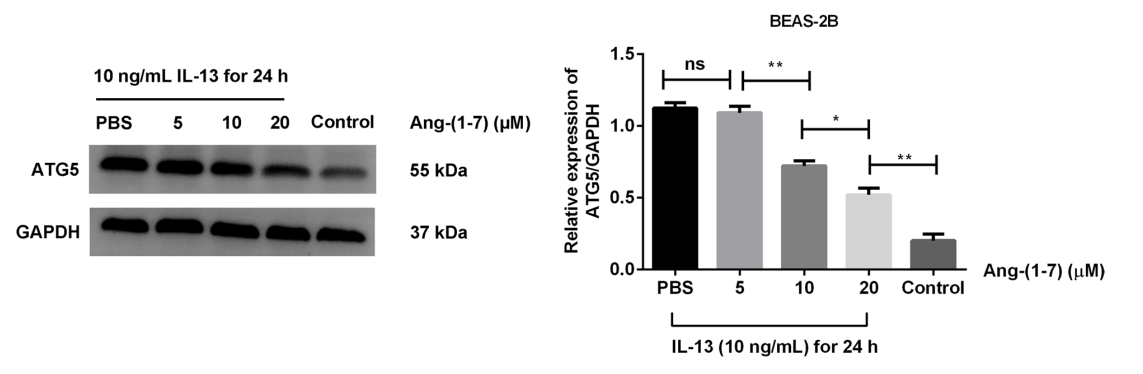
IL-13 Protein, Human purchased from MedChemExpress. Usage Cited in: BMC Pulm Med. 2023 Nov 2;23(1):422. [Abstract]
BEAS-2B cells were first treated with 10 ng/mL human IL-13 for 24 hours, and then treated with different concentrations (5, 10, 20 µM) of Ang-(1–7) for 24 hours. The expression of ATG5 protein in BEAS-2B cells was detected by Western blotting.
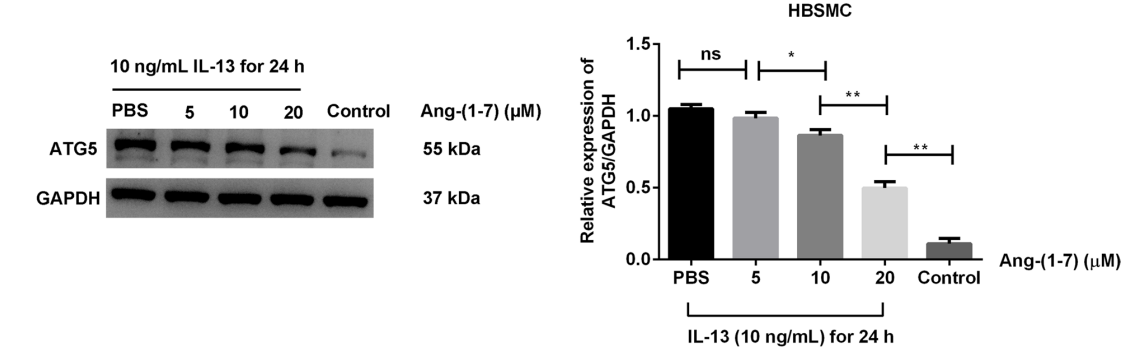
IL-13 Protein, Human purchased from MedChemExpress. Usage Cited in: BMC Pulm Med. 2023 Nov 2;23(1):422. [Abstract]
HBSMC cells were first treated with 10 ng/mL human IL-13 for 24 hours, and then treated with different concentrations (5, 10, 20 µM) of Ang-(1–7) for 24 hours. The expression of ATG5 protein in HBSMC cells was detected by Western blotting.
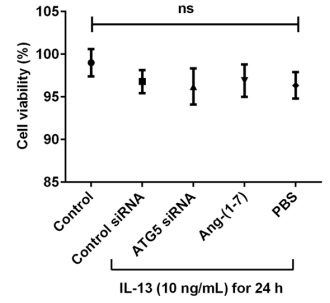
IL-13 Protein, Human purchased from MedChemExpress. Usage Cited in: BMC Pulm Med. 2023 Nov 2;23(1):422. [Abstract]
HBSMC cells were transfected with either control siRNA or ATG5 siRNA and then treated with IL-13 (10 ng/mL) for 24 hours. Cells treated with IL-13 were then treated with 20 µM Ang-(1–7) for 24 hours, with PBS treatment serving as a control. Cell viability was assessed using the CCK-8 assay kit.
-
Biochem Genet
Silencing THBS1 in M2 Macrophages Exerts an Inhibitory Effect on Tongue Squamous Cell Carcinoma by Suppressing TGF-β Pathway. [Abstract]2025 Jul 1. PMID: 40591142 -


Technical Parameters
-
Species Human
-
Source E. coli
-
Tag Tag Free
-
Accession
P35225 (G35-N146)
-
Molecular Construction
-
N-term
-
IL-13 (G35-N146, Q144R)
Accession # P35225 -
C-term
-
-
Protein Length
Partial
-
Synonyms
IL13; MGC116789; Interleukin 13; ALRH; IL-13; BHR1; Interleukin-13; Bronchial Hyperresponsiveness-1 (Bronchial Asthma); P600; Allergic Rhinitis; MGC116786; NC30; MGC116788
-
AA Sequence
GPVPPSTALRELIEELVNITQNQKAPLCNGSMVWSINLTAGMYCAALESLINVSGCSAIEKTQRMLSGFCPHKVSAGQFSSLHVRDTKIEVAQFVKDLLLHLKKLFREGQFN
-
Predicted Molecular Mass
12.3 kDa
-
Molecular Weight
Approximately 13 kDa, based on SDS-PAGE under reducing conditions.
-
Purity
≥ 95%, as determined by reducing SDS-PAGE.


Product Properties
Lyophilized powder
1.Lyophilized from a 0.22 μm filtered solution of PBS, pH 7.2, 5% trehalose.
2.Lyophilized from a 0.22 μm filtered solution of PBS, pH 7.2, 8% trehalose.
Please refer to the lot-specific COA for specific buffer information.
<1 EU/μg; determined by LAL method.
It is not recommended to reconstitute to a concentration less than 100 μg/mL in ddH2O. For long term storage it is recommended to add a carrier protein (0.1% BSA, 5% HSA, 10% FBS or 5% Trehalose).
Stored at -20°C for 2 years from date of receipt. After reconstitution, it is stable at 4°C for 1 week or -20°C for longer (with carrier protein). It is recommended to freeze aliquots at -20°C or -80°C for extended storage.
Room temperature in continental US; may vary elsewhere.


Documentation
-
Data Sheet (264 KB)
-
SDS (251 KB)
- English - EN (251 KB)
- Français - FR (251 KB)
- Deutsch - DE (251 KB)
- Norwegian - NO (251 KB)
- Español - ES (251 KB)
- Swedish - SV (251 KB)
- Italian - IT (251 KB)
- Korean - KR (251 KB)
- Portuguese - PT (251 KB)
-
Handling Instructions (2659 KB)


References
[1]. Junttila IS, et al. Tuning sensitivity to IL-4 and IL-13: differential expression of IL-4Ralpha, IL-13Ralpha1, and gammac regulates relative cytokine sensitivity. J Exp Med. 2008 Oct 27;205(11):2595-608. [Content Brief]
[2]. Shimamura T, et al. Novel role of IL-13 in fibrosis induced by nonalcoholic steatohepatitis and its amelioration by IL-13R-directed cytotoxin in a rat model. J Immunol. 2008 Oct 1;181(7):4656-65. [Content Brief]
[3]. Blanchard C, et al. Inhibition of human interleukin-13-induced respiratory and oesophageal inflammation by anti-human-interleukin-13 antibody (CAT-354). Clin Exp Allergy. 2005 Aug;35(8):1096-103. [Content Brief]
[4]. de Waal Malefyt R, et al. Effects of IL-13 on phenotype, cytokine production, and cytotoxic function of human monocytes. Comparison with IL-4 and modulation by IFN-gamma or IL-10. J Immunol. 1993 Dec 1;151(11):6370-81. [Content Brief]
[5]. May RD, et al. Preclinical development of CAT-354, an IL-13 neutralizing antibody, for the treatment of severe uncontrolled asthma. Br J Pharmacol. 2012 May;166(1):177-93. [Content Brief]

Calculators
Concentration (start) × Volume (start) = Concentration (final) × Volume (final)


 Powered by Bioz

